Someone in a hurry with limited space
If you want to make a short or long coffee with minimal effort, consider a portion-based machine. For a capsule machine, compare the model’s dimensions and the cost of compatible capsules before choosing.


If you regularly make espresso at home, start by thinking about the steps you’re happy to take for each cup. Capsule and pod machines use pre-portioned coffee, a portafilter machine requires you to handle ground coffee, while a grinder is for those who want to use coffee beans. UFC-Que Choisir distinguishes between these four types; the cost of the coffee and the maintenance involved may affect your choice depending on how often you use the machine. Then check portion compatibility, the space available and the cleaning involved for the model you’re considering.
If you want to make a short or long coffee with minimal effort, consider a portion-based machine. For a capsule machine, compare the model’s dimensions and the cost of compatible capsules before choosing.
A portafilter machine is a good fit if you’re happy to add ground coffee, lock in the portafilter and empty it after each use. These steps mean you don’t need individually wrapped portions of coffee.
A machine with a grinder lets you start with whole beans and automates extraction once you’ve filled the hopper. However, UFC-Que Choisir points out that buying one is a bigger investment, so consider how much coffee you drink and the maintenance involved.
Start with the preparation method you’re happy to use every day, then compare the consumables and the requirements of the specific model. UFC-Que Choisir highlights factors including water tank capacity, speed and ease of use.
| Criteria | What to check | What I need |
|---|---|---|
| Steps per cup | Compare using a compatible capsule or pod with measuring and emptying a portafilter, or filling a bean hopper. Check the machine’s controls, too. | In the morning, I’d rather keep handling to a minimum; or, on the other hand, I want to prepare my own ground coffee. |
| Preparation time | Check the warm-up time, the steps before extraction and the time it takes to pour a coffee on the specific model. UFC-Que Choisir’s test protocol assesses these steps separately. | If I make several coffees in a row, the time from switching on the machine to making each cup matters to my routine. |
| Running costs | Compare how often you drink coffee with the price of compatible portions, ground coffee or beans. Include any maintenance products required for the model. | I want to work out what my daily coffees will cost over time, rather than looking only at the price of the machine. |
| Space and water tank | Measure the available space and allow room to fill or open the machine. Compare the water tank capacity with the number of cups you usually make. | My machine needs to fit on the worktop, and I’d like to know how often I’ll need to refill the water tank. |
| Cleaning and noise | Check the manual for rinsing, the parts that need cleaning and descaling. If you’re considering a grinder, check how noisy it is while grinding, too: UFC-Que Choisir assesses this as a separate stage. | A convenient way to make coffee wouldn’t suit me if maintenance didn’t fit into my day or the noise bothered me. |
| Portions and waste | Before choosing capsules or pods, check their compatibility, availability and material. Sorting and composting guidance varies by consumable, as ADEME and UFC-Que Choisir point out. | If I use portions every day, I want to know what packaging I’ll need to dispose of and how to sort the ones I buy. |
Coffee portions are an ongoing expense. UFC-Que Choisir says that, depending on usage, the savings from using coffee beans over the years can offset the higher upfront cost of a machine with a grinder.
Work out how much coffee you usually drink and compare the current price of coffee compatible with each machine. Then factor in the maintenance products specified in its manual.
Water tank capacity, warm-up time and noise vary from model to model. UFC-Que Choisir’s test protocol measures warm-up time and distinguishes between the noise made during rinsing, grinding and pouring.
Compare the dimensions and water tank capacity of the models you’re considering, then check their manuals or tests of those specific models for details of the preparation steps and noise levels.
A statement on the packaging alone doesn’t tell you how to dispose of it at the end of its life. UFC-Que Choisir notes that guidance varies, particularly for capsules made from plant fibres.
Find out what material your coffee portion is made from and follow the relevant ADEME guidance, as well as checking what local collection schemes are available. Don’t assume a compostable portion can go in a home compost bin.
Rinsing, cleaning the containers and descaling take time, even if your machine has automatic programmes. ADEME highlights the role of appropriate maintenance in preventing household appliances from developing faults through use.
Before buying, read the descaling instructions and check how easy it is to reach the parts that need cleaning, particularly the infuser if it’s removable.
Remember to budget for the maintenance products recommended for your chosen model, too.
These models illustrate two ways to make coffee at home: use beans with an integrated grinder or choose a capsule machine. To compare them, consider the preparation steps, compatible consumables and maintenance for each model.
 Image unavailable
This espresso machine with grinder and LatteGo system is suited to a routine based on coffee beans, with the option to make milk-based drinks. Check how much space you’ll need and what’s involved in cleaning it before choosing.
 Image unavailable
This bean-to-cup espresso machine suits regular use without the need to empty a portafilter after every cup. If you want to froth milk, the steam wand requires some hands-on use and cleaning.
 Image unavailable
This automatic machine with a grinder is an option for making coffee regularly from beans. Its steam wand means you’ll need to froth milk by hand and clean it after use.
 Image unavailable
This automatic machine combines a grinder with a milk system, and its product name lists six coffee varieties. If you plan to use these features every day, check the manual to see what cleaning you’ll still need to do.
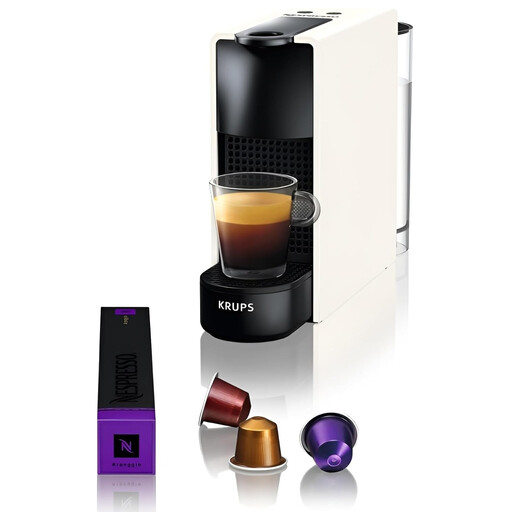 Image unavailable
This capsule machine suits a routine based on pre-portioned coffee rather than measuring out ground coffee. Its water tank is listed as 0,6 L and its power as 1200 W. Check the compatibility and cost of your chosen capsules, as well as how often you’d be happy to refill the tank.
For aluminium or plastic capsules, ADEME recommends putting them in the recycling bin, bag or container for paper and packaging. For paper capsules, check whether suitable composting facilities are available before composting them at home, and follow local guidance, too.
Follow the schedule and instructions for your specific model rather than using one timetable for all machines. The number of coffees you make and the hardness of your water also matter. Before buying, check the manual to find out which products are approved and what steps are required.
If it still works, consider donating it; if it can be repaired, look into that option. Otherwise, take it to a suitable collection point for electrical equipment. The ecosystem scheme also offers take-back options through retailers when you buy a new appliance.