If you make coffee at home regularly, start by choosing between the convenience of a ready-to-use portion, the hands-on preparation of a portafilter machine, and grinding beans to brew. Capsule and coffee pod machines require you to check which formats they’re compatible with. A portafilter means filling and tamping the coffee yourself, while a grinder takes those steps off your hands but needs regular cleaning. Then compare the water tank, footprint and milk functions of the specific model to suit the coffee you make.
Which option suits you?
You’re short on time and space
If you mainly make one cup at a time, a compact machine that’s easy to use may matter more than having lots of settings. Que Choisir describes capsule machines as compact and quick, but be sure to check the dimensions of the model you’re considering.
You drink coffee regularly and keep an eye on the cost per cup
If you use your machine often and want to choose your own beans, compare a grinder with portion-based systems. Que Choisir says an espresso made with a grinder costs two to three times less per cup than one made with a coffee pod. Your actual costs will depend on the coffee you buy and how much you drink.
You like to get hands-on with brewing or make milk-based drinks
A portafilter lets you fill and tamp ground coffee yourself, as De’Longhi explains. If you also make milk-based drinks, check the milk function on your chosen model and how it needs to be cleaned. This feature isn’t determined by the type of machine alone.
What makes the difference when choosing?
Choose a brewing method you’ll be happy to use every day, then check the details of the specific model.
Capsules
Worth considering: if you want to make a single serving with minimal effort, especially if you have limited worktop space.
Bear in mind: you’ll need to buy capsules that are compatible with your chosen system and factor in the ongoing cost.
Soft coffee pods
Worth considering: if you want an easy way to make a single serving, particularly a longer coffee.
Bear in mind: you’ll need to check which pod format the machine accepts. Drink sizes and the number of cups you can make vary by machine.
Portafilter
Worth considering: if you want to prepare ground coffee yourself and have more control over the extraction.
Bear in mind: you’ll need to fill and tamp the coffee each time, rather than simply pressing a button to make a drink.
Bean-to-cup grinder
Worth considering: if you regularly drink coffee made from beans but don’t want to prepare each portafilter by hand.
Bear in mind: you’ll need to make room for the machine and keep up with its cleaning and descaling.
| Criterion | What to check | Who it matters to |
|---|
| Ease of use and size |
Compare the dimensions, the steps involved and the stated preparation time for the specific model. |
When I make a cup before heading out, I want to keep the steps to a minimum without taking up the whole worktop; around 29% of consumers put this convenience first. |
| Running costs and choice of coffee |
Check the format of the consumables or the type of coffee the machine accepts, then compare their cost with your usual consumption. |
If I drink several coffees a day, I want to choose my own beans and manage my regular spending; this is the top priority for around 29% of consumers. |
| Hands-on brewing and milk |
Consider the steps involved in using the portafilter and, if needed, the milk function and how it needs to be cleaned. |
I prefer to be involved in making my coffee or regularly prepare milk-based drinks, even if that means a few extra steps; around 21% of consumers prioritise this. |
| Long coffees and serving several cups |
Compare the drink sizes available, the water tank capacity and whether the chosen model can make two cups at once. |
At home, I switch between long coffees and serving cups one after another. I don’t want to refill the tank too often; this is the top priority for around 21% of consumers. |
Mistakes to avoid
-
Choosing a machine before checking its consumables
With a portion-based system, you’ll need to find capsules or pods in the right format. Que Choisir also points out that capsules can increase the cost of your coffee over time.
Check which format the machine accepts, then compare the coffee you’d actually buy with the number of cups you make.
-
Assuming the tank capacity means a fixed number of coffees
The same tank will make a different number of drinks depending on whether you brew short or long coffees. A rinse cycle may also use some water.
Compare the stated capacity with the drink sizes you serve, and check whether the tank on your chosen model is removable.
-
Underestimating the cleaning involved with a grinder or milk system
The drip trays, coffee circuit and parts that come into contact with milk all need cleaning, and the process varies by model. Melitta, for example, describes cleaning and descaling as regular tasks for its automatic machines.
Check the manual to see which parts can be accessed, how to descale the machine and how to clean the milk system after use.
Depending on the model, you may also need water filters or cleaning products.
-
Assuming a feature applies to an entire range
Speed, drinks and milk functions vary from one model to another. In its machine comparison tests, Que Choisir assesses these features separately, along with noise levels and ease of maintenance.
Check the full model number and its accessories before assuming it has a feature advertised for another model.
Brands to compare across systems
Nespresso
Nespresso offers several capsule machine systems. Its Vertuo range, for example, includes drinks in different sizes.
- A range of portion-based drinks to explore, depending on the system you choose.
- Check which capsules are compatible before choosing a machine; formats aren’t automatically interchangeable.
SENSEO (Philips)
Philips describes SENSEO as a range of machines that use soft coffee pods to make individual servings.
- Philips says the HD7823/73 makes a cup in around 30 seconds. This timing doesn’t apply to the whole range.
- Descaling involves several steps and rinses, as set out in Philips’ instructions. Check the guidance for the model you’re considering.
De’Longhi
The range includes manual portafilter machines and automatic machines with grinders. Milk functions vary by model.
- For a manual portafilter machine, De’Longhi explains that you fill and tamp the ground coffee yourself.
- Check separately that the model you choose has the milk function you want and find out how to maintain it.
Melitta
Melitta offers bean-to-cup espresso machines and care advice, including guidance on cleaning and descaling.
- The brand describes filtration solutions and care products for its automatic machines.
- Check the model’s manual to find out which parts need cleaning and which care products are suitable.
Machines available at Joybuy
This selection includes bean-to-cup machines, a portafilter machine and a capsule machine, so you can compare these options for home. It’s still worth considering a soft pod system based on your habits, even though one isn’t included here.
 Image unavailable
Philips Series 2200 EP2230/10 with LatteGo
Worth considering if you want to make coffee with a grinder and use the LatteGo milk system. Check how to clean the milk system parts and which care products you’ll need for your use.
View on Joybuy
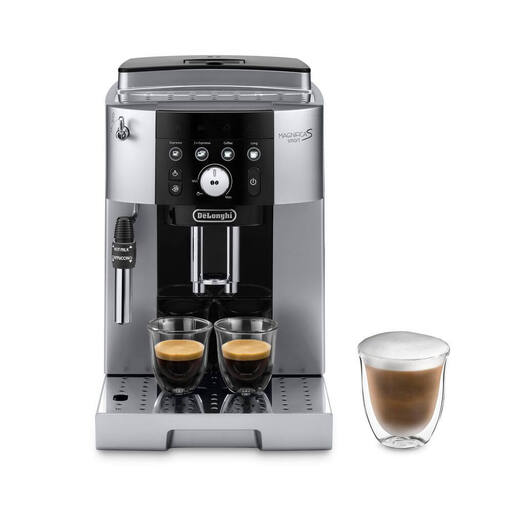 Image unavailable
DE'LONGHI Magnifica S Smart ECAM250.23.SB
An option with a grinder if you want to make coffee from beans regularly. If milk-based drinks are important to you, check how to use the steam wand and remember to clean it after use.
View on Joybuy
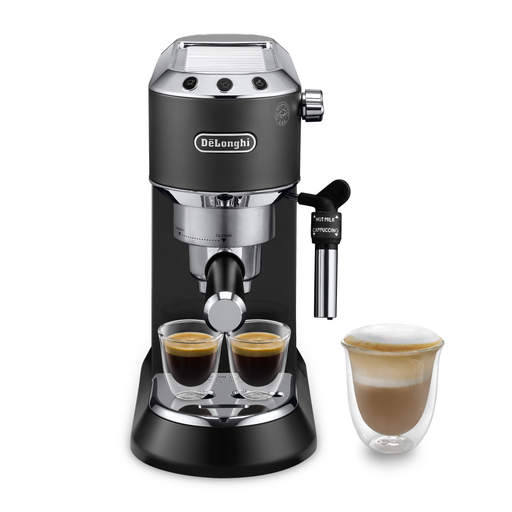 Image unavailable
DE'LONGHI Dedica Style EC685.BK
Worth considering if you want to fill the portafilter yourself and brew ground coffee. Check the tank capacity of the version on sale before estimating how often you’ll need to refill it. Using the steam wand also means extra steps during preparation and cleaning.
View on Joybuy
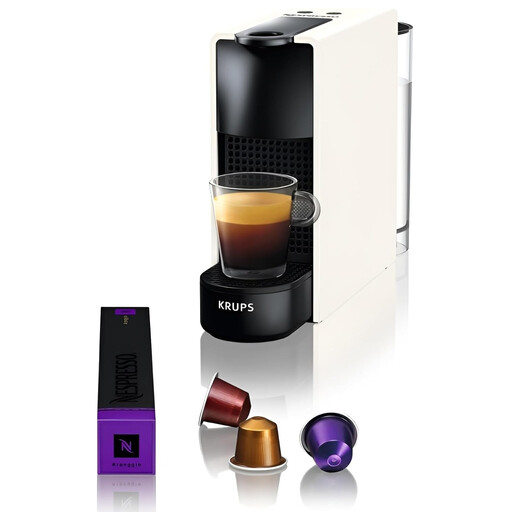 Image unavailable
KRUPS Nespresso Essenza Mini, white, 0,6 L
A capsule machine to consider if you prefer making coffee in individual portions. Its tank is listed as 0,6 L; check which capsules it accepts and whether that capacity suits the number of coffees you make one after another.
View on Joybuy
 Image unavailable
HiBREW H7A with grinder and dual boiler, 2,8 L
Worth considering if you want a machine with a grinder and a tank listed as 2,8 L. Measure the available space before buying, then check the manual for the drinks it can make and how to clean the milk system.
View on Joybuy
Frequently asked questions
How often should you descale a coffee machine?
Follow the schedule and instructions for your model: there’s no single interval that applies to every machine. De’Longhi notes, for example, that water hardness affects how often its bean-to-cup espresso machines need descaling. Make sure you also follow the rinsing steps in the manual.
Does a fast machine mean you won’t need to refill the tank as often?
No. Brewing speed and tank capacity are two separate considerations. Philips says the SENSEO HD7823/73 makes a cup in around 30 seconds, but the number of drinks you can make before refilling depends on the model’s tank and the size of each drink.
Where should you dispose of aluminium or plastic coffee capsules?
In France, ADEME advises putting aluminium or plastic capsules in the recycling bin, bag or container. Check the guidance for your local collection point to find out how to dispose of them correctly.


