If your household often makes espresso and wants to choose its own beans, an automatic bean-to-cup machine could be a good fit, provided you’re happy to make room for it and keep up with regular maintenance. Capsules and pods make it easy to prepare individual portions, while a portafilter gives you more hands-on control. A filter coffee machine is better suited to serving several cups of long coffee at once.
Which households is each type suited to?
Households making several espressos a day
If you want to use your choice of beans and regularly make individual coffees, consider automatic bean-to-cup machines. Check that you have enough space and that the cleaning routine fits into your day-to-day life.
Households that prefer ready-to-use portions
Capsules and soft pods mean fewer steps when making coffee. Before choosing a machine, check exactly which type of coffee portion it takes and what maintenance the instruction manual recommends.
Households serving several cups of long coffee at once
If you mainly make long coffee for several people at the same time, compare filter coffee machines with machines that prepare drinks one cup at a time. The right choice depends on the drinks you actually make, not just how many you serve.
What should you compare when choosing a machine?
Start by distinguishing single espressos from larger quantities of long coffee, then consider the steps and consumables involved with each type of machine. UFC-Que Choisir highlights size and ease of use as key differences between types of espresso machine.
| Priority |
What to check |
Your needs |
| Type of coffee |
Compare the drinks each machine can actually make: espresso, long coffee and milk-based drinks. If you serve several cups of long coffee at once, consider a filter coffee machine too. |
Do I mainly make individual espressos, or do several people want a long coffee at the same time? |
| Preparation steps |
An automatic grinder grinds the beans inside the machine; a portafilter requires you to prepare and then clean the filter. Capsules and pods use portions designed for the system you choose. |
Would I like to choose my own beans while keeping preparation simple, or would I prefer to be more involved in making my coffee? |
| Maintenance |
Check the model’s instruction manual for emptying containers, cleaning accessible parts and descaling. If there’s a milk system, check its maintenance requirements separately. |
Who will take care of the regular cleaning, and are we happy to clean a milk system after making milk-based drinks? |
| Size |
Measure the machine and the space needed to reach the water tank, remove containers and use accessories. Don’t compare width alone. |
The machine needs to fit on my worktop without getting in the way when I fill or clean it. |
| Consumables |
For capsules and pods, check exactly which format the machine accepts. UFC-Que Choisir points out that capsule systems don’t all take the same portions; the Nespresso Citiz Platinum, for example, only accepts Nespresso Original capsules. |
Do I want the freedom to choose my coffee, or does a specific portion format already suit my habits? |
What mistakes should you avoid before choosing?
-
Assuming all machines are descaled in the same way
The steps you need to follow depend on the model. De’Longhi even specifies two different descaling procedures for the ECAM22.110, depending on its production date.
Check the instruction manual for the machine you’re considering. Look for alerts, manual steps and the products recommended by the manufacturer.
-
Choosing recipes no one will make
A milk system or saved profiles won’t be as useful in a household where everyone drinks the same black coffee as in one where tastes vary. A milk system also means extra cleaning.
Make a note of the drinks you prepare over the course of a week, then check the machine’s recipes and the maintenance required for its specific milk system.
-
Assuming that sorting capsules means there’s no waste
Each individual portion leaves packaging behind after use. In France, ADEME advises putting aluminium and plastic capsules in the recycling collection for paper and packaging.
If packaging is a factor in your choice, compare portion formats with whole beans and ground coffee. Then check what the capsules are made of and which recycling instructions apply where you live.
What can you learn from the brands?
De’Longhi
De’Longhi offers automatic bean-to-cup machines and publishes model-specific maintenance instructions.
- For the ECAM22.110, the manufacturer specifies two descaling procedures, depending on the production date.
- You’ll still need the manual for the specific model and machine to find out which steps to follow.
Philips
Philips offers automatic machines fitted with its LatteGo milk system, among other models.
- According to Philips, LatteGo has two parts and no tubes, and is dishwasher-safe. These details apply to this system.
- Philips says that an AquaClean filter doesn’t eliminate the need to descale: descaling is still required after eight filter cycles.
Melitta
Melitta offers both automatic bean-to-cup machines and filter coffee machines, for different ways of making coffee.
- According to Melitta, the Barista SE lets you save up to four profiles and offers adjustable preparation settings.
- These features are specific to the Barista SE. Check the controls and instruction manual for the model you’re considering.
Nespresso
Nespresso offers capsule machines, and compatibility depends on the system used.
- The Citiz Platinum featured by Nespresso France only accepts Nespresso Original capsules, so it’s worth checking the system name.
- Nespresso recommends descaling its machines regularly. Check your model’s instruction manual for the correct procedure.
Bean-to-cup machines available on Joybuy
These models are worth considering if you’re looking for an automatic bean-to-cup machine to make coffee at home. To decide between this type and capsules, pods, a portafilter or a filter coffee machine, start with the drinks you want to make and how hands-on you’d like the preparation to be.
 Image unavailable
Philips EP2230/10 Series 2200 LatteGo
Worth considering if your household wants to make coffee from beans and also use a milk system. Check the recipes available on this version and the LatteGo cleaning steps in the instruction manual.
View on Joybuy
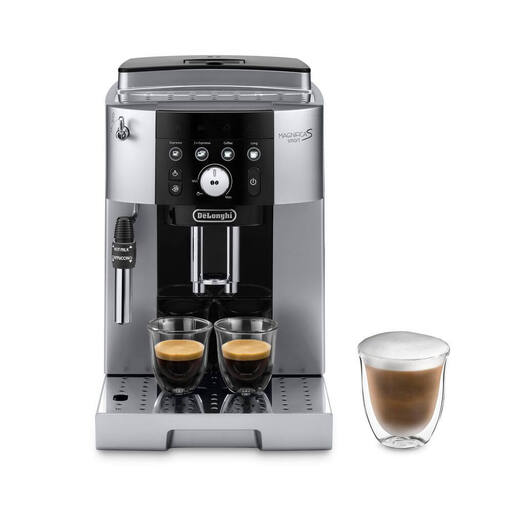 Image unavailable
De’Longhi Magnifica S Smart ECAM250.23.SB, silver
An option for households that regularly want to make espresso from beans. Check the instruction manual for this model to compare the drinks available, settings and maintenance requirements.
View on Joybuy
 Image unavailable
De’Longhi Magnifica Start ECAM220.21.WW, white
Consider this if you’re looking for an automatic machine that uses beans. Before making space for it in your kitchen, check its dimensions and make sure you can access the parts that need filling or cleaning.
View on Joybuy
 Image unavailable
HiBREW H16, grinder and milk system, 6 drinks
It’s worth checking that the six advertised drink options match what your household actually makes. If you use the milk system, check the instruction manual for cleaning and other maintenance steps.
View on Joybuy
 Image unavailable
De’Longhi Magnifica S ECAM22.140.B, black
This bean-to-cup model is designed for making coffee from beans in an automatic machine. Measure the space you have available and check the ECAM22.140.B instruction manual for cleaning and descaling tasks. Instructions for another model aren’t a substitute.
View on Joybuy
Frequently asked questions
What needs cleaning on an espresso machine with a grinder?
Allow time to empty and clean the containers and accessible parts, and descale the machine according to its instruction manual. UFC-Que Choisir’s test protocol looks at the drip tray, tanks, grounds container, brewing unit and automatic programmes, among other things. Check which ones apply to your chosen machine, and don’t assume a programme replaces every manual cleaning step.
When should you descale a Nespresso capsule machine?
Nespresso France recommends descaling its machines every three months or after around 300 capsules. Follow the procedure in your model’s instruction manual. The manufacturer advises against using vinegar, as it may damage the machine.
Where should you put aluminium or plastic capsules for recycling in France?
ADEME advises putting aluminium or plastic coffee capsules in the recycling bin, bag or container for paper and packaging. Check what your capsules are made of so you can follow the relevant instructions.


