A household that gets through several espressos
You make coffee regularly and want to compare consumables, maintenance and the steps involved, without assuming that one format will suit every use.


For regular coffee at home, a bean-to-cup machine is a good choice if you want to use whole beans while automating some of the preparation. Capsules and soft pods mean less handling, while a portafilter machine is for those happy to measure out their coffee and clean the equipment themselves. Check the drinks available, compatible consumables and care requirements for the specific model.
You make coffee regularly and want to compare consumables, maintenance and the steps involved, without assuming that one format will suit every use.
You want to make a cup quickly with minimal handling. The formats the machine accepts and the drinks it can make matter more than having lots of settings. Que Choisir’s guides describe the different brewing systems in particular.
You want to choose your beans, adjust the brewing process or froth milk, and are happy to carry out the necessary cleaning afterwards.
Worth considering: if you make coffee regularly and want to use different beans with most of the preparation automated.
Bear in mind: according to Que Choisir, the grinder takes up more space and makes more noise than a capsule system. Rinsing and descaling are also still required.
Worth considering: if you prioritise quick preparation with minimal handling, for example for an espresso or lungo.
Bear in mind: check which system the machine accepts. Nespresso Original and Vertuo are different, and a particular machine may not accept every format.
Worth considering: if you’re looking for a simple way to make coffee, especially longer cups.
Bear in mind: soft pods, capsules and ESE pods are different formats. Check which ones are specified for the model.
Worth considering: if you want to measure out and prepare your coffee yourself, and are happy to clean the portafilter after use.
Bear in mind: a portafilter machine without a built-in grinder needs ground coffee or coffee ground separately. Also check which coffee formats it accepts.
When comparing machines for regular use at home, Que Choisir’s guides highlight consumables, ease of preparation, the drinks available and maintenance. The table summarises what to consider based on your main priority.
| Priority | What to check | Who it matters most to |
|---|---|---|
| Consumables and frequency | Format used, amount per cup, how often you brew and the maintenance required. | I make several coffees regularly and want a format that fits my habits. Around 33% of consumers prioritise consumables and frequency of use. |
| Everyday ease of use | Number of steps, water tank capacity, size and consumable compatibility. | I want to make coffee in just a few steps and avoid repeated handling. Around 27% of consumers put ease of use first. |
| Choice of drinks | Recipes listed for the exact model, whether it has a steam wand or milk system, and the type of coffee it accepts. | I want to choose my beans, adjust my brew or froth milk. Around 20% of consumers prioritise control over their drinks. |
| Noise and maintenance | Access to trays and parts that need cleaning, descaling steps and the noise made by the specific model. | I want to keep noise and cleaning to a minimum when using the machine regularly. Around 20% of consumers prioritise maintenance and noise levels. |
The format accepted depends on the machine. Nespresso Original and Vertuo are two different systems, and Senseo soft pods are not capsules.
Note down the exact machine model and check the formats listed in its manual before choosing your consumables.
A grinder also requires the trays to be cleaned and the maintenance steps set out in the manual to be followed. A milk drink may mean extra cleaning for the steam wand or milk system.
Check the model’s instructions for cleaning the trays, brew group and milk system, as well as for descaling.
The Magnifica S ECAM22.140.B and Dedica Style EC685.BK EX:4 are examples of two different ways to prepare coffee.
The Essenza Mini is an example of the Original capsule system, with espresso and lungo drinks listed for this model.
The Senseo Original Plus CSA210/50 is an example of a soft pod machine.
The Intuition Essential EA870810 is a bean-to-cup model worth considering if you’re comparing machines in this category.
The products below are bean-to-cup espresso machines. The Cuisinart model combines a built-in grinder with portafilter brewing.
 Image unavailable
Worth considering if you want to make different drinks from whole beans with an automatic machine.
Grinder with 12 settings; 1.8 L water tank; removable brew group. Listed drinks include espresso, coffee, cappuccino and hot water, with adjustable strength and volume.
The removable parts of the LatteGo system are listed as dishwasher-safe.
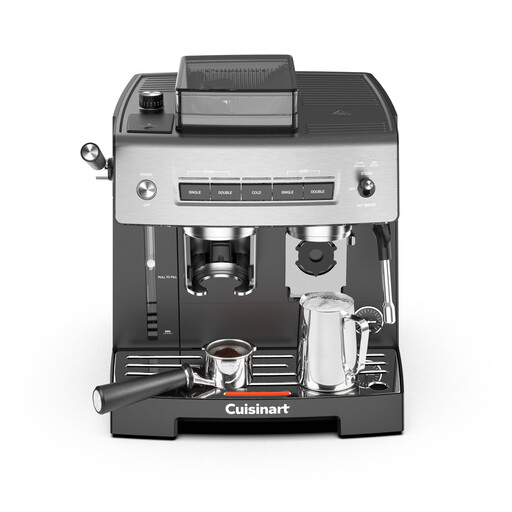 Image unavailable
Worth considering if you want to grind your beans and brew coffee using a portafilter, which requires manual handling when inserting and cleaning it.
Grinder with 16 settings, 54 mm portafilter and 2.2 L water tank. The product description lists whole-bean or ground coffee, as well as milk drinks, cold extraction and hot water.
 Image unavailable
Worth considering if you’re looking for an automatic bean-to-cup machine for making coffee from whole beans.
Grinder with 13 settings and three pre-programmed recipes; adjustable strength, temperature and volume. An adjustable steam wand and the option to make two coffees are also listed.
The water tank holds 1.8 L and the grounds container holds enough for 14 coffees, according to the product description.
 Image unavailable
Worth considering if you want to make coffee with a built-in grinder and have a steam wand for milk drinks.
The product description lists a 1.8 L water tank, the option to make one or two coffees, and the use of whole beans or ground coffee. The drip tray is removable and dishwasher-safe; a descaling programme is also mentioned.
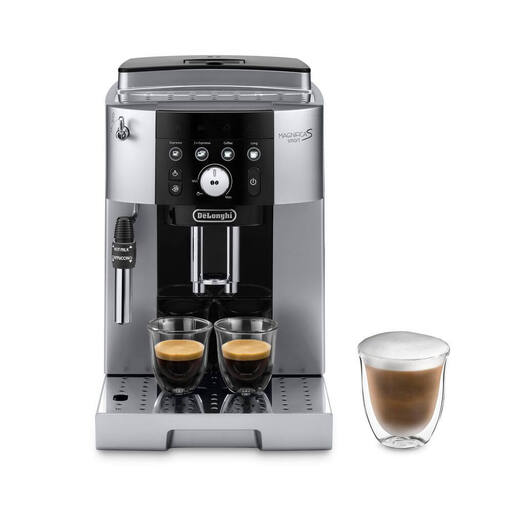 Image unavailable
Worth considering if you want a machine with a grinder and several customisable recipes.
Grinder with 13 settings and four listed recipes; adjustable strength, volume and temperature. The product description mentions a steam wand, a 1.8 L water tank and removable components, including the brew group.
Regularly clean the coffee grounds and drip trays, then follow the manual’s instructions for the brew group and descaling. After making a milk drink, also follow the instructions for cleaning the steam wand or milk system. The process varies by model.
No, grinding naturally makes a noise. Que Choisir says that automatic machines with grinders are noisier than capsule systems, but this does not provide a comparable noise level for each model. If the noise seems unusual, check the manual for your machine.
No, coffee machines are not among the product categories covered by the repairability index in the official list from the Ministry for the Ecological Transition. You can ask for available information about spare parts for the model. The absence of an index does not prove that it is either repairable or irreparable.
In France, the statutory guarantee of conformity covers new, second-hand and refurbished goods sold by a professional to a private individual, and claims must be made to the seller. The Ministry of the Economy and Finance distinguishes this statutory guarantee from the manufacturer’s commercial warranty, whose terms may include a specified number of cycles, for example.
The Ministry for the Ecological Transition classifies coffee grounds as biowaste and states that local authorities have had to offer a way to separate biowaste at source since 1 January 2024. Follow your local authority’s instructions for practical guidance; don’t assume that a whole capsule should be sorted in the same way as coffee grounds on their own.