If you drink several coffees a day, first decide whether you want each cup made at the touch of a button or prefer coffee beans and are happy to maintain the machine. Que Choisir reports that a bean grinder costs less per cup than pods, but is also noisier and takes up more space than a capsule machine or filter coffee maker. If anyone in your household enjoys milk-based drinks, check how the milk is prepared and what cleaning is involved.
Which option suits each household?
Households keeping an eye on everyday costs
If you make several coffees a day, choosing your own beans may matter more than the convenience of pre-portioned coffee. A grinder does take up space and needs regular maintenance, as Que Choisir points out.
Households looking for coffee with no preparation
Capsules and soft pods are a good fit if several people want to make their own coffee without measuring or grinding beans. You’ll need to keep buying the format that’s compatible with your chosen machine.
Households that enjoy milk-based drinks
If you often make cappuccinos or similar drinks, compare manual milk preparation with integrated systems. Even when preparation is automated, parts that come into contact with milk still need cleaning.
What sets the machines apart?
Bean grinder
Worth considering: if several people regularly drink espresso and want to choose their own beans.
Bear in mind: Que Choisir says these machines are noisier and take up more space than capsule machines or filter coffee makers, and need regular maintenance.
Capsules
Worth considering: if everyone wants to make their own cup quickly, without measuring out coffee.
Bear in mind: you’ll need to keep buying compatible capsules; milk-based recipes depend on the model’s features.
Soft pods
Worth considering: if you prefer coffee in pre-portioned soft pods.
Bear in mind: you’ll need compatible pods, as well as regular descaling, which Philips recommends for SENSEO machines in particular.
Portafilter machine
Worth considering: if users want to be involved in making every espresso.
Bear in mind: you’ll need to do more for each cup than with a pod machine or an automatic grinder.
Filter coffee maker
Worth considering: if your household mostly drinks long coffee made for several people.
Bear in mind: this won’t replace a machine designed to make espresso or milk-based drinks.
| What to consider |
What to check before buying |
Who it suits |
| Running costs and choice of coffee |
Compare your cost per cup, based on the coffee you plan to use and the machine’s maintenance supplies. |
When we make coffee throughout the day, I want to choose my own beans without relying on pre-portioned coffee. Around 31% of consumers make this their top priority. |
| Speed and simplicity |
Check what you need to do for each cup, the water tank capacity and which consumables the machine takes. |
If several people use the machine, I want everyone to be able to make their own cup without measuring or grinding coffee. Around 23% of consumers put this convenience first. |
| Milk-based drinks |
Check whether it has a manual steam wand, an integrated milk jug or a separate frother, and which parts need rinsing after use. |
For regular cappuccinos, I want a milk preparation system that’s easy to clean as part of our routine. Around 23% of consumers prioritise this. |
| Control over your espresso |
Check how much time and effort it takes to measure, tamp and clean the portafilter. |
I enjoy being involved in making my espresso, even if it takes longer each time. Around 15% of consumers prioritise this level of control. |
| Making larger quantities of long coffee |
Compare the type of coffee it makes, the usable capacity and how many cups it can prepare in one go. |
When several people mostly drink long coffee, I’d rather make a quantity to share than prepare individual espressos. Around 8% of consumers make this their priority. |
What not to overlook
-
Focusing only on the machine’s price
For a household making lots of cups, coffee and consumables are ongoing costs. Que Choisir reports a lower cost per cup for a grinder than for pod espresso, but it’s still worth calculating the cost based on the coffee you’ll actually use.
Estimate how many cups you usually make and compare the consumables required for each machine you’re considering.
-
Choosing a milk system without checking how it needs cleaning
Being able to make a milk-based drink at the touch of a button doesn’t mean you can skip cleaning the parts that come into contact with milk.
Check the machine’s instructions to see which parts need removing or rinsing, and whether any specific cleaning products are recommended.
-
Underestimating the space and maintenance a grinder needs
Que Choisir describes grinders as taking up more space and making more noise than capsule machines or filter coffee makers. The bins and other parts that need maintenance also require regular attention.
Measure the space you have in mind and check that everyone using the machine is happy to carry out the maintenance described in the instructions.
-
Assuming a feature applies to an entire range
Recipes and milk systems vary between models. Philips says that the EP3347/90 model can make up to 5,000 cups before descaling, provided you replace the AquaClean filter when prompted by the machine.
Check the exact model and variant before relying on a feature or maintenance instruction.
Brands to know across the range
Philips
Philips offers bean-to-cup espresso machines and the SENSEO soft pod range: two different ways to make coffee at home throughout the day.
- According to Philips, the Series 3300 EP3347/90 offers six drinks and a LatteGo milk jug.
- The recipes and maintenance instructions for this model don’t automatically apply to other models; Philips also recommends descaling SENSEO machines regularly.
De'Longhi
The bean-to-cup range includes models focused on making espresso, as well as others that offer a wider choice of milk-based drinks.
- De'Longhi positions Magnifica as a straightforward option, while Dinamica offers a wider choice of drinks.
- Compare the milk system and maintenance requirements for the specific models you’re considering, rather than relying on the range name alone.
Nespresso
The capsule ranges cover different coffee sizes, and some models have a system for making milk-based drinks.
- Nespresso’s Original range is aimed at ristretto and espresso, while Vertuo includes sizes up to a mug.
- Check which capsules are compatible and whether the model can be repaired. Nespresso says that repairs may not be possible if parts are unavailable.
Melitta
Melitta offers bean-to-cup espresso machines and products to help maintain them.
- Melitta’s guidance covers cleaning the machine and cleaning the milk system separately.
- The products and steps required depend on the model, so check its instructions before deciding on a maintenance routine.
Machines for these uses on Joybuy
These models are mainly designed to make espresso using a grinder, with a capsule machine and a model that combines espresso and filter coffee also included. Compare their features with everyone’s coffee habits, especially when it comes to milk-based drinks.
 Image unavailable
Philips Series 2200 EP2230/10 LatteGo, gloss black
Worth considering if your household wants to make espresso from beans and use a milk system too.
Bean-to-cup machine with a LatteGo system. Check the recipes available with this variant and what cleaning it will involve in your routine.
View on Joybuy
 Image unavailable
De'Longhi Magnifica Start ECAM220.21.WW, white
An option for making espresso from beans regularly, if your household is happy to carry out the maintenance needed for a grinder.
The ECAM220.21.WW model number identifies this variant. If you enjoy milk-based drinks, check how the milk is prepared and how the system needs cleaning.
View on Joybuy
 Image unavailable
HiBREW H16 with grinder and milk system
Worth a look if members of your household want to choose between different coffees and milk-based drinks.
The model name mentions six coffee varieties and a touchscreen. Check the exact recipes and how to clean the milk system.
View on Joybuy
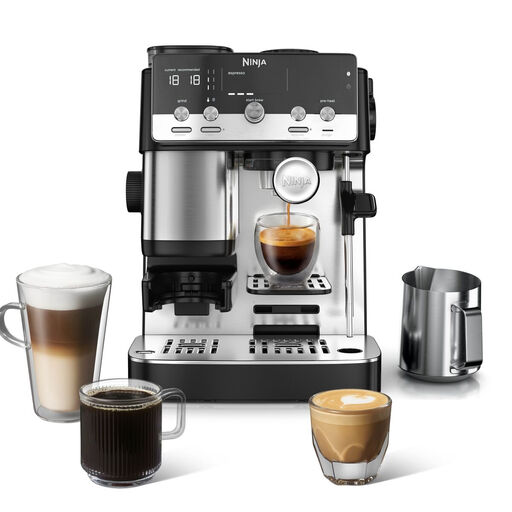 Image unavailable
Ninja Luxe Café Mini ES301EU, espresso and filter coffee
Worth considering if your household can’t decide between espresso and filter coffee and wants to try both with one machine.
The ES301EU model is listed with an integrated grinder. Check the milk frother set-up and the usable capacity of this variant before buying.
View on Joybuy
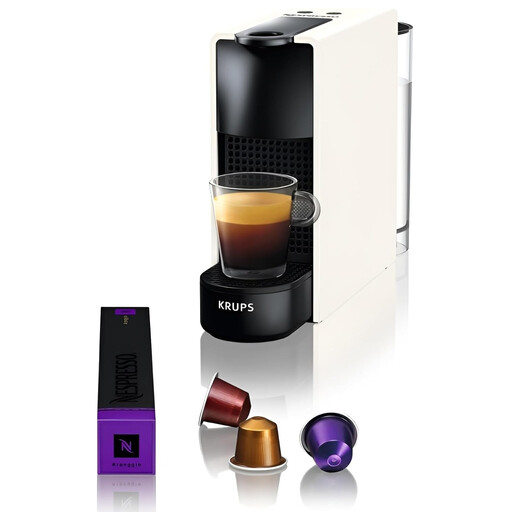 Image unavailable
KRUPS Nespresso Essenza Mini, white, 0.6 L
An option if everyone would rather make a cup with a capsule than measure out coffee or use a grinder.
This model has a 0.6 L tank and a stated power rating of 1200 W. If you make coffee throughout the day, bear in mind that you’ll need to refill the tank and check which capsules are compatible.
View on Joybuy
Frequently asked questions
Is a grinder suitable for several coffees a day?
Yes, if your household wants to use beans and is happy with the space, noise and maintenance involved. Que Choisir reports a lower cost per cup than for pod espresso, but your choice should also take into account the cleaning tasks everyone will actually carry out.
Does making a milk-based drink at the touch of a button mean there’s no cleaning?
No. Automating the recipe doesn’t remove the need to clean parts that come into contact with milk. Melitta, for example, specifies a cleaner for the milk system. Check your model’s instructions for the steps and products it requires.
Do you need to descale a soft pod machine?
Yes, descaling is part of the maintenance you’ll need to plan for. Philips recommends descaling SENSEO machines regularly, so follow the instructions for your chosen model to find out how to do it.
What should you check about repairing a capsule machine?
Check whether the model can be repaired and whether parts are available. Nespresso says that if parts are unavailable, its repair service may not be able to fix the machine. This doesn’t affect your rights if goods are faulty.


