Buying priorities
Start by defining which drinks you make and how many cups you prepare each day. Then check the available space and the maintenance tasks your household is happy to take on.
| Priority |
What to check |
Your needs |
| Coffee format |
Check which consumables are accepted: pods, coffee pads, ground coffee or beans. Also compare how readily the format is available from the shops you usually use. |
I want to be able to choose my coffee easily and avoid being tied to one particular consumable format. |
| Drinks and speed |
Check whether the machine prepares one or two cups, longer coffees, espressos or milk-based drinks. Also see whether milk is handled automatically or with a manual steam wand. |
In the morning, I want simple preparation; at other times, I would like to adjust the strength, volume or type of drink. |
| Footprint and noise |
Measure the worktop and the clearance needed to remove tanks, trays and drawers. UFC-Que Choisir states that a bean-to-cup machine is generally larger and noisier than a pod machine or filter coffee machine. |
The machine needs to fit in my kitchen without getting in the way during the morning routine. |
| Maintenance and repairs |
Check the rinsing, cleaning and descaling processes, as well as access to manuals, accessories and parts for the exact model. |
I prefer to know in advance which regular tasks will be required and to be able to have the machine repaired if necessary. |
| Consumable waste |
Check local guidance for pods and look for any information about composting or collection schemes. A paper coffee pad or a plant-fibre pod is not automatically suitable for home composting. |
I want the disposal of pods, coffee pads or grounds to fit my habits and the rules in my local area. |
Joybuy machines for regular coffee at home
These Joybuy options mainly cover bean-to-cup espresso machines for households that regularly drink espresso, along with a soft coffee-pad machine for quick individual coffees.
 Image unavailable
Philips EP2230/10 Series 2200 LatteGo
For households wanting regular espressos and cappuccinos made with an automatic grinder.
Grinder with 12 settings, three strength and temperature levels, adjustable volumes, a 1.8 L tank and a 275 g bean hopper.
Advertised dimensions: 246 x 371 x 433 mm. The AquaClean filter is listed as compatible but not included; check the consumables and available space.
Joybuy
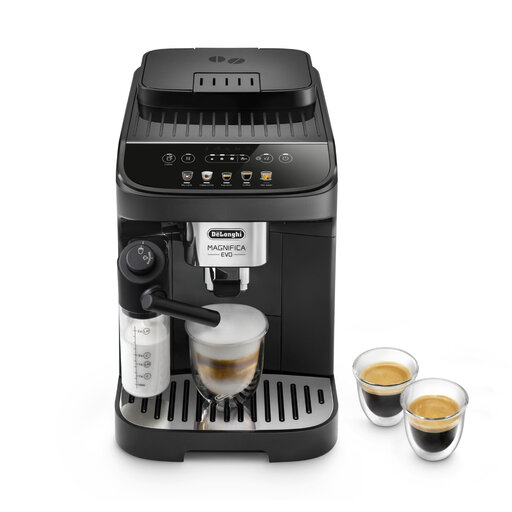 Image unavailable
De'Longhi Magnifica Evo ECAM290.61.B LatteCrema
Worth considering if automatically prepared milk-based drinks are part of your household’s routine.
250 g bean hopper, 1.8 L tank, 13 grinding levels and adjustments for aroma, temperature and quantity.
Advertised dimensions: 240 x 440 x 360 mm. Check the exact number of recipes and the model’s rinsing, cleaning and descaling routine.
Joybuy
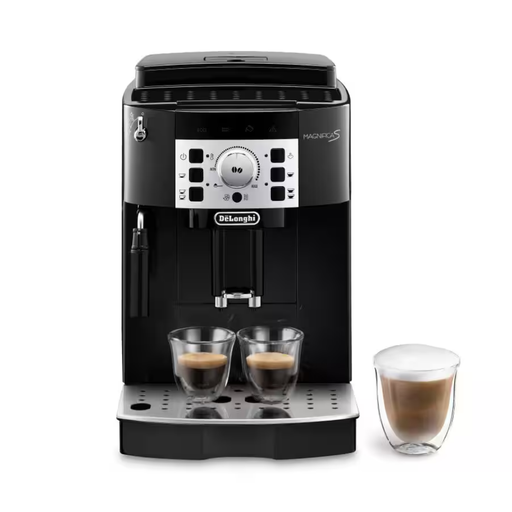 Image unavailable
De'Longhi Magnifica S ECAM22.140.B
This machine suits households wanting to prepare one or two espressos using beans or ground coffee.
1.8 L tank, adjustable grinder, ground-coffee option, preparation of one or two cups and a steam wand for milk.
Frothing milk requires manual use and cleaning of the wand. Check the footprint before buying.
Joybuy
 Image unavailable
De'Longhi Magnifica Start ECAM220.21.WW
A choice for households mainly focused on espresso and black coffee, with an occasional steam wand.
250 g bean hopper, three direct recipes, two-cup function, 13 grinding settings and adjustments for strength, temperature and quantity.
Advertised dimensions: 240 x 440 x 350 mm. Milk-based drinks require manual preparation and cleaning.
Joybuy
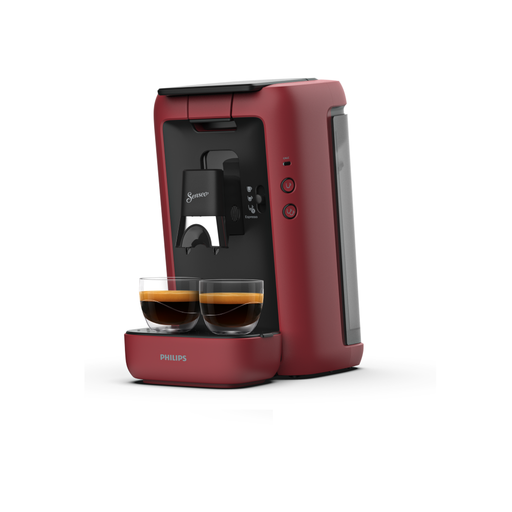 Image unavailable
Philips Senseo CSA260/91 Maestro
For households prioritising quick individual coffees and longer coffees without moving to a bean-to-cup machine.
Preparation of one or two cups, three recipes, Memo function, 1.2 L tank and descaling indicator.
Advertised dimensions: 28,5 x 17 x 31 cm. Check the availability of compatible SENSEO coffee pads and local recycling guidance.
Joybuy
Frequently asked questions
Should you descale a coffee machine even if it is still working?
Yes. Follow the machine’s instructions, taking the water hardness and how often you use it into account. UFC-Que Choisir recommends descaling every two to three months on average, adjusted to your usage conditions.
Can all pods and coffee pads go in home compost?
No. ADEME explains that composting or collection options depend on the product and local arrangements. UFC-Que Choisir also points out that paper coffee pads are not automatically suitable for home composting.
How can you check that parts will be available before buying?
Check the exact model’s product information, along with the manuals, accessories and parts offered by the manufacturer. The Institut national de la consommation recommends checking this information when you buy, rather than waiting for a breakdown.
What protection applies if a machine breaks down soon after purchase in France?
The legal guarantee of conformity lasts for two years after delivery, according to information published by the Institut national de la consommation with the DGCCRF. A commercial warranty may be added, but does not replace this legal protection.
Is a filter coffee machine only suitable for a large household?
No. It is particularly suitable when you prepare longer coffee or several cups in one go. Check the jug capacity, its performance with smaller quantities, the keep-warm function and automatic shut-off to make sure they suit your routine.


