If you make coffee regularly at home, your choice will largely depend on the balance between ongoing costs, preparation steps and maintenance. A grinder automates preparation from whole beans, while a portafilter involves more hands-on work. Capsules and pods make serving simple, but you’ll need to check which consumables are compatible and how to dispose of them. Also think about the drinks you’d like to make and the space you have available before choosing a model.
Who is each type of machine for?
Households that make lots of coffee each day
You want to compare the ongoing cost of consumables with the preparation steps and maintenance involved in using a grinder or portafilter. UFC-Que Choisir’s guides associate bean-to-cup machines with coffee enthusiasts and regular coffee drinkers.
Busy households looking for a range of drinks
You’re looking for a straightforward way to make coffee, while checking which drinks the model actually offers, such as long coffee, espresso or milk-based drinks. UFC-Que Choisir’s guides distinguish between machine types according to how they’re used.
Households thinking about long-term use
You want to know what cleaning and descaling are required, whether repairs are possible and what the warranty covers before choosing. UFC-Que Choisir looks at maintenance for bean-to-cup machines and the terms of certain commercial warranties.
What should you compare before choosing?
For households that make coffee regularly at home, the choice comes down to factors such as ongoing costs, daily preparation, maintenance, the drinks available and the space you have.
| What matters |
What to check |
Who it matters most to |
| Total cost of your coffees |
Compare the machine, coffee or pods, maintenance and repairs over the same period and for the same number of cups. |
If you make several coffees a day, compare ongoing spending with the initial outlay; around 28% of consumers surveyed put total cost at the top of their list. |
| Maintenance and long-term use |
Check the manual for instructions on cleaning the containers, brewing unit and milk system, as well as descaling; check which warranties apply. |
If you want to plan for regular tasks and repair terms before buying, around 22% of consumers surveyed put maintenance and long-term use first. |
| Everyday convenience |
Count the steps involved in making each cup, and check how easy it is to reach the water tank, use your preferred programmes and clean the machine after use. |
If you want to make a cup with minimal effort, around 22% of consumers surveyed prioritise ease of preparation. |
| Drinks and consumables |
Check the capsule or pod system, the drinks available with that model and how milk is prepared. |
If everyone at home likes different drinks, check the recipes and compatible pod formats; around 17% of consumers surveyed prioritise drink variety. |
| Space in your kitchen |
Measure the available width, depth and height, and allow enough clearance to fill the tanks. |
If your worktop is narrow, make sure you can still reach the parts that need filling; around 11% of consumers surveyed prioritise a compact design. |
Pitfalls to avoid
-
Choosing the cheapest machine without factoring in consumables
If you make coffee regularly at home, you’ll need to buy capsules or pods for every use. A grinder or portafilter involves a higher initial outlay and more preparation. The overall cost depends on how many cups you make and how long you use the machine.
Compare costs over the same period and for the same number of coffees. Don’t assume that one system will always become more cost-effective after a set amount of time.
Repeated purchases of capsules or pods add to the cost of using the machine. How much they add depends on the format you choose and how often you make coffee.
-
Assuming all pods are compatible or can be sorted in the same way
Some formats are specific to a particular system. For example, a capsule designed for Nespresso Original is not the same as a Vertuo capsule. Nor does paper necessarily mean that a soft pod can be composted at home: UFC-Que Choisir found this to be the case for the products it examined in 2025.
Check the system specified on the machine and packaging, then consult the sorting instructions for the specific consumable.
An incompatible format could leave you with a pack you can’t use in your chosen machine. Disposal instructions also depend on the consumable.
-
Assuming automatic preparation means no maintenance
The containers, water system and, depending on the machine, milk-related parts all need regular care. UFC-Que Choisir recommends regularly rinsing the coffee grounds and drip trays on bean-to-cup machines, for example.
Before buying, check the manual for your chosen model to see which parts are easy to access, how to descale it and what needs to be done after making a milk-based drink.
Cleaning and maintenance products take time and money. What’s required will vary by model and how you use it.
-
Confusing a commercial warranty limit with the limits of your legal rights
In 2023, UFC-Que Choisir found that some commercial warranties for bean-to-cup machines were also limited by the number of coffees made. A commercial warranty is separate from the legal guarantee of conformity.
Read the commercial warranty terms for the model and keep your proof of purchase. For purchases from a professional seller, the DGCCRF explains that statutory rights apply under their own terms.
You may have to pay for a repair if it isn’t covered. This depends on the circumstances and the protections that apply.
Brands to consider by machine type
De’Longhi
The Dedica Style EC685.M EX:4 is an example of a compact portafilter machine with a steam wand. The brand also offers automatic bean-to-cup machines.
- According to the manufacturer, the EC685.M EX:4 variant is around 15 cm wide and has a steam wand.
- This model doesn’t have a built-in grinder. Check which filters and consumables are compatible with the specific variant.
Philips
The 2200 Series EP2220/10 is an example of an automatic bean-to-cup machine. Philips also offers machines for soft pods.
- For the EP2220/10, Philips lists grind and strength settings.
- Its classic milk frother doesn’t mean milk-based drinks are made fully automatically. Check the drinks and milk system on the model you’re considering.
Nespresso
The Essenza Mini is an example of a compact Original system capsule machine, designed for espresso and lungo.
- Nespresso lists two cup sizes and a 0,6 L water tank for the black Essenza Mini.
- Original and Vertuo are separate systems, so check which capsule format the model accepts.
Krups
The models reviewed include automatic bean-to-cup machines and Nespresso capsule machines. These types are suited to different needs.
- The EA876D10 is an example of an automatic bean-to-cup machine in the available product information.
- The features of one model don’t apply to the whole range. Check the full model name and manual before comparing drinks and maintenance requirements.
Bean-to-cup machines available on Joybuy
These Joybuy models are for households looking to make coffee with an automatic bean-to-cup machine. Check the drinks, settings and maintenance requirements for each model.
 No image available
Philips 2200 Series EP2230/10 with LatteGo
This bean-to-cup machine with a LatteGo system could suit a household looking to switch between coffee and milk-based drinks.
View on Joybuy
 No image available
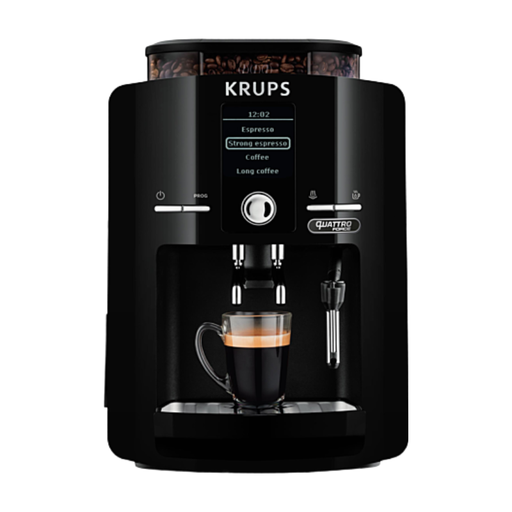
Krups EA82F0 automatic coffee machine
This bean-to-cup model may appeal to households that make coffee regularly and would also like to enjoy milk-based drinks.
Milk is prepared using a steam wand, so you’ll need to do this by hand; it isn’t described as fully automatic.
View on Joybuy
 No image available
De’Longhi Magnifica Start ECAM220.21.WW, White
This bean-to-cup espresso machine is designed for households that want to make coffee from whole beans.
Milk-based drinks require you to use the steam wand.
View on Joybuy
 No image available
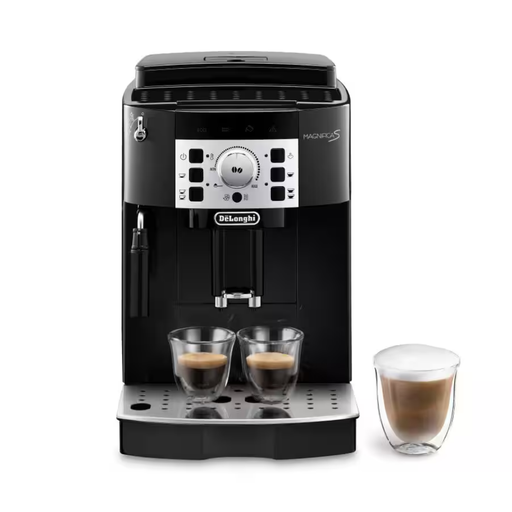
De’Longhi Magnifica S ECAM22.140.B, Black
This automatic machine with a grinder could suit a household that wants to use whole beans to make coffee regularly.
Milk-based drinks are made using the steam wand and require some hands-on preparation.
View on Joybuy
 No image available
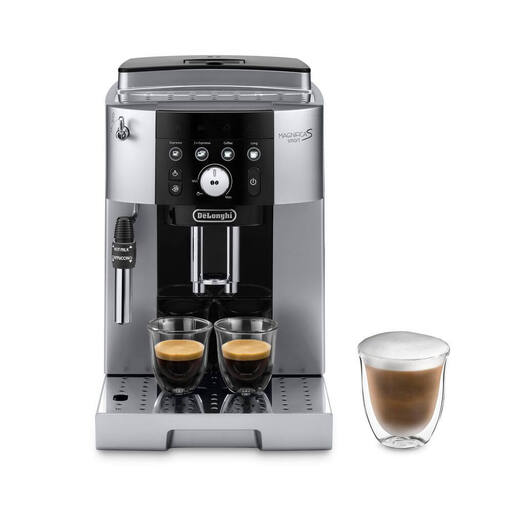
De’Longhi Magnifica S Smart ECAM250.23.SB, Silver
This espresso machine with a grinder could suit a household that wants to make coffee from whole beans and choose from a range of drinks.
Milk-based drinks require you to use the steam wand.
View on Joybuy
Frequently asked questions
How can we compare the cost of two systems if we make several coffees a day?
Compare them over the same period and for the same number of cups, factoring in the machine, coffee or pods, maintenance and likely repairs. The result depends on how often you use the machine and which consumables are compatible; there’s no universal payback period.
Does a soft pod always make an espresso?
Not necessarily: the word ‘pod’ alone doesn’t tell you what kind of coffee it makes. Check which drinks the exact model is designed to make, and don’t assume they’ll be the same as a portafilter extraction.
What needs cleaning on a bean-to-cup machine or a machine with a milk system?
Follow the manual for your chosen model when cleaning the containers, accessible parts and milk system, and when descaling. UFC-Que Choisir recommends regularly rinsing the coffee grounds and drip trays, and cleaning the brewing chamber less often. Exact instructions vary by model.
Where should you dispose of capsules, and can paper pods be composted?
ADEME recommends putting aluminium or plastic capsules in the packaging recycling bin, and says paper capsules can be composted where local conditions allow. Don’t confuse these capsules with soft pods: none of the products examined by UFC-Que Choisir in 2025 could be composted at home. Check the sorting instructions for the specific consumable.
Which legal guarantee applies when buying a machine in France?
For a consumer purchase from a professional seller, the DGCCRF states that claims under the legal guarantee of conformity must be made within two years of delivery of the goods, subject to the legal terms. A commercial warranty is separate and doesn’t replace these rights; contact the seller to make a conformity claim.


