
Livraison le jour même ou le lendemain

Qualité garantie

Débloquez vos offres de bienvenue: Livraison GRATUITE | Jusqu'à -80 % | 30 jours d'essai gratuits à JoyPlus
Téléchargez l'application
Grinding beans just before making your coffee can be a real game-changer at home. But choosing a coffee grinder isn’t about going on looks or the number of settings printed on the box. Between promises of “professional” grinding, sometimes oversized capacities, and accessories that are more gimmick than useful, some models can disappoint after just a few weeks.
Before comparing an electric coffee grinder, a manual model, or a more advanced burr grinder, there are three pitfalls worth keeping in mind.
A coffee grinder offering 40 or 50 positions isn’t necessarily more precise than a simpler model. The real question is about the nature of the adjustment: fixed positions, closely spaced clicks, or stepless adjustment. For espresso, even a tiny variation can alter the water flow rate and force you to make several attempts. With a cafetière, a coarse, even grind generally matters more than a multitude of clicks.
Conical burrs crush the beans between two surfaces, unlike blades, which chop them far less evenly. A coffee grinder fitted with conical burrs is often better suited to achieving a consistent grind, but the material, diameter, and shaft stability also play a role. Stainless steel burrs will be fine for daily use, while a larger diameter can better handle repeated preparations, depending on the motor and usage cycle.
Particles that remain in the chute or hopper can mix with your next batch of grounds. A removable hopper, an easy-to-empty catch cup, and a suitable brush make maintenance much simpler. However, be careful: burrs and electrical components should never be rinsed unless the manufacturer clearly states it’s safe. As for dishwasher-safe parts, it’s best to identify them precisely in the instruction manual.
For versatile use, choose a grinder with settings that cover several methods: espresso, moka pot, filter coffee, pour-over, or French press. A coffee grinder for French press needs to produce a coarse grind without creating an excessive amount of fines. For an espresso coffee grinder, the fineness of the adjustments and the stability of the mechanism come first.
A stepless adjustment, found on some models, lets you fine-tune the grind gradually. It takes a bit more time to find your bearings, but it’s well worth it if you often switch between different coffees or machines.
A large hopper can be handy in a household where several coffees are made every day. However, you don’t have to fill it every time. To better preserve the aromas, it’s often best to grind only what you need. Models with a cup selector or a timer make dosing easier, but check whether the quantity depends on the running time, the density of the beans, and the grind setting you’ve chosen.
An electric model starts up quickly and requires less effort, but you have to contend with its size, noise level, and the need for a suitable plug socket. A rechargeable portable coffee grinder can accompany you to the office, on trips, or on camping getaways. A manual grinder, on the other hand, works without electricity, at the cost of a more physical preparation, especially when you’re aiming for an espresso grind.
For an imported appliance, check the voltage, the type of plug supplied, the contact details of the responsible party established in the European Union, and the safety instructions. This information is far more useful than a simple marketing claim like “professional quality”.
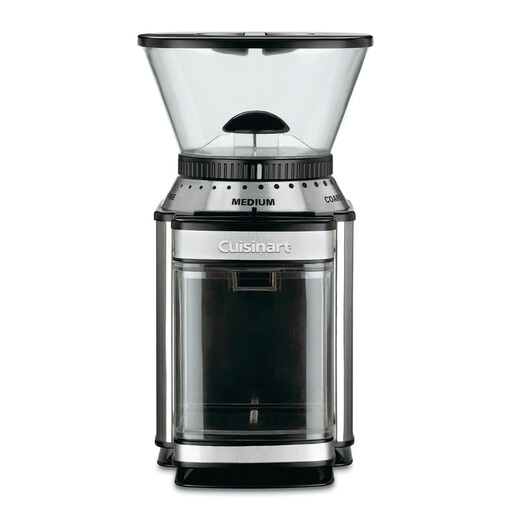
Why this choice suits this profile: its electric operation and selector for 4 to 18 cups make it ideal for regular home use, without imposing overly complex settings.
Its 18 positions and 225 g bean hopper offer simple benchmarks for getting started. The removable parts, said to be dishwasher-safe, also make cleaning easier.
Burr mechanism, auto shut-off, and quantity adjustment for multiple cups.

Why this choice suits this profile: its stepless adjustment lets you fine-tune the grind in tiny increments, a feature particularly appreciated by espresso machine users who regularly tweak their settings.
The stepless adjustment system doesn’t just offer spaced-out clicks. The manufacturer also claims a device designed to reduce static electricity, plus a removable magnetic catch cup.
55 mm titanium alloy conical burrs and machined aluminium body.

Why this choice suits this profile: its 48 settings and compatibility with 51, 54, and 58 mm portafilters cater to users who switch between different espresso machines.
The portafilter holder reduces handling during grinding. The touchscreen and dose-based controls help maintain a more consistent preparation.
Stainless steel conical burr, touch panel, and claimed static electricity reduction function.

Why this choice suits this profile: compact, manual, and with a claimed capacity of 20 g, it can be used at the office, on the go, or camping, without needing a plug socket.
Its disassemblable design makes cleaning easy, and its internal adjustment lets you switch from fine to coarser grind. However, you’ll need to put in a bit of elbow grease.
Stainless steel burr, double bearing, and manual operation, with no cable or battery.
We’ve put together a comprehensive, real-time updated selection of products that meet these demanding criteria as well as European safety requirements.
Choose a model capable of producing a coarse, even grind. A click-based adjustment is usually enough to get started. The hopper capacity and ease of maintenance also matter, because a cafetière often requires more coffee than a single serving.
Yes, provided it has a sufficiently fine and stable adjustment. However, you’ll have to accept a longer, more physical grinding process. For making several espressos a day, an electric grinder will often be more practical, especially if it can grind directly into the portafilter.
Avoid damp beans, very oily flavoured coffees, and anything other than coffee if the manual doesn’t allow it. Remove residue regularly, don’t force the adjustment dial, and stick to the recommended usage cycles. Simple maintenance helps preserve grind consistency and motor longevity.