
Livraison le jour même ou le lendemain

Qualité garantie

Débloquez vos offres de bienvenue: Livraison GRATUITE | Jusqu'à -80 % | 30 jours d'essai gratuits à JoyPlus
Téléchargez l'application
A coffee grinder can transform a cup made with freshly ground beans. But you need to choose a model that suits how you use it. Between the promises of "professional" grinding, compact appliances and supposedly versatile accessories, some features are sometimes overhyped or remain surprisingly vague.
Before you place an order, three pitfalls deserve your attention:
A burr grinder crushes the beans between two surfaces, which generally gives you better control over the particle size. Blade models, on the other hand, chop the beans more unevenly and are more likely to heat them up during prolonged use.
If you make coffee regularly, start by checking the type of mechanism. Stainless steel burrs are valued for their durability and resistance to corrosion. Ceramic burrs, meanwhile, are often preferred for spices and certain manual grinders.
A good grind adjustment should be easy to understand and sufficiently gradual. A fine grind is ideal for espresso, a medium grind for filter coffee and a coarser grind for a cafetière.
However, take the number of advertised settings with a pinch of salt: two grinders each boasting "20 settings" don't necessarily cover the same range. When the information is available, also look at the gap between two settings and the type of adjustment offered.
For a single person, a small hopper limits both wasted beans and the amount of space taken up. For a family, office or restaurant, a larger capacity means you won't have to keep refilling the grinder.
An electric coffee grinder should also be used within the limits set by its manufacturer. Follow the recommended rest periods to avoid excessive heat build-up. A rechargeable model can be handy on the go, but check its battery life, charging time and the protection of its USB port.
Finally, plan for a coffee grinder cleaning accessory or a suitable brush. A manual air blower can dislodge particles from hard-to-reach nooks without adding moisture.
The products below cater to different needs. Their features are taken from the information available on each product page, without extrapolating their performance beyond the stated data.
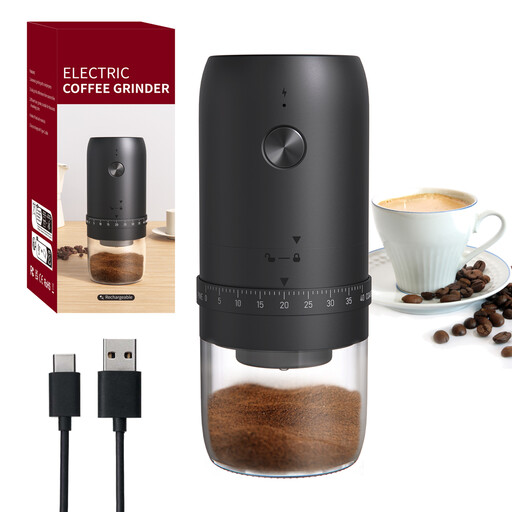
Why this choice suits this profile: This electric grinder is suitable for daily use at home, when you want to avoid manual grinding and keep things simple on your worktop.
It stops you paying for unnecessary features when a compact electric grinder is all you need to grind beans at home. However, check the number of grind levels and the capacity stated on the product page before ordering.
A black electric design focused on grinding coffee beans. An option to compare based on the volume you need and the settings available.

Why this choice suits this profile: This rechargeable grinder is for those who want to fine-tune their brew, whether at home, in the office or on the move.
With its advertised 30 settings, it makes switching from espresso to cafetière easy, unlike a single-position grinder. However, it's still essential to follow the stated operating limits.
A stainless steel burr grinder, a maximum capacity of 50 g, a rechargeable battery and an automatic shut-off. The model weighs 940 g.
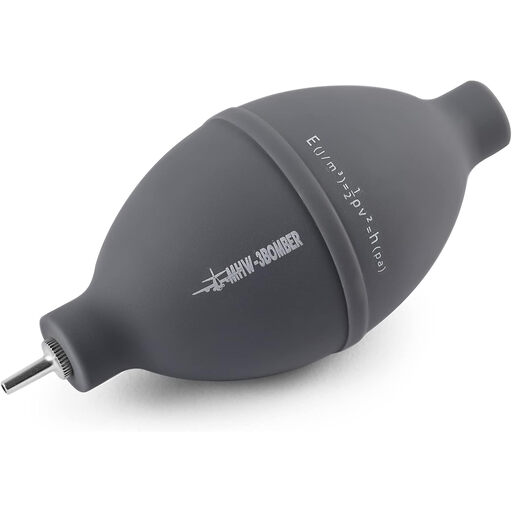
Why this choice suits this profile: People who regularly maintain their grinder, coffee machine or other delicate equipment can use this manual accessory, which requires no batteries.
It avoids having to use water or rigid tools to dislodge residue. Its use is manual and should be kept away from eyes and sensitive areas.
A silicone body, a stainless steel nozzle, a built-in air filter and dimensions of 13 × 8 × 5.9 cm. It can also be used to clean a keyboard or a camera.
A manual coffee grinder can be handy when travelling, especially when there's no power socket nearby. However, it requires more time and effort. For spices, a wooden pepper mill serves a completely different purpose: the Pepper Mill Lotus Wood model has a ceramic mechanism and an adjustment from fine to coarse, but it is not designed for coffee beans.
The same goes for a stainless steel vegetable mill like the Moulinex A40102, which is made for preparing purées, compotes or coulis. Its discs and manual mechanism are not suitable for grinding coffee. This distinction will stop you from buying a multi-purpose kitchen tool thinking it can replace a proper grinder.
We've put together a complete, real-time updated selection of products that meet these demanding criteria and European safety standards.
Generally, opt for a coarse grind to limit the amount of sediment in your cup. The ideal setting then depends on your grinder, the brewing time and your personal taste. Start with a medium to coarse grind, then adjust gradually until you get the result you want.
Its lifespan depends on how often you use it, the mechanism, how well you maintain it and whether you follow the manufacturer's instructions. Avoid moisture, don't overfill the chamber and remove residue regularly. With an electric model, also follow the recommended rest periods to reduce the risk of overheating.
It depends on its power and how long you use it, but grinding usually only takes a few seconds. The running cost therefore mainly comes down to the price of the beans, cleaning and, for rechargeable models, charging the battery.