
Livraison le jour même ou le lendemain

Qualité garantie

Débloquez vos offres de bienvenue: Livraison GRATUITE | Jusqu'à -80 % | 30 jours d'essai gratuits à JoyPlus
Téléchargez l'application
Switching to whole bean coffee is the single most decisive step toward revolutionising your morning cup. But let's be honest: choosing a burr coffee grinder can quickly become a minefield. Between marketing jargon and opaque spec sheets, buyer's remorse is a real risk. Our mission? To help you cut through the noise and invest in a model that truly delivers on its promises.
Before you take the plunge, here are 3 classic (and costly) traps that many coffee lovers fall into:
To avoid falling into these traps, here are the technical specifications that truly make a difference.
The burrs are the heart of the machine. Their shape has a direct impact on grind consistency and heat management.
The choice, therefore, depends on your needs. For versatile home use, stainless steel conical burrs remain a reliable and high-performing option.
The ability to finely adjust the grind particle size is crucial. This is what allows you to "dial in" your coffee, perfectly matching it to your extraction method.
A good grinder is a long-term investment. Its longevity is directly tied to its construction. A metal body (aluminium, steel) will always offer better stability than a plastic chassis. It absorbs vibrations more effectively and ensures the long-term alignment of the burrs. For travellers, a manual coffee grinder with an aluminium body and stainless steel burrs is the ideal road companion: robust and lightweight.
The one-size-fits-all grinder doesn't exist. The key is to find the one that matches your habits and your machine. Here is a selection of models that caught our attention.

Why we love it : Because it delivers a quality grind without needing a power outlet. Perfect for the office, travel, or for getting serious about coffee on a controlled budget, without compromising on what matters most: the quality in the cup.
This is a true grinder equipped with stainless steel conical burrs that ensure a consistent grind, light-years ahead of blade models. Its internal stepped adjustment offers more than enough precision for most brew methods.
Its all-metal construction and dual-bearing-mounted axle guarantee a smooth rotation and excellent durability. These are features rarely seen at this price point.
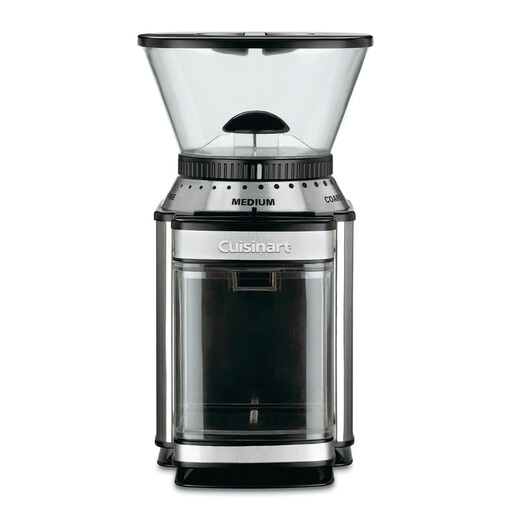
Why we love it : For anyone who brews pot after pot of filter or French press coffee daily and is looking for the simplicity and reliability of an efficient electric grinder.
With 18 steps, it covers a sufficient range of settings for most brew methods (filter, French press, etc.), avoiding the "jack-of-all-trades, master-of-none" trap. Its flat burrs guarantee a much more consistent grind than a blade grinder.
Its large hopper (225g) and cup selector with automatic shut-off are incredibly practical: just set the desired amount, start grinding, and walk away. It simplifies the morning routine.
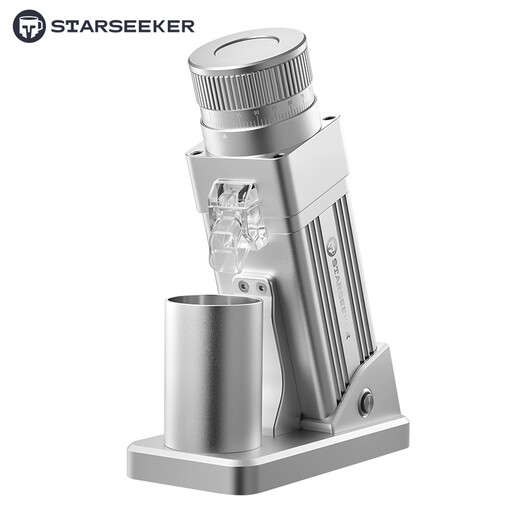
Why we love it : A model tailor-made for espresso machine owners who refuse to compromise on precision. Here, every micro-adjustment counts in the quest for the perfect extraction.
It checks all the expert boxes: its stepless (micrometric) adjustment provides the absolute precision required for espresso, while its integrated plasma generator neutralises static electricity. Say goodbye to flying grounds and a messy countertop!
Its 55mm flat burrs and solid, CNC-machined metal body give it a grind consistency and robustness worthy of professional equipment.
We have curated a complete selection of grinders that meet our quality criteria and European safety standards.
A blade grinder is essentially a blender for coffee: it randomly shatters the beans, producing a very uneven grind that sabotages the extraction. In contrast, a burr coffee grinder uses two components (conical or flat) to crush the beans in a controlled manner, achieving a precise and consistent particle size. The result in the cup is night and day: more richness, more balance, and more flavour.
For routine maintenance, a quick brush is enough to dislodge coffee residue from the grind chamber and burrs. Crucially, never use water, as it will cause steel burrs to rust. For a deep clean, special grinder cleaning tablets are available to absorb stale coffee oils. Always remember to unplug the appliance before any cleaning.
It all depends on your brewing methods. If you exclusively use a French press, a dozen steps might be sufficient. If you like to switch between methods (filter, AeroPress, Moka pot), a model with 15 to 20 steps will be more convenient. For espresso, however, the verdict is clear: a stepless (micrometric) grind adjustment or a model with a very high number of steps (30+) is essential to achieve the necessary fine-tuning.