Buying priorities
Start by comparing the coffee format and consumables, then check that the maintenance routine and drinks available fit your day-to-day habits.
| Priority |
What to check |
Your needs |
| Running costs |
Compare the price per serving for capsules or pods, along with the price per kilogram and the dose for beans or ground coffee. Add descaler, any filters and cleaning products. |
I want to understand the cost of coffee and maintenance, not just the price of the machine. |
| Maintenance |
Check access to the coffee-grounds container, drip tray and brewing unit. Look at the descaling procedure and the rinsing required for the steam wand or milk system. |
My routine needs to remain realistic, especially with hard water or frequent milky drinks. |
| Drinks and automation |
Check the recipes available, how the milk is prepared, the machine’s footprint and the stated noise level. A portafilter machine requires more dosing and cleaning than an automatic machine. |
I want to choose between a simple espresso, automatic milky drinks or greater manual control. |
| Waste and format |
Compare the number of individually packaged servings and your local recycling instructions. ADEME states that aluminium or plastic capsules belong in France’s paper and packaging recycling stream. |
I prefer to limit individual packaging without assuming that recyclable packaging eliminates the waste that needs to be managed. |
Joybuy options for beans or portafilter coffee
These Joybuy options include bean-to-cup machines for everyday espresso made from beans and portafilter machines for preparing ground coffee without capsules.
 Image unavailable
Philips EP2230/10 Series 2200 LatteGo
For switching between espresso and milky drinks made from beans, with automatic preparation.
Advertised features include 12 grind settings, a 275 g bean hopper, LatteGo system, removable brewing unit and guided descaling. Check the cost and availability of the AquaClean filter, which is listed as compatible but not included.
Joybuy
 Image unavailable
De'Longhi Magnifica S ECAM22.140.B
For automatic espresso made from beans or pre-ground coffee, with manual milk frothing.
Advertised features include an adjustable grinder, preparation for one or two cups, steam wand, Thermoblock, water filter and descaling alert. Check the space available on your worktop.
Joybuy
 Image unavailable
HiBREW H16 automatic machine with grinder
Worth considering for memorised coffee and milk recipes made from beans at home.
Advertised features include a 15-level conical grinder, six drinks, touchscreen, dual heating system and 1.5 L water tank. Consult the instruction manual for the milk system’s cleaning and descaling procedure.
Joybuy
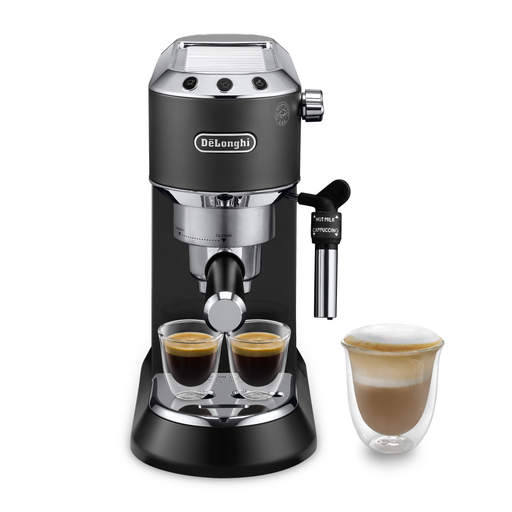 Image unavailable
De'Longhi Dedica Style EC685.BK
For preparing everyday espresso with ground coffee on a limited worktop.
Advertised features include a width of 149 mm, a one- or two-cup portafilter, steam wand, Thermoblock and filters compatible with ESE pods. Check the tank’s actual capacity before buying.
Joybuy
 Image unavailable
HiBREW H13A semi-automatic espresso machine
For espresso made with ground coffee and cappuccinos or lattes with a more guided preparation process.
Advertised features include a 51 mm portafilter, three adjustable temperatures, dual heating, six modes, a removable 1.3 L water tank and a 700 ml milk tank. Check the milk system’s cleaning routine.
Joybuy
Frequently asked questions
Does a machine with a grinder eliminate all maintenance tasks?
No. With an automatic grinder, rinse the coffee-grounds container and drip tray regularly and, depending on the model, the brewing chamber or brewing unit. Que Choisir also recommends running the descaling programme when prompted and rinsing the steam wand after every milky drink.
How often should you descale a Nespresso capsule machine?
Nespresso recommends descaling every three months or after around 300 capsules. However, check your model’s instruction manual and adjust the frequency if you have hard water.
Do used capsules go in the recycling bin in France?
ADEME states that aluminium or plastic capsules go into the paper and packaging recycling stream. Paper capsules can only be composted where a local composting or food-waste collection solution is available.
Does coffee grounds have to be composted?
Check the solution provided by your local authority. ADEME states that local authorities have been required to provide a food-waste sorting solution since 1 January 2024, under arrangements that may include composting, collection or a drop-off point.
Is a portafilter machine always cheaper than a bean-to-cup machine?
No, because the price of the machine, accessories, a separate grinder if needed and maintenance products varies depending on the equipment. For coffee alone, the result depends on the coffee selected and the dose; Sage cites 18 g for its Barista Express, a figure specific to that model.


