For lactose-free family shopping, choose a size that matches how much each recipe calls for. A multipack of smaller portions can help you avoid leftovers, while a 400 ml or 1 l carton is a better choice if you’ll use it up quickly. Then check the ingredients and allergens for each product, along with its storage instructions once opened.
Who are these sizes suitable for?
Families who regularly cook without lactose
If you make several coconut milk curries, sauces or desserts, compare the amount each recipe uses with the size of the container. A larger size can work well if you’re making dishes close together; separate portions mean you don’t have to open your whole supply at once.
People who pay close attention to ingredients
When shopping without lactose, check each product rather than relying on the words ‘coconut milk’ alone. The ingredients list and any highlighted allergens can also help you check for other dietary requirements in your household.
People who only cook with coconut milk occasionally
A 200 ml portion may be just right for a smaller recipe. If you choose a larger container, check the instructions for storing it after opening: the product pages for Markal and Grace say to keep the relevant products in the fridge for four and three days respectively.
What should you check before buying?
First, work out how much coconut milk you’ll use before and after opening a container. Then compare the labels on sizes that suit your recipes.
| What to consider | What to check | Who it matters to |
|---|
| Ingredients and allergens |
The ingredients list and any highlighted allergens for the product you choose. |
If I need to avoid lactose or take an allergy in my household into account, the product name alone isn’t enough. Around 36% of consumers would put this check at the top of their list. |
| Usable quantity |
The size of each portion and the storage instructions once opened. |
When I leave a gap between recipes, I’d rather not open more coconut milk than I can use. For around 29% of consumers, choosing a size to suit their meals would be the top priority. |
| Ingredients to suit your recipe |
The product description, stated coconut content and fat content, measured on the same basis, per 100 ml or per 100 g. |
For a sauce or dessert, I want to choose a product that’ll give me the result I’m looking for, rather than relying on the picture on the pack. Around 21% of consumers would put this first. |
| Formulation preferences |
The ingredients list and organic label, if that matters to you. |
If I’m looking for a particular formulation, I check the ingredients before choosing between sizes. This would come first for around 14% of consumers. |
Common mix-ups to avoid
-
Mistaking coconut drink for coconut milk for cooking
A plant-based drink, coconut milk for cooking and coconut cream are different types of product. So the size of the pack alone won’t tell you whether it’s suitable for a sauce or dessert.
Check the product description, ingredients list and fat content before stocking up.
-
Choosing the largest container without planning how you’ll use it
An opened 1-litre container could leave you with leftovers if you leave a long gap between recipes. Storage times after opening vary by product: the Grace and Markal product pages say to keep them in the fridge for three and four days respectively.
Match the size of each container to the recipes you have planned, then follow the storage instructions for the product you buy.
If you can’t use an opened container within the stated time, some of it could go to waste.
-
Assuming ‘lactose-free’ covers every allergy
This label doesn’t tell you everything about a product’s ingredients. For example, the product details for one Grace product list sodium metabisulphite.
Check the ingredients and any highlighted allergens whenever you switch to a different product.
Brands and sizes to compare
KARA
Carrefour lists a KARA product in a pack of 3 x 200 ml cartons. It’s worth considering if you use one portion per recipe.
- The product details state that it contains 64% fresh coconut extract.
- Check the ingredients and pack size of the product on offer when you buy.
BJORG
Carrefour lists an organic BJORG product in a pack of 3 x 200 ml cartons.
- The cartons can be opened one at a time.
- The ingredients list for this product includes maltodextrin, among other ingredients. Compare it with alternatives if formulation is your main priority.
THAI EXPERT
Carrefour lists a THAI EXPERT product in a pack of 3 x 200 g cartons. Keep this unit as stated when comparing it with sizes listed in millilitres.
- The ingredients listed for this product include coconut extract, water and xanthan gum.
- Check how much your recipe needs before comparing this multipack with 200 ml cartons.
CARREFOUR SENSATION
Carrefour lists CARREFOUR SENSATION coconut milk in a 400 ml tin. It’s worth considering if your recipe uses most of the tin.
- The product details state that it contains 85% coconut extract and 18 g of fat per 100 g.
- If you don’t use the whole tin, follow the storage instructions on the packaging.
Joybuy product for a smaller portion
This 200 ml single carton is suitable for occasional use or a small recipe. On its own, it isn’t a family-size multipack of cartons.
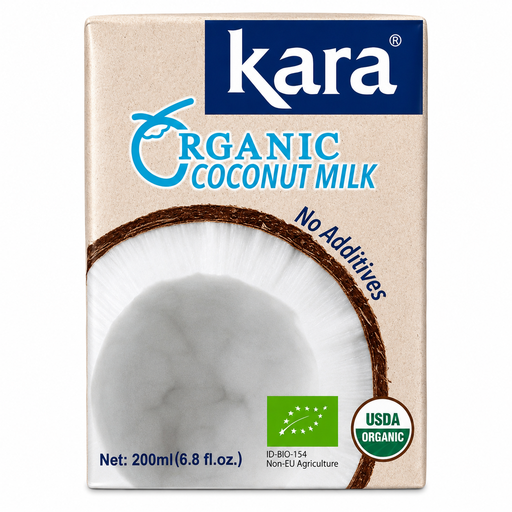 Image unavailable
Kara Organic UHT coconut milk, 17% fat, 200 ml
This single carton may suit an occasional recipe better than stocking up on a multipack for the family.
The product name describes a 200 ml carton of UHT coconut milk containing 17% fat. For lactose-free shopping, check the ingredients and allergens on the product you buy.
View on Joybuy
Frequently asked questions
Is coconut milk automatically suitable for lactose-free shopping?
Don’t assume so from the product name alone: check the ingredients and allergens for the product you choose. In France, the DGCCRF states that allergens must be highlighted in the ingredients list of prepacked foods.
A multipack of small cartons or a larger size: which leaves less waste?
Choose separate portions if you only cook with coconut milk occasionally; a larger container is better if you have several recipes planned close together. Always read the instructions for after opening: the product pages for Markal and Grace say to keep them in the fridge for four and three days respectively.
What should I look for when choosing coconut milk for a sauce?
First, check that it’s coconut milk for cooking, then compare the stated coconut content and fat content. For fat, use the same basis, per 100 ml or per 100 g: don’t compare figures given in different units directly.
Can you use coconut milk after its best-before date?
According to Anses, going past a best-before date doesn’t in itself make a product unfit to eat, although its quality may change. This date doesn’t replace checking the packaging and product, or following the storage instructions once opened.


