
Livraison le jour même ou le lendemain

Qualité garantie

Débloquez vos offres de bienvenue: Livraison GRATUITE | Jusqu'à -80 % | 30 jours d'essai gratuits à JoyPlus
Téléchargez l'application
Between seasonal clothing, bulky duvets and household linens, French wardrobes can fill up remarkably quickly. Clothing storage bags make it easier to group textiles together, move them around and protect them from dust. However, it is important to choose a design suited to how you intend to use it.
A large bag will not necessarily suit every type of clothing. A coat, duvet or pile of jumpers will take up different amounts of space depending on the material and thickness. If the bag is overfilled, it becomes difficult to close and its seams may be placed under excessive strain.
For storing seasonal clothing, it is best to leave a little room around the contents. The external dimensions do not always correspond to the usable internal capacity either.
Some designs highlight a material that is resistant to moisture. This may help protect against splashes and dust, but it does not mean the bag can be left in a damp cellar or out in the rain. PEVA garment covers, for example, offer light protection and make it easy to identify the contents, but they are not a substitute for storage in a dry, well-ventilated place.
A fragile zip can make a bag unusable, even if the fabric appears thick. Check its length, the quality of the stitching and whether any reinforcements are included. Storage bags with handles are very practical when moving house or transporting items, but always observe the stated load capacity to avoid awkward handling or even tearing.
For folded clothes, a rectangular design slips more easily under a bed, onto a shelf or into a wardrobe. For dresses, jackets and suits, a sufficiently long vertical garment cover helps prevent pronounced creases.
Storage bags for duvets and blankets should provide enough width and height for your bedding while remaining easy to close. Measure the available space before ordering, particularly in small flats, student accommodation and loft-style homes.
For delicate clothing, avoid heavily compressing sensitive materials for long periods. Always clean and dry textiles before storing them to help prevent odours and mould.
A zip running the full length makes filling easier and lets you check the contents without taking everything out. Handles should be attached to reinforced areas, especially on storage bags for moving house. Care depends on the material: many PEVA covers can be wiped clean with a damp cloth, while some textile bags require more careful handling.
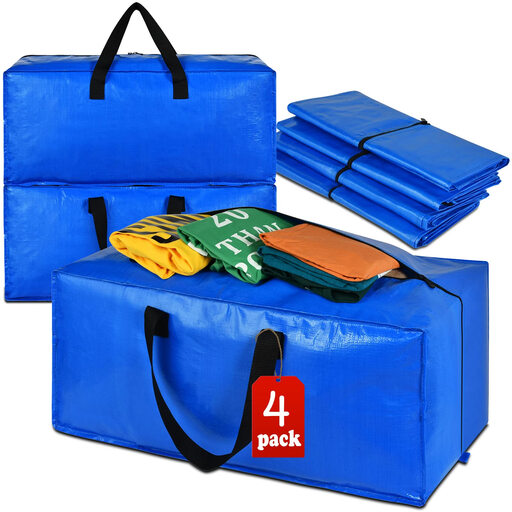
Why this choice suits this profile : This set of four bags lets you separate jumpers, bed linen and camping equipment. The stated size of 73 × 34 × 37 cm is suitable for bulky items, while the handles make them easier to move.
The size and number of bags prevent all the textiles from being concentrated in one excessively heavy container. The zip and handles make both storage and transport easier.
Pack of 4, stated dimensions of 73 × 34 × 37 cm, zip fastening and integrated handles.
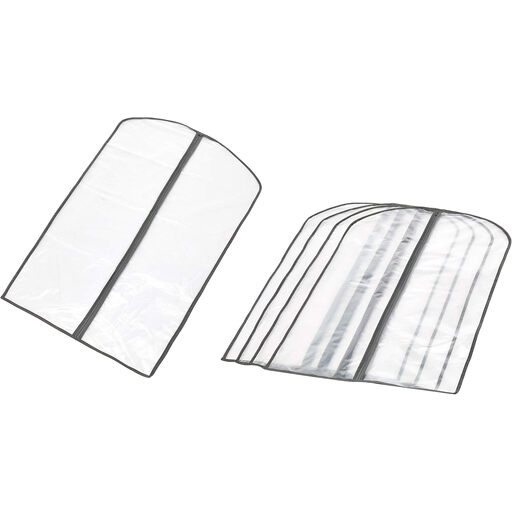
Why this choice suits this profile : This set of five translucent PEVA covers is ideal for anyone who wants to organise suits, dresses and seasonal clothing precisely, whether at home or when travelling.
The translucent material lets you identify the contents at a glance, without repeatedly opening the covers. The zip on each cover helps limit exposure to dust, without suggesting that the product is completely waterproof.
Water-resistant PEVA according to the description, translucent design, zip fastening and a selection of 5 sizes.
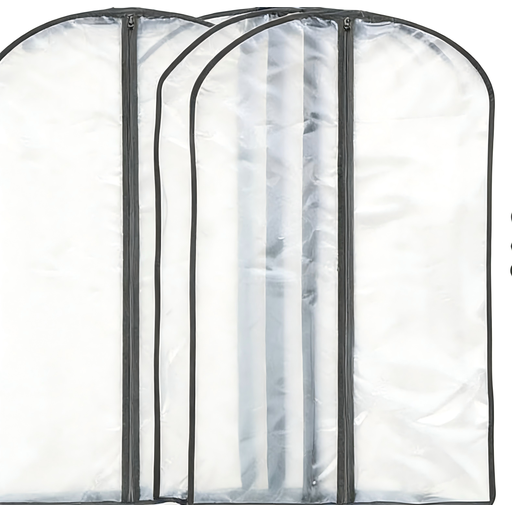
Why this choice suits this profile : These three rectangular containers are designed to be stacked or slid under a bed. They are suitable for blankets, clothing and textiles that need to be handled regularly.
The stated capacity of 5 pounds, or approximately 2.3 kg per container, provides a clear guide to help prevent overloading. The handles and rectangular shape make transport and stacking easier.
Pack of 3, integrated handles, zip fastening, stated dimensions of 106.7 × 45.7 × 15.2 cm and a capacity of approximately 2.3 kg per unit.
Before closing a cover, sort the items by category and add a clearly visible label. Never store textiles that are still damp in a closed bag. For hanging clothes, choose a cover that is long enough and avoid putting strain on the zip.
When moving house, spread the weight across several bags rather than filling one container to the brim. For duvets and blankets, fold them without forcing them into place and check the condition of the storage regularly if the bag is kept in a garage, cellar or loft.
They can help limit dust and certain splashes, depending on the material and fastening system. However, a water-resistant cover is not necessarily waterproof. For long-term storage, choose a dry, well-ventilated room protected from significant temperature fluctuations.
No. They are mainly suitable for items that can withstand compression, such as certain clothes, blankets or synthetic duvets. Bulky, delicate or naturally lofty materials may lose their shape if they remain compressed for too long.
A full-length zip makes it easier to access the contents and distribute textiles evenly. For frequent use, check that it glides smoothly and do not fill the bag beyond its dimensions or maximum load.