
Livraison le jour même ou le lendemain

Qualité garantie

Débloquez vos offres de bienvenue: Livraison GRATUITE | Jusqu'à -80 % | 30 jours d'essai gratuits à JoyPlus
Téléchargez l'application
A clothes rail can take the pressure off a wardrobe, organise a utility room or restore order to a cluttered hallway. However, some models quickly prove unstable, awkward to move or too narrow for coats. Price should therefore not be your only consideration.
Three common pitfalls to look out for:
To avoid a disappointing purchase, compare the dimensions, materials and features that will genuinely be useful in everyday life.
For a clothes rail, load capacity is an essential indicator. Thick jackets, winter clothes and wooden hangers weigh considerably more than a collection of lightweight shirts. Check whether the stated figure refers to the maximum static load, and look for reinforcements, lower rails or adjustable feet.
A steel frame is suitable for regular use, whether in a bedroom or a small shop. However, the load should be distributed to reduce the strain placed on the top rail. For a unit installed in a hallway, an anti-tip device is also a sensible precaution, particularly if children use the room.
Measure the available width, depth and height before ordering. An extendable clothes rail allows you to adjust the width to suit the amount of laundry, but make sure you leave enough clearance to handle hangers easily.
The dimensions to pay particular attention to include:
A compact model can fit under a bed or into a corner. By contrast, a wider mobile wardrobe is better suited to intensive use or a retail space.
A clothes rail on castors makes it easy to move garments between the bedroom, utility room and ironing area. Swivel castors simplify changes of direction, while lockable wheels keep the unit in place.
Lower rails can hold storage boxes, shoes or accessories. A clothes rail with shelves is more versatile, provided you do not overload the different levels. In a hallway, a unit with a shoe bench adds practical seating and lets you keep coats, bags and shoes together in one place.
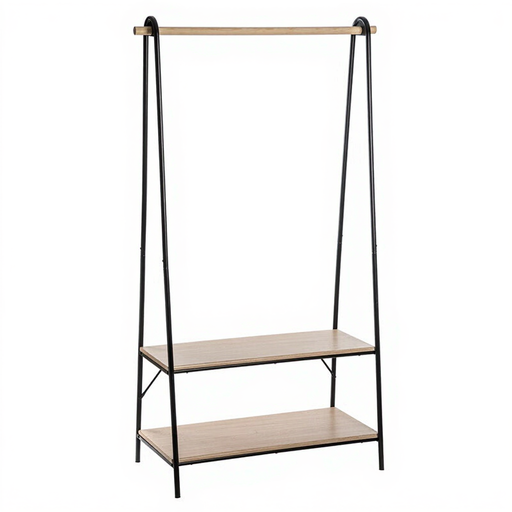
Why this choice suits this profile : Its two shelves let you combine hanging clothes, shoes and accessories in a bedroom or small dressing room.
Its dimensions of 95.5 × 46.5 × 165 cm provide a clear reference before purchase, while the stated maximum load is 40 kg.
A steel frame, a 120.5 cm pine rail, two MDF shelves and FSC-certified wood, according to the product details.
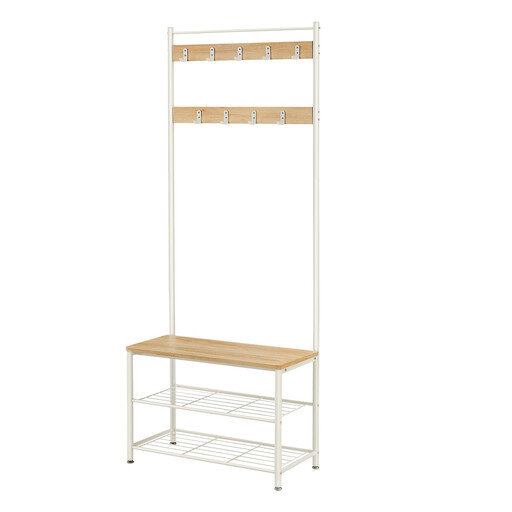
Why this choice suits this profile : This combination is ideal for a stylish hallway that needs to bring together coat storage, seating and shoe storage.
Adjustable feet, an anti-tip kit and load limits for each component make usage clearer. Wall mounting still needs to be arranged.
Nine hooks, a bench supporting up to 136 kg and shelves that can hold 10 kg each, according to the information provided.
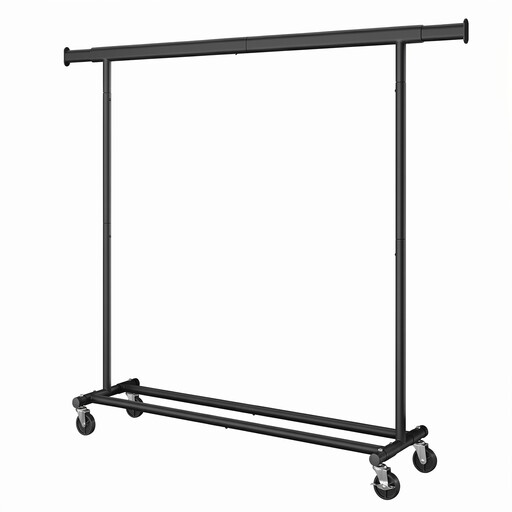
Why this choice suits this profile : Its adjustable width and wheels make it suitable for shops, frequent moves or households that regularly move their mobile wardrobe.
The swivel wheels with locking system make it easy to move the rail and then secure it in place. The telescopic rail adjusts from 160 to 200 cm.
A steel frame, a stated static capacity of 150 kg, two lower rails and tool-free assembly, according to the product details.
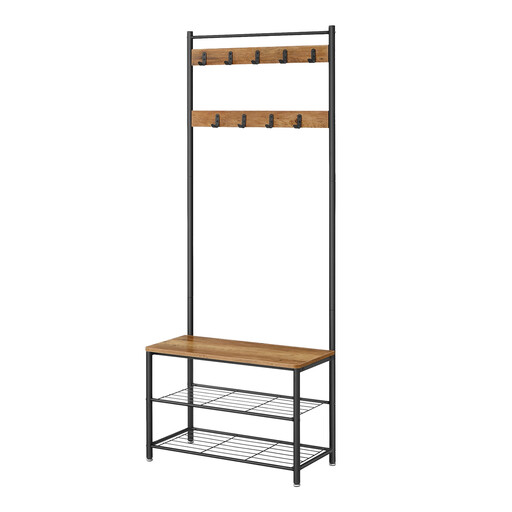
Why this choice suits this profile : Its rustic walnut and black finish fits into a hallway where storage also contributes to the room’s layout and atmosphere.
Maximum loads are specified for the hooks, bench and shelves. The anti-tip kit must be installed in accordance with the instructions.
A 32 × 70 × 177 cm format, nine metal hooks, a bench rated for 136 kg and two wire shelves.
We have put together a complete, real-time updated list of products that fully meet these strict selection criteria and European safety regulations.
Distribute the clothes along the full length of the rail and place the heaviest items in the centre. Lock the wheels when the rail is in position. If your floor is uneven, choose a model with adjustable feet or place it on a level surface. In all cases, avoid exceeding the stated static load.
Its lifespan depends on the suspended weight, how often it is moved and the surrounding environment. A steel frame, properly used castors and a well-distributed load can help prevent premature wear. Check the joints, wheels and screws regularly, especially in a shop or utility room used every day.
No. An extendable or telescopic clothes rail operates manually and does not require a power supply. Its running costs are therefore limited to routine maintenance and the occasional replacement of moving parts. Before retracting a telescopic rail, keep your fingers away from the sliding area to prevent them from getting trapped.