What should you consider before choosing?
First, decide whether you can keep a clothes airer in a suitable room. Then consider each appliance in light of the space you have and how often you do the laundry.
Heat pump condenser dryer
Worth considering: if you dry clothes frequently, don’t have an air-exhaust duct and want to factor electricity use into your decision.
The trade-off: cycles are generally longer than with a conventional condenser dryer, according to UFC-Que Choisir. Filters and the condenser also need the maintenance specified in the manual.
Conventional condenser dryer
Worth considering if: you already have this type of appliance at home and cycle duration matters for the way you use it.
The trade-off: UFC-Que Choisir says it uses more electricity than heat pump models. If you’re buying a new appliance, check the model’s status too: according to the European Commission, only household heat pump tumble dryers may be placed on the EU market from 1 July 2025.
Indoor clothes airer
Keep using one: if you have a genuinely large, well-ventilated room or a room with mechanical ventilation (MVHR) extraction, as recommended by ADEME.
The trade-off: your laundry continues to dry in the air inside your home. ADEME notes that this releases a lot of moisture indoors. A closed or poorly ventilated room doesn’t meet its recommendations.
| Criterion |
What to check |
What I need |
| Moisture and ventilation |
If you use a clothes airer, check the size of the room and how well it’s ventilated, or whether it has mechanical ventilation (MVHR) extraction, as ADEME recommends. For a tumble dryer, check the installation requirements in the manual. |
I don’t want laundry left to dry in an occupied room, but I also don’t want to treat buying an appliance as a fix for poor ventilation. |
| Electricity and drying time |
Compare the stated energy consumption and programme duration on a like-for-like basis. According to UFC-Que Choisir, heat pump models use less electricity than conventional condenser dryers, which generally have shorter cycles. |
If I use a tumble dryer often, I want to account for the electricity it uses over repeated cycles, not just how quickly one cycle finishes. |
| Capacity and space |
Match the capacity in kg to your usual loads. Measure the height, width and depth, door clearance and delivery route; check the manual for the permitted ambient temperature. |
My usual laundry loads need to fit in the appliance, and I need to be able to install it and open the door in the space I’ve chosen. |
| Maintenance and water |
Check where the filters are and what the manual says about the condenser and water tank. If you want direct drainage, confirm that the model supports a drain hose connection and that a suitable water outlet is available. |
I’d like to know what I’ll need to do after each cycle and how the water will be drained before choosing a model. |
A few brand examples
These examples highlight features to check on a specific model; they don’t describe every product range from these brands.
Bosch
The WQG24502FR is an 8 kg Bosch heat pump tumble dryer.
- Bosch lists a self-cleaning condenser, a water drain hose and dimensions of 842 × 598 × 613 mm for this model.
- Check the manual for installation clearances and any maintenance that’s still required.
Electrolux
The EDHF5841EC is an 8 kg Electrolux heat pump model.
- Electrolux lists an operating temperature range of 5 °C to 35 °C, as well as alerts for the filter, condenser and full water tank on this model.
- Don’t assume that this temperature range and these features apply to another model without checking its product details and manual.
Miele
Miele describes the TCA520WP 8kg Active as an 8 kg heat pump tumble dryer.
- Miele lists an integrated condensation water drainage kit and options for stacking the appliance or placing it side by side.
- For your planned installation, check the accessories and requirements in the model documentation.
Tumble dryers to consider on Joybuy
These Joybuy appliances are designed for drying laundry indoors: three are described as heat pump tumble dryers, while the exact condenser technology of the fourth needs to be confirmed. Start by considering your available space, the loads you need to dry and the maintenance requirements, rather than assuming all these models will suit the same room.
 Image unavailable
Hotpoint CHD84MWBSEE, 8 kg heat pump
Worth considering if you regularly want to dry loads within its stated 8 kg capacity without using a clothes airer in an occupied room. The product name indicates an energy rating of C, and the model details mention a 2-in-1 filter and a drain connection. Before deciding where to place it, check its dimensions, permitted temperature and installation requirements in the manual. Also compare the energy use and programme duration.
View on Joybuy
 Image unavailable
Comfee CD08EHP05W-HR, 8 kg heat pump
This heat pump model has a stated capacity of 8 kg for the laundry you want to dry in the machine. Its name indicates an energy rating of D, and the product details describe a double-layer lint filter. Before comparing it with another appliance, check its dimensions, the permitted room temperature, energy use and programme duration.
View on Joybuy
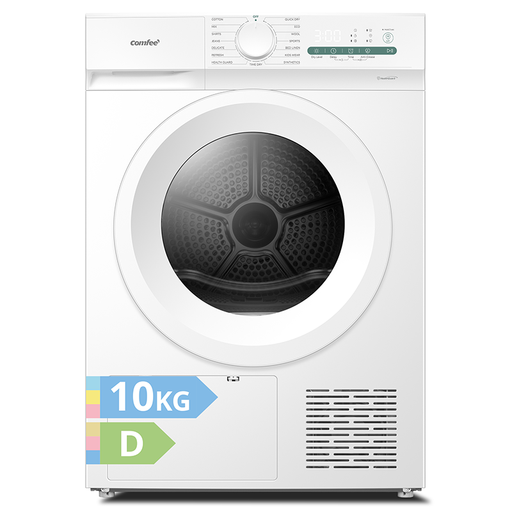 Image unavailable
Comfee CD10EHP05W-HR, heat pump
This model is described as a class D heat pump tumble dryer with several programmes and a double-layer filter. Its capacity is listed as both 8 kg and 10 kg, so confirm the capacity for this model before deciding whether it suits your loads. Also check the dimensions, permitted temperature, energy use and programme duration.
View on Joybuy
 Image unavailable
Electrolux EDH1018CD GentleCare, 8 kg condenser dryer
The stated 8 kg capacity makes it easier to compare this model with the laundry loads you plan to dry in the machine. Its name mentions the OptiSense function, and the product details list a water tank and a reversible door. Confirm the condenser technology, including whether or not it has a heat pump, before comparing its energy use with other models. Also check the permitted temperature and installation requirements.
View on Joybuy
Frequently asked questions
Does a heat pump tumble dryer mean you don’t need to ventilate your home?
No. It can reduce the need to use a clothes airer, but it won’t fix poor ventilation. If you still dry clothes indoors on an airer, ADEME recommends using a large, well-ventilated room or one with a mechanical ventilation (MVHR) extraction vent, preferably with humidity control.
How do you compare the energy use of two tumble dryers?
Check the stated energy use for each model, its energy label and the programmes you’ll use. Don’t rely on the rating letter alone. The European Commission says that the A to G label has applied to the relevant tumble dryers in shops and online since 1 July 2025. Don’t compare an old A+++ to D rating directly with a rating on the new scale.
What capacity should you choose for your household laundry?
Start with the amount of laundry you actually expect to dry and the capacity of your washing machine. UFC-Que Choisir recommends taking the size of your household and washing machine into account. Then check the tumble dryer’s dimensions, door opening and installation space.
Can cleaning affect cycle times?
Yes, on some tumble dryers. UFC-Que Choisir found that a build-up of dirt and fluff could make cycles longer and increase energy use. Follow the manual’s instructions for the filters, condenser and water tank, even if the model has a self-cleaning condenser.


