
Livraison le jour même ou le lendemain

Qualité garantie

Débloquez vos offres de bienvenue: Livraison GRATUITE | Jusqu'à -80 % | 30 jours d'essai gratuits à JoyPlus
Téléchargez l'application
A cleaning sponge may seem like a straightforward purchase. Yet the wrong model can scratch a hob, retain unpleasant odours or lose its shape after only a few uses. From dish sponges and scourers to absorbent and washable models, design differences have a direct impact on everyday use.
Here are the main pitfalls to avoid and the criteria to check before stocking up on household sponges.
An abrasive side can remove dried-on residue, grease and burnt-on food. However, it is not necessarily suitable for a non-stick pan, painted surface or delicate glass. The label “non-scratch” should be accompanied by clearly stated uses and does not remove the need to test the sponge on an inconspicuous area.
For delicate surfaces, choose a non-scratch sponge or a microfibre side. Reserve scouring models for materials compatible with their level of abrasion.
A reusable or machine-washable sponge can reduce how often it needs to be replaced, provided it is properly maintained. A sponge that remains constantly damp dries poorly, accumulates residue and will often begin to develop an unpleasant odour.
Always check the maximum washing temperature, whether it is dishwasher-safe and the drying instructions. This information is far more useful than a vague “long-lasting” claim.
The kitchen, bathroom and glass surfaces have different requirements. A sponge designed to remove limescale in the bathroom will not necessarily be suitable for washing dishes. For a more hygienic routine, assign a colour or model to each area of the home whenever possible.
A cellulose sponge, made from plant fibres, absorbs water effectively. It is suitable for wiping worktops, sinks and dishes. In double-sided models, it is often paired with a scouring surface.
Foam retains water well while remaining flexible. Microfibre, meanwhile, is particularly well suited to mirrors, windows and surfaces that require a streak-free finish. For these applications, wring out the cleaning side properly and avoid saturating it with product.
The colour of a scouring side alone is not enough to determine how aggressive it is. Check the manufacturer’s instructions and identify the surfaces for which it is approved or not recommended. Even a sponge marketed as non-scratch should be rinsed before first use to remove particles that could leave marks.
On a ceramic hob, stainless-steel sink or non-stick pan, start by testing it on a small area. Never use a sponge on a hot surface.
After each use, rinse the sponge with clean water, wring it out without twisting it excessively and leave it to dry in a well-ventilated place. A machine-washable sponge should be cleaned in accordance with its instructions. Some manufacturers specifically advise against using fabric softener.
Replace it as soon as its structure begins to tear, its abrasive side starts to fray or an odour persists after washing. Its service life will depend primarily on how often it is used and the types of tasks it handles.
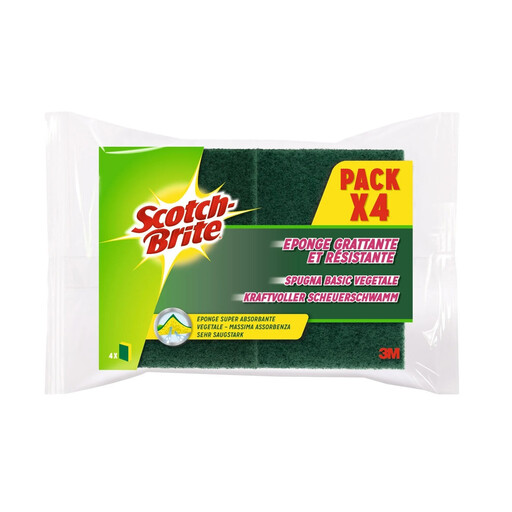
Why this choice suits this profile : this four-pack of double-sided sponges covers everyday kitchen needs, with a plant-based cellulose side for absorption and a scouring side for tougher messes.
The two separate sides prevent you from automatically reaching for the abrasive surface when simply wiping. Delicate surfaces should nevertheless be excluded in accordance with the instructions.
Four sponges, absorbent cellulose and a scouring side for everyday household cleaning.
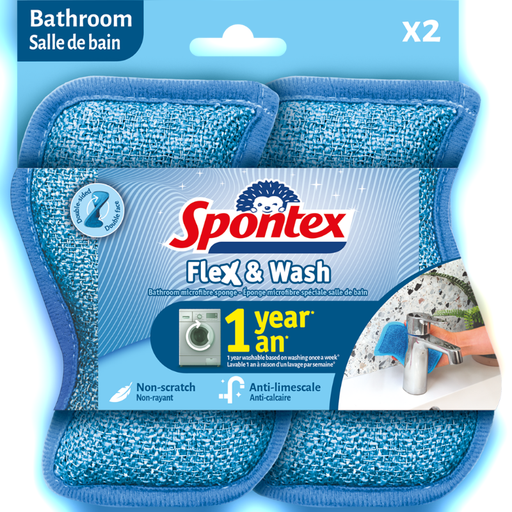
Why this choice suits this profile : this model is designed for households seeking a reusable bathroom sponge, with a microfibre side for mirrors and a scouring side for limescale deposits.
The instructions state that it can withstand up to 52 washes at 40 °C, without fabric softener or tumble drying. This concrete guidance makes it easier to plan and maintain properly.
A microfibre side made from recycled fibres, an absorbent foam core and a medium-intensity scouring side.
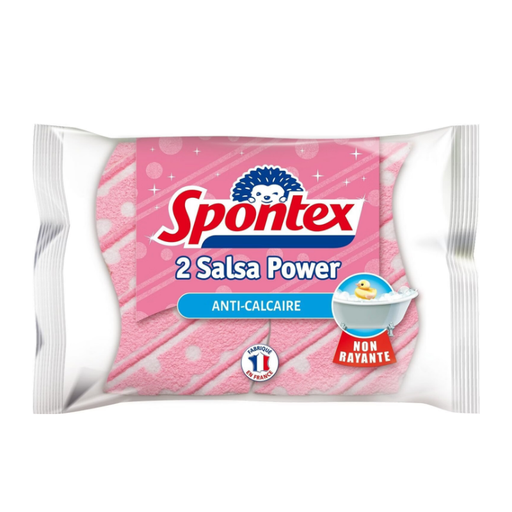
Why this choice suits this profile : this pack is designed for bathrooms particularly exposed to limescale, especially around taps, in showers, baths and sinks.
Its design is dedicated to limescale removal and specifies the compatible bathroom surfaces. Testing it first on an inconspicuous area is still recommended.
Two sponges, a non-scratch design and a practical shape for narrow, hard-to-reach areas.
We have put together a comprehensive, real-time-updated selection of products that meet these exacting criteria and European safety standards.
Choose a sponge whose surface is explicitly described as non-scratch and consult the pan’s care instructions. Avoid traditional abrasive models, even when their absorbent side appears soft. Testing it on an inconspicuous area is still preferable.
It depends on how often it is used and the condition of the material. Some washable models specify a precise number of wash cycles. Traditional sponges should be replaced as soon as they begin to fray, lose their shape or retain an odour despite rinsing.
It can reduce the number of replacements, but you should also consider its purchase price, washing frequency and compliance with the care instructions. Compare the stated number of cycles, the permitted temperature and the sponge’s ability to dry properly between uses.