
Livraison le jour même ou le lendemain

Qualité garantie

Débloquez vos offres de bienvenue: Livraison GRATUITE | Jusqu'à -80 % | 30 jours d'essai gratuits à JoyPlus
Téléchargez l'application
A Clairefontaine notebook or paper pad can support a wide range of activities: drawing, watercolour, studying, professional note-taking and organising your everyday life. However, an attractive reference shown in a photo will not necessarily be right for the intended use. Format, paper weight and binding all directly affect comfort, page durability and the lifespan of the paper product.
Joybuy’s selection is based on the specifications provided by manufacturers, helping you distinguish genuine practical requirements from simple marketing claims.
A notebook advertised as having 160 pages may contain 80 sheets that can be used on both sides. Conversely, a 20-sheet art paper pad contains only 20 sheets, even if its paper weight is considerably higher. Before comparing prices, always check both details.
70 or 80 g/m² paper is generally suitable for note-taking, pens and pencils. With watercolour, gouache or washes, however, it may start to warp quickly. For these techniques, it is better to choose a watercolour paper pad or 250 g/m² mixed-media paper.
Paper weight is not everything: sizing, texture and water resistance matter too.
An A5 spiral notebook is easy to carry and can stay open flat. A sewn notebook offers a more structured presentation, while a glued pad allows you to detach sheets when needed. For a student who often writes while travelling, a rigid spine may prove more practical than a beautiful cover.
An A4 sketchbook gives you more freedom for large compositions, but it also takes up more room on a desk or in a bag. For use on the go, a more compact format helps reduce bulk.
Drawing paper intended for pencil, charcoal or pastel can remain relatively light, provided it can withstand erasing and rubbing. The Clairefontaine Cray’ON R.I. Pad A4 uses extra-white cellulose paper weighing 120 g/m², with one very lightly textured side and one smoother side. This double texture lets you adapt the surface to the finish you are looking for.
For wet techniques, the Aquapad shown below uses 300 g/m² cellulose paper with a fine-medium texture and double sizing. These details are far more useful than simply describing a product as “multi-purpose”.
Black drawing paper works differently: it makes white pencils, metallic inks and light colours stand out. Clairefontaine’s Paint’ON Black is black, lightly textured and has a paper weight of 250 g/m². It accepts dry and wet media, including pencil, marker, Indian ink, gouache and acrylic. It therefore does not always replace white paper.
For note-taking, look closely at the type of ruling:
The PEFC label means that the paper comes from forests managed according to the requirements of this certification system. Some models, such as the Zap Book, use PEFC recycled paper or recycled paper advertised as acid-free and pH-neutral. Nevertheless, it is best to check the details for each reference, as not all collections have the same composition.
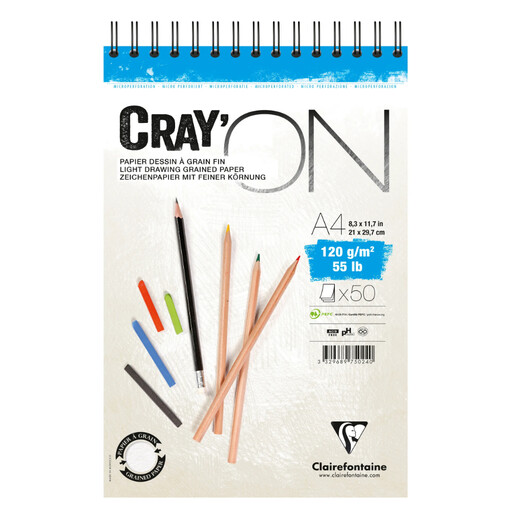
Why this choice suits this profile : This A4 pad is suitable for sketches, charcoal, pastels, coloured pencils and regular practice. Its two sides let you try a smoother or lightly textured surface without having to buy several types of paper.
With its clearly stated 120 g/m² paper weight, this paper is designed to withstand repeated corrections when using dry techniques. It prevents you from mistaking a basic notebook for a genuine drawing surface.
Extra-white, acid-free cellulose paper, PEFC-certified, with a fine-textured side and a smooth side.
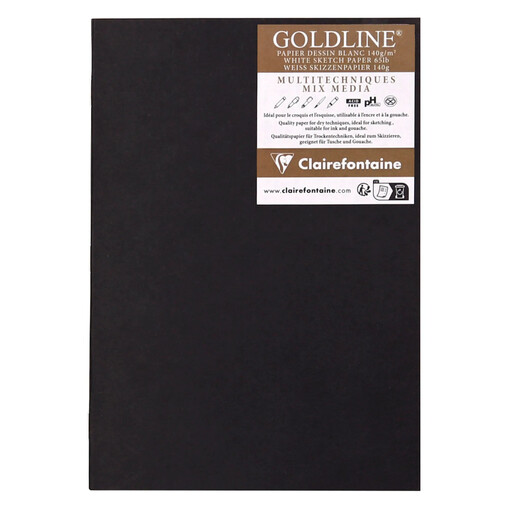
Why this choice suits this profile : This notebook with a flexible black cover combines 140 g/m² white paper with sewn binding. It is aimed at artists who want to bring sketches, pencil, charcoal, pastel and watercolour experiments together in one product.
The product details specify the paper weight, compatible media and type of binding. This allows you to compare its uses without relying on a vague promise of versatility.
140 g/m² mixed-media paper, black cover and easy flat opening thanks to the sewn binding.
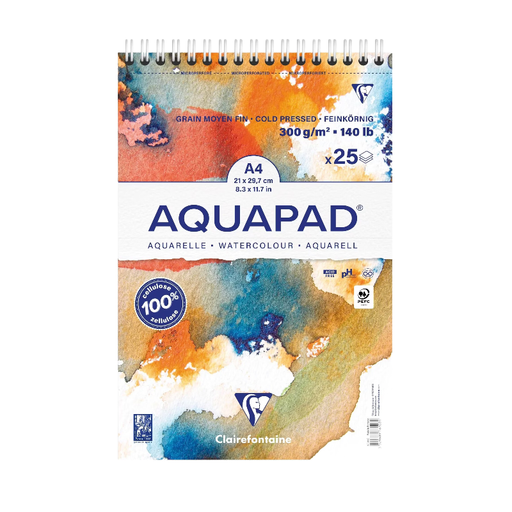
Why this choice suits this profile : This watercolour paper pad is designed for washes, gouache and fluid inks. Its fine-medium texture preserves detail while providing a surface suited to water-based effects.
The 300 g/m² paper weight and double sizing are clearly stated. These are practical benchmarks for wet techniques, rather than assuming that lightweight drawing paper will do the job.
Natural white cellulose, acid-free paper, fine-medium textured surface and spiral binding.
We have put together a complete, real-time updated selection of products that meet these strict criteria and European safety regulations.
For a student notebook, a squared notebook or a Rhodia notepad, the priority is often readability and the ability to file the sheets. The Rhodia No. 20 features a 5 × 5 mm grid, 80 micro-perforated sheets, a rigid card-backed cover and four filing holes. The Cornell A4 adds a layout designed to structure note-taking, using 90 g/m² Clairefontaine Vélin Velouté paper.
A Clairefontaine notebook with Seyès ruling is more suitable for schoolchildren and handwritten notes with wide line spacing. For everyday use while travelling, the A5 Deli spiral notebooks or small M&G A7 pads provide subject-based organisation in a pocket-sized format. However, their 70 g/m² paper is mainly intended for writing.
For a few light experiments, mixed-media paper may be enough. For more generous washes, choose 250 to 300 g/m² watercolour paper, with a sized surface and texture suited to your painting style. Even this type of paper may need to be fixed to a board to limit warping.
It depends entirely on the paper composition and the ink used. A high paper weight alone does not guarantee that ink will not bleed through. Check the product details and place a spare sheet underneath the page if you are using markers with a high solvent or ink content.
Store it flat in a dry place, away from moisture and direct light. Avoid leaving it in a car or near a radiator. For loose sheets, a document wallet or ring binder helps prevent creasing and makes filing easier.