
Livraison le jour même ou le lendemain

Qualité garantie

Débloquez vos offres de bienvenue: Livraison GRATUITE | Jusqu'à -80 % | 30 jours d'essai gratuits à JoyPlus
Téléchargez l'application
A Clairefontaine notebook can support very different uses: taking notes in class, organising documents, revising, writing at the office or practising watercolour. Yet the differences between a Rhodia notebook, a spiral notebook, an A5 notepad and an artist’s pad are not always immediately obvious.
Before buying, three common pitfalls are worth avoiding:
For classes, meeting notes and diagrams, a large-format notebook close to A4 provides a comfortable layout. Measuring 21 × 31.8 cm, the Rhodia No. 20 pad is well suited to detailed notes, tables and project plans.
An A5 notepad measuring 14.8 × 21 cm is much easier to carry. It is ideal for lists, journaling, short meetings and personal notes. Narrow formats, such as the Rhodia No. 8 at 7.4 × 21 cm, are better suited to columns, reminders and vertical lists.
The ruling should also match the way you write:
Paper weight refers to the paper’s weight per square metre. It is a useful indicator, but it is not enough on its own to determine writing comfort.
Watercolour paper is also distinguished by its texture and treatment. Clairefontaine Aquapad uses natural white cellulose, a medium-fine grain and double sizing. For generous washes, it is still best to secure or stretch the sheet to minimise warping.
Spiral binding often allows the notebook to open completely flat, or even 360°, making it easier to write on a narrow desk or while travelling. However, it can take up more room in a bag when the cover provides limited protection for the pages.
The Koverbook system adds a transparent polypropylene cover and two flaps for storing loose sheets, tickets or documents. This design is practical for students carrying several types of material, although the complete notebook is generally heavier than a flexible-cover notebook.
Finally, remember to check the number of sheets, whether the pages are microperforated and the type of perforation. The Rhodia No. 20 contains 80 microperforated sheets and four holes for filing in a ring binder.
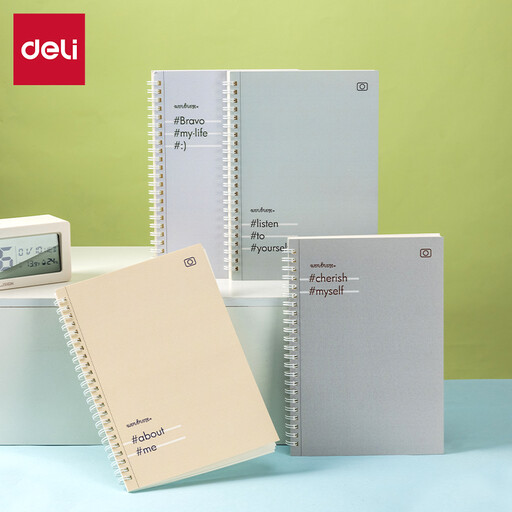
Why this choice suits this profile: A pack of four A5 notebooks lets you separate subjects, projects or personal uses without having to buy multiple notebooks individually.
The format, page count and paper weight are clearly stated: 60 sheets, 120 pages and 70 g/m² per notebook.
Easy-to-carry A5 format, spiral binding and four notebooks for organising notes at school, university or the office.
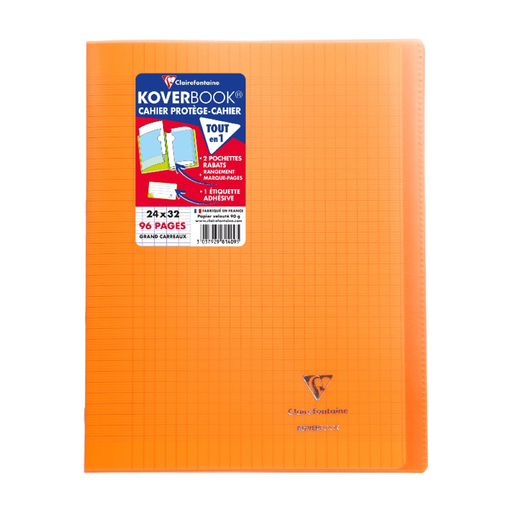
Why this choice suits this profile: Its 90 g/m² Vélin Velouté paper and protective cover make it suitable for regular use in class, at work or at home.
The polypropylene cover and two flaps help prevent wear and eliminate the need to buy a separate folder.
Large 24 × 32 cm format, 90 g/m² paper, large-square ruling and a cover with integrated storage compartments.
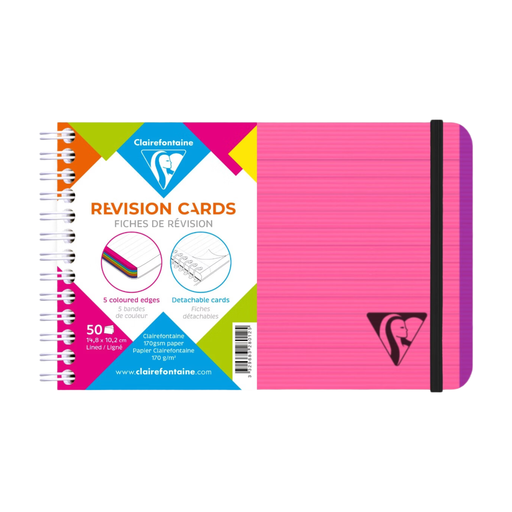
Why this choice suits this profile: This compact revision notebook slips easily into a pocket or bag. It lets you organise definitions, dates and key concepts by topic.
Its 170 g/m² paper is designed for revision cards, unlike a lightweight notebook, which may warp or wear more quickly with frequent use.
50 ruled cards, five colour-coded sections and a lay-flat opening for writing on both sides.
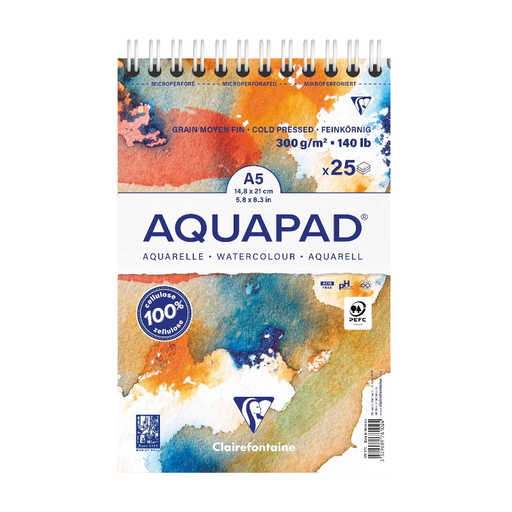
Why this choice suits this profile: This compact format is ideal for beginner and hobby artists who want to practise washes or gouache without carrying a large pad.
The 300 g/m² paper weight is clearly stated. This pad should therefore not be replaced with a standard writing notebook for wet techniques.
25 sheets, natural white cellulose, medium-fine grain, double sizing, acid-free paper and vegan composition, according to the product specifications.
Explore our updated selection of spiral-bound products to compare the formats, rulings and uses available in France.
Clairefontaine paper between 80 and 90 g/m² has a smooth surface that feels excellent with a fountain pen. The result nevertheless depends on the nib, ink flow and pressure applied. To minimise show-through, allow the ink to dry and avoid particularly free-flowing models.
Rhodia is a range from the Clairefontaine group, offering pads and notebooks in a variety of rulings, bindings and formats. When choosing, focus primarily on the format, sheet count, perforation and intended use. The Rhodia No. 20, for example, combines Seyès ruling, a 21 × 31.8 cm format and four filing holes.
It is not essential for a simple dry sketch, but becomes highly useful as soon as you work with substantial amounts of water. A 300 g/m² surface absorbs moisture more effectively than writing paper. For generous washes, secure the sheet to a board to reduce buckling.