
Livraison le jour même ou le lendemain

Qualité garantie

Débloquez vos offres de bienvenue: Livraison GRATUITE | Jusqu'à -80 % | 30 jours d'essai gratuits à JoyPlus
Téléchargez l'application
A new project, the back-to-school season, or simply the desire to organize your thoughts: buying a notebook might seem trivial. Yet, who hasn't cursed at paper that bleeds ink, a cover torn after three days in a bag, or an unsuitable ruling? Starting with a Clairefontaine notebook is an excellent choice, but faced with a jungle of options, the decision can quickly become a headache. Let's break down the essential criteria together to find the perfect writing companion.
The two most common mistakes? Underestimating the importance of paper weight and choosing an inappropriate binding. Paper that is too thin allows ink to show through, making the back of the page unusable. Similarly, a fragile binding (like simple staples on a thick notebook) is a guarantee of premature wear and tear.
Before you dive in, let's review a few technical details that make all the difference. Often overlooked, they are what determine your writing comfort and the lifespan of your notebook.
Paper weight, expressed in grams per square meter (g/m?), measures the paper's thickness and density. For context, a standard printer sheet is 80 g/m?. For optimal writing comfort, especially if you use a fountain pen or fine-liners, 90g Clairefontaine paper is the absolute benchmark. Its thickness and ultra-smooth surface, the famous "Vélin Velouté," ensure a perfect glide and prevent ink from smudging or bleeding through the page. This is the non-negotiable feature for anyone who wants to use both sides of every sheet without compromise.
The choice of size and ruling depends entirely on your use case.
The way the pages are held together determines the sturdiness and practicality of your notebook.
To help you see more clearly, we've matched user profiles with their ideal Clairefontaine notebook.
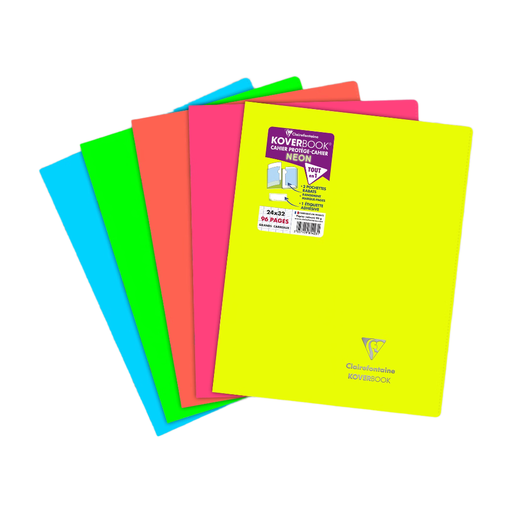
WHY IT'S A MATCH: Built to survive a full school year, this notebook combines an ultra-protective cover with the star format of the classroom. It's designed for students who are tough on their bags and demand reliable equipment.
Its polypropylene cover acts as a built-in book protector, putting an end to tears and dog-eared corners. The 90g paper handles fountain pen ink—a middle and high school classic—without flinching.
Its two large flaps serve as both a bookmark and a pocket for storing loose sheets. A remarkably practical all-in-one solution.
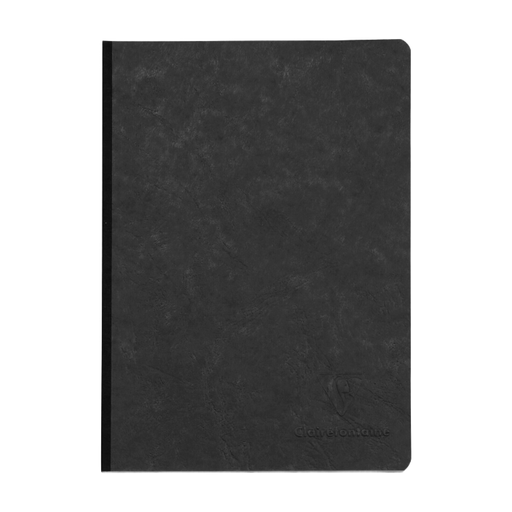
WHY IT'S A MATCH: For the professional who juggles meetings and travel, this A5 notebook strikes the perfect balance between understated elegance and efficiency. Its timeless design fits in anywhere, from the office to the airport lounge.
Its sewn binding with a cloth spine is built to last and allows for a perfectly flat opening. No more spirals snagging in your bag or glued bindings that split.
The 90g Vélin Velouté paper offers an incomparable glide worthy of a premium product. Its soft, leather-like grained cover is as pleasant to the touch as it is resistant to wear.
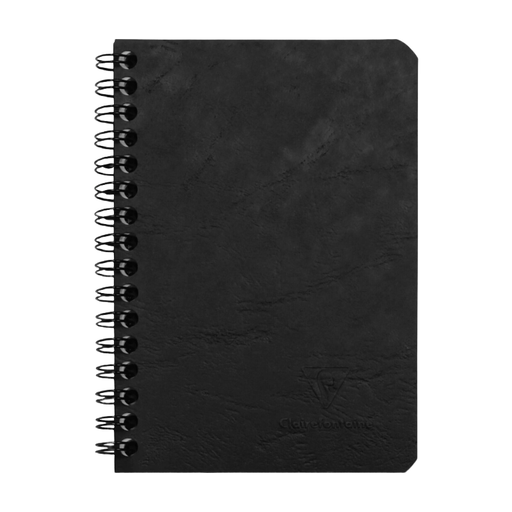
WHY IT'S A MATCH: Perfect for journaling, on-the-spot sketches, or as a travel journal. Its pocket size and hardcover provide a stable surface for writing or drawing anywhere: in a café, a park, or on public transport.
Its binding allows for a full 180° lay-flat opening, essential for drawing or writing across the entire two-page spread. No more frustration from notebooks that constantly close on your hands.
Sturdy and compact, it's the reliable companion to ensure no idea slips away. The small grid ruling offers maximum versatility for both writing and drawing.
Discover our complete selection of notebooks and journals that meet all our criteria for quality and durability.
The Seyès ruling (or French ruling) features large 8x8 mm squares, with thinner horizontal lines spaced 2 mm apart to guide the height of letters. It is primarily used in the French school system, especially for learning handwriting. The small grid notebook (or 5x5 graph) has a simple 5x5 mm grid without intermediate lines. It is more versatile and often preferred for mathematics, science, note-taking, or drawing.
90g paper offers an optimal balance of thickness, opacity, and smoothness. Unlike thinner paper (70g or 80g), it prevents almost all inks (including those from fountain pens) from bleeding through the page. This allows for comfortable use of both the front and back of each sheet, while providing a particularly pleasant writing experience.