
Livraison le jour même ou le lendemain

Qualité garantie

Débloquez vos offres de bienvenue: Livraison GRATUITE | Jusqu'à -80 % | 30 jours d'essai gratuits à JoyPlus
Téléchargez l'application
A Clairefontaine Koverbook notebook 24 x 32 cm with 96 pages can be used for just about anything: school homework, note-taking, practical work, projects or document filing. Its large notebook format offers more space than a standard A4 notebook, while its polypropylene cover reduces wear and tear over time.
However, not all models are created equal depending on your intended use. Random colour dispatch, unsuitable ruling, or a binding that isn't practical for heavy use – certain details can quickly turn a promising purchase into a false economy. Here are the points to check before you order.
The 24 x 32 cm format refers to the notebook's overall dimensions, not just the printable area. It remains particularly practical for subjects that require lengthy workings, diagrams or tables. Also remember to check that it will fit into the school bag, rucksack or drawer where you plan to store it.
A colourful cover catches the eye, but it doesn't necessarily protect the pages from scuffs, spills and repeated handling. A notebook with a polypropylene cover behaves very differently from one simply covered with laminated cardboard. Koverbook notebooks also feature two flaps, useful as bookmarks or for slipping in a few loose sheets.
A French-ruled (Seyès) notebook works well for school exercises and structured writing. A squared model is better suited to notes, tables or projects. Stapled binding holds the pages together with staples and generally allows the notebook to lie flat. However, it reaches its limits when you need to fold the pages right back or write on a very thick surface – in that case, spiral binding is often more practical.
The large 24 x 32 cm format leaves plenty of room for instructions, corrections and annotations. For primary or secondary school pupils, Seyès ruling makes it easier to keep to line spacing and margins. Some models offer three-colour ruling, with a red margin, violet lines and blue line spacing.
For professional or university use, squared notebooks are often more versatile. They work equally well for reports, lists, calculations and simple diagrams.
The Koverbook notebooks featured here use Vélin Velouté 90 g/m² paper. The paper weight is a good indicator for comparing notebooks, but it isn't enough to predict how every pen will behave. The smooth surface feels pleasant with a ballpoint pen, rollerball or pencil. With very liquid ink, however, it's worth checking the drying time and the potential risk of ink bleeding through to the next page.
The paper is stated as made in France and PEFC certified on the relevant product pages. This certification confirms responsible forest management according to the applicable standard; it does not mean that all components of the notebook come from certified forests.
Lightweight polypropylene can be cleaned with a dry or slightly damp cloth. The flaps can hold handouts, tickets, index cards or a few small documents. However, they don't replace a proper filing folder capable of holding a large quantity of paper.
To keep your notebook in good condition for longer, avoid placing sharp objects against the cover and store it away from prolonged damp. An included self-adhesive label allows you to write the name, subject or class.
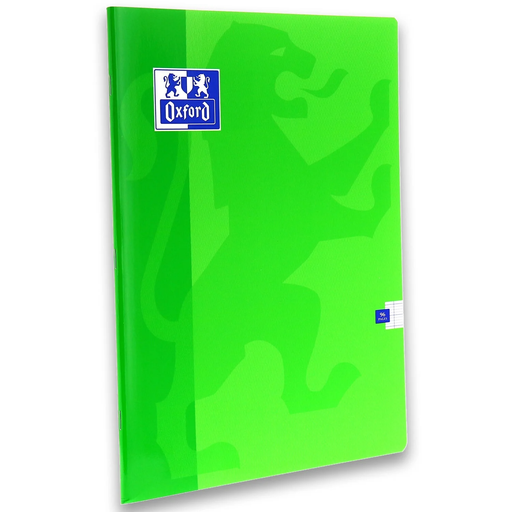
Why this choice suits this profile: This squared notebook offers the standard school format you're looking for, with a laminated cardboard cover. The colour depends on the model chosen.
The product page clearly states the format, 96 pages, Seyès ruling and stapled binding, making it easy to compare before you buy.
24 x 32 cm format, 96 pages, laminated cardboard cover and Seyès ruling.
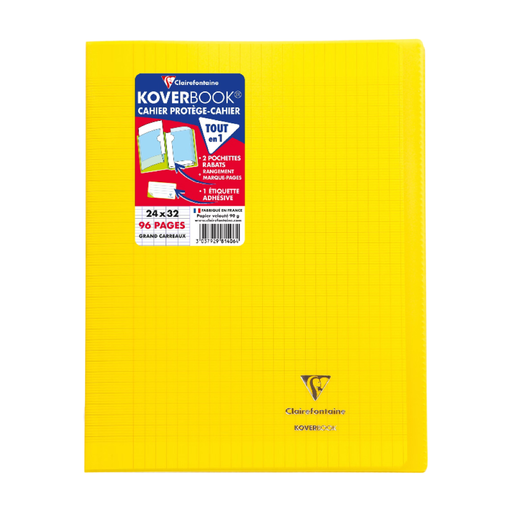
Why this choice suits this profile: It combines Vélin Velouté 90 g/m² paper with an integrated transparent polypropylene cover and two storage flaps.
Protection and storage are built in – no need to buy a separate cover and wallet for a few sheets of paper.
90 g/m² paper, polypropylene cover, two flaps and paper stated as made in France.
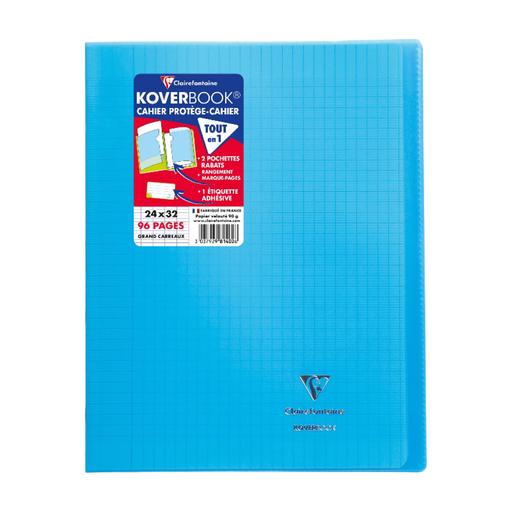
Why this choice suits this profile: Its protective cover and storage spaces are ideal for notes carried every day, shared folders and frequent note-taking.
The polypropylene limits direct exposure of the pages to scuffs, while the flaps hold documents you need temporarily.
96 pages, Vélin Velouté 90 g/m² paper, transparent cover and personalisation label.
We've selected a comprehensive, real-time updated list of products that meet these demanding criteria, as well as European safety standards.
Yes, its format and Seyès ruling match the most common school requirements. However, do check your school's guidelines, particularly regarding the number of pages, ruling type and colour requested.
The product pages indicate a stapled binding with non-detachable pages. This is practical for keeping your notes all in one place, but less suitable when you need to hand out individual sheets.
Avoid damp, repeated twisting and overloading the flaps. Clean the cover with a soft, slightly damp cloth, then let it dry before closing the notebook.