
Livraison le jour même ou le lendemain

Qualité garantie

Débloquez vos offres de bienvenue: Livraison GRATUITE | Jusqu'à -80 % | 30 jours d'essai gratuits à JoyPlus
Téléchargez l'application
A Clairefontaine Koverbook 24 x 32 cm large square notebook meets a very real need: enjoying a comfortable writing surface while protecting your notes every day. Pupils, students, teachers, parents and professionals appreciate this larger-than-standard format, paired with a durable cover and French ruling.
However, a few details can make the difference between a truly practical notebook and one that quickly ends up at the bottom of a bag.
The 24 x 32 cm format is slightly larger than an A4 sheet, which measures 21 x 29.7 cm. This extra space gives you more room for annotations, diagrams or homework, but it also takes up more space in a schoolbag or briefcase.
Before ordering, check the internal dimensions of the compartment where you plan to store the notebook. A large format is very pleasant on a desk, but it can be less practical in a small pouch.
A simple soft cover can bend, get dirty or allow the corners of the pages to become damaged. The Koverbook relies on a polypropylene cover, a plastic commonly used for school supplies and ring binders. Depending on the reference, it can be transparent, opaque or two-tone.
The integrated flaps serve both as bookmarks and as pockets for slipping in a few sheets, index cards or thin documents. However, avoid overloading them: these compartments are not a replacement for a high-capacity folder.
90 g/m² paper is thicker than lightweight school paper, but the result also depends on the writing instrument you use. Clairefontaine's Vélin Velouté paper is renowned for being smooth and pleasant for fluid writing. With a heavily inked felt-tip pen or a marker, a slight show-through may still appear.
For taking notes with a ballpoint pen, rollerball or pencil, the Clairefontaine 90 g notebook is a consistent choice. For wet drawing or painting, it is better to turn to paper specifically designed for those practices.
The term Séyès 96 pages refers to the French large-square ruling, with its horizontal lines and regular spacing. It is particularly suitable for:
Some references simply mention "large squares" or "French ruling" rather than "Séyès". Check the product description if the type of ruling is a deciding factor.
A stitched Clairefontaine notebook is assembled with staples or stitching, depending on the reference. Compact, it slips easily into a schoolbag. However, its pages are not designed to be removed regularly.
Spiral binding allows for a wider opening. Some Koverbook models open 360 degrees, a practical option for writing in a confined space or keeping the notebook next to a computer. On the downside, the binding can take up a little more room on a shelf.
A transparent polypropylene cover lets the colour or label of the notebook show through. An opaque version offers more discretion. In both cases, choose models with two large flaps with pockets if you often carry loose sheets.
The supplied self-adhesive label makes it easy to identify by subject, name, class or project. The paper is stated as PEFC certified for the relevant references, while the models indicated are made in France.
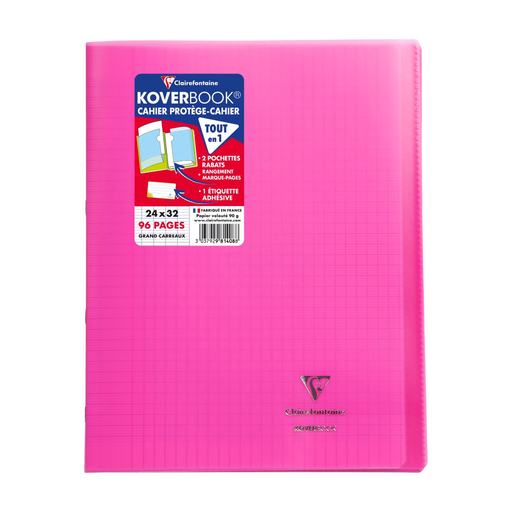
Why this choice suits this profile: A simple reference to start with, offering a large format, Séyès ruling and an integrated cover that saves you buying a separate notebook protector.
The polypropylene cover and two flaps protect the pages and reduce the need for additional accessories.
96 pages, Vélin Velouté 90 g/m² paper, customisable label and stated manufacture in France.
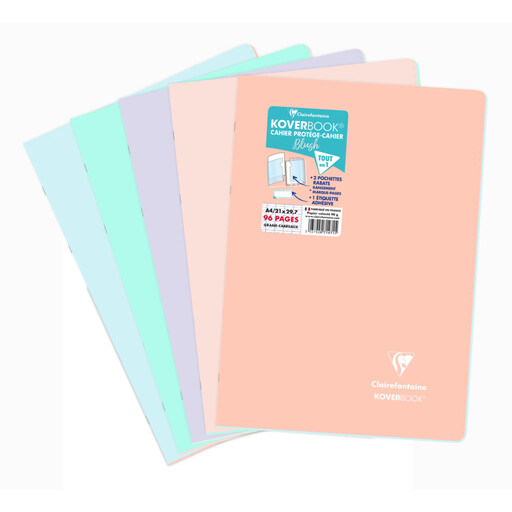
Why this choice suits this profile: Its two-tone pastel look will appeal to those who want to pay attention to presentation while enjoying integrated storage, whether in class or at the office.
The opaque cover protects your notes from prying eyes, while the integrated flaps eliminate the need for extra filing pockets.
24 x 32 cm format, Clairefontaine 90 g/m² paper, two flap pockets and pastel colour dispatched subject to availability.
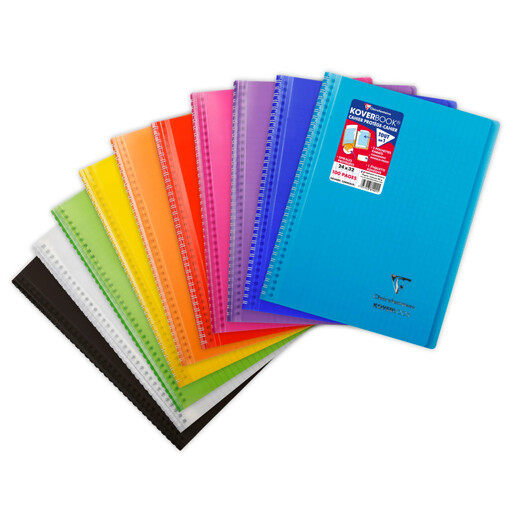
Why this choice suits this profile: Its spiral binding and 360-degree opening make intensive note-taking easier, whether in meetings, training sessions or on a cramped desk.
The cover also protects the spiral, while the integrated pockets allow you to keep project-related documents close at hand.
100 pages, 360-degree opening, 90 g/m² paper and two flaps for marking or storing sheets.
We have selected a comprehensive, real-time updated list of products that meet these exacting criteria, while complying with European safety regulations.
It can fit into many schoolbags, but it is larger than A4. Measure the pocket reserved for notebooks before buying, especially if it is reinforced or compartmentalised.
The stitched model is generally more compact and suitable for regular classes. The spiral makes it easier to open flat and write on both sides, which can be handy for frequent note-taking or working at a desk.
It all depends on how it is transported, the weight placed on it and how you use the flaps. A polypropylene cover withstands everyday wear and tear better than a paper cover, but it should be kept away from high heat, sharp objects and prolonged dampness.