
Livraison le jour même ou le lendemain

Qualité garantie

Débloquez vos offres de bienvenue: Livraison GRATUITE | Jusqu'à -80 % | 30 jours d'essai gratuits à JoyPlus
Téléchargez l'application
A Clairefontaine Koverbook 24 x 32 cm notebook meets a very specific need: enjoying a generous writing surface while protecting your notes, homework or documents slipped between the flaps. This format is suitable for pupils, students, teachers and professionals who find an A4 notebook too restrictive for diagrams, annotations or lessons.
However, certain details can turn a carefully considered purchase into something that is ultimately impractical. Here are the key points to check before choosing your large-format notebook.
A coloured or transparent cover does not, by itself, guarantee effective protection. Instead, look at its material and design. Polypropylene will generally withstand everyday handling better than a thin paper cover. However, it can become scratched if it rubs against metal objects or sharp edges.
The Koverbook stands out with its integrated transparent cover and two large flap pockets. They can be used to store loose sheets, cards, tickets or a few writing tools, and can even serve as a bookmark. There is no need to add a separate folder to your bag every time.
A 96-page notebook is about more than just its thickness. The paper weight, ruling and binding type all affect how comfortable it is to use.
Clairefontaine 90 g/m² Vélin Velouté paper provides an especially smooth writing surface. This is a valuable feature when using a fountain pen, rollerball or liquid-ink pen. However, the result will still depend on the amount of ink applied and how long it takes to dry. It is therefore better to check compatibility with the writing instruments you normally use rather than relying on an overly general promise.
A staple-bound notebook keeps its pages together in a compact block. A spiral-bound notebook, on the other hand, makes it easier to open flat and sometimes to 360°. The right choice mainly depends on how you write and carry your notebook.
Staple binding is suitable for lessons followed in order, homework and conventional note-taking. Spiral binding is more practical when using the notebook on a small table or folding the back pages over. The trade-off is that the wire may take up more space in a bag.
The 24 x 32 cm format offers greater width and height than an A4 sheet, including additional margin space at the sides. This extra room can be useful for annotations, corrections and diagrams.
However, remember to check the internal dimensions of your school bag or backpack. A large-format school notebook will not necessarily fit into pockets designed for a smaller model.
Séyès ruling, often referred to as ‘large squares’ in the French school context, combines horizontal lines with a regular grid. It is suitable for handwriting, exercises and structured note-taking.
Before ordering, check the wording on the product page carefully. Some Koverbook references are described as ‘French ruled’, while others explicitly mention Séyès or large-square ruling. This check helps you avoid receiving a model that does not match either your school’s requirements or your usual writing style.
A transparent polypropylene cover allows you to identify the notebook’s contents quickly and personalise it using the adhesive label provided. The integrated pockets can hold a few documents, but they do not replace a folder when you need to carry a large number of sheets.
To extend the notebook’s lifespan, clean the cover with a dry or slightly damp cloth. Avoid sharp objects and prolonged exposure to moisture.
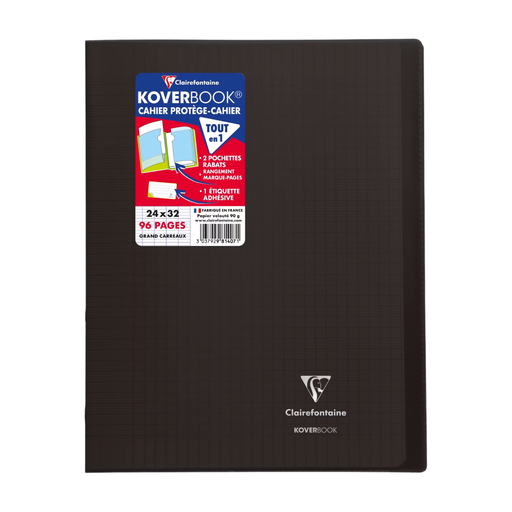
Why this choice suits this profile : It includes everything you need in a large-format school notebook, with a protective cover and practical storage space.
The polypropylene cover and two flaps mean you do not need to buy separate protection straight away.
96 pages, 90 g/m² Vélin Velouté paper, staple binding and personalisation label.
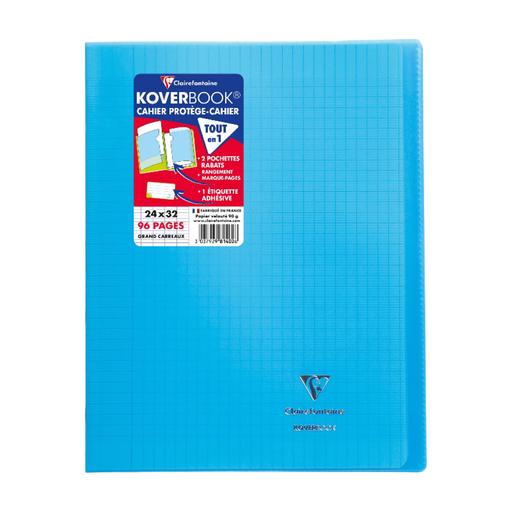
Why this choice suits this profile : It combines 90 g/m² paper, a refined design and integrated storage, making it equally suitable for lessons and professional documents.
The product page clearly states the format, paper weight and binding, allowing you to compare references on a practical basis.
Clairefontaine 90 g/m² paper, protective transparent cover, two flap pockets and stated French manufacture.
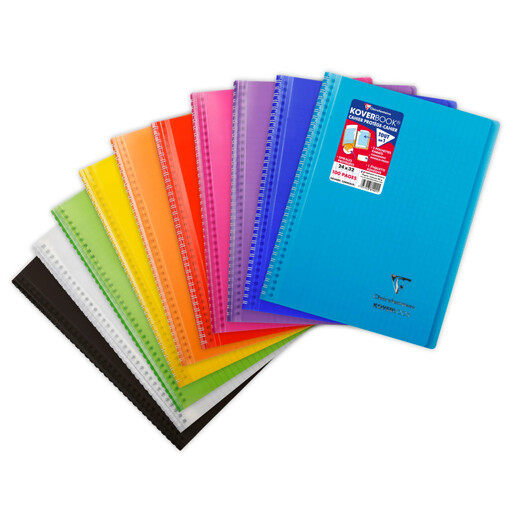
Why this choice suits this profile : Its 360° opening is ideal for frequent note-taking, meetings and anyone writing in confined spaces.
The wraparound cover also protects the spiral area, which is particularly exposed to rubbing inside a bag.
24 x 32 cm format, 100 pages, 90 g/m² paper, two flap pockets and advertised flat opening.
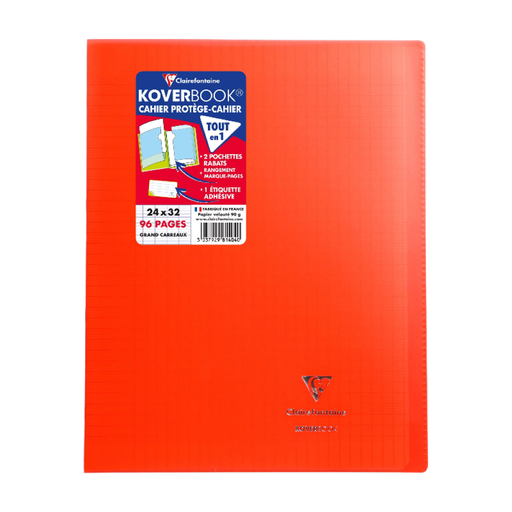
Why this choice suits this profile : Séyès ruling is suitable for school notebooks, exercises and the guided handwriting required in many schools.
The ruling type is specified on the product page, reducing the risk of choosing an unsuitable grid.
96 pages, transparent polypropylene cover, two pockets and adhesive label.
We have put together a complete, real-time updated list of products that fully meet these strict selection criteria and European safety regulations.
To minimise wear, store the notebook flat or upright, without pressing it against books with rigid corners. The flaps are designed to hold a few sheets and bookmarks, but avoid overloading them. A label showing the name, material or project makes it easier to organise your notebooks when several are the same colour.
If you use a fountain pen, allow the ink to dry before closing the flaps. The 90 g/m² paper provides a pleasant writing surface, but no paper weight can make a sheet completely waterproof against every type of ink.
It is larger than a standard notebook and slightly bigger than A4. Measure the inside pocket of your school bag before buying, taking the thickness of the cover and binding into account.
The staple-bound model forms a compact block, making it suitable for working through pages in order. The spiral model can open flat or to 360°, making it easier to write in a confined space. Check the product page to confirm the page count and ruling of the reference you have chosen.
No. They are designed for a few sheets, notes or small accessories. To carry a set of documents, a separate folder or ring binder remains more suitable.