
Livraison le jour même ou le lendemain

Qualité garantie

Débloquez vos offres de bienvenue: Livraison GRATUITE | Jusqu'à -80 % | 30 jours d'essai gratuits à JoyPlus
Téléchargez l'application
A large exercise book should be able to follow its owner between home, school and the office, while remaining pleasant to use every day. However, some details highlighted in product descriptions do not necessarily match the real needs of pupils, students, parents or professionals.
Before buying a Clairefontaine Koverbook exercise book 24 × 32 cm, 96 pages, take the time to check three things: the exact size, the type of cover and the binding. These criteria directly affect the protection of the sheets, writing comfort and the exercise book’s lifespan.
An A4 exercise book generally measures 21 × 29.7 cm. At 24 × 32 cm, the larger school format offers more room: it leaves a wider margin around the ruling, which can be useful for annotating lessons, sticking in documents or writing headings. On the other hand, it takes up more space in a bag and may not fit into some compartments designed for A4 items.
So, check the dimensions carefully before ordering, particularly if the exercise book needs to fit in a compact schoolbag.
A classic transparent cover protects the exercise book, but it does not necessarily include pockets. The Koverbook combines the exercise book and its protection with a transparent polypropylene cover featuring two large flaps. These can be used as page markers or to hold sheets, revision cards and small documents temporarily.
This system avoids the need for several separate folders, but it does not replace a document wallet if you need to carry a large quantity of papers.
90 g/m² paper can feel pleasant to write on, but writing comfort also depends on its surface and the ink being used. Clairefontaine’s 90 g Velin Velouté paper is described as smooth and conducive to fluid writing. However, the result may vary depending on the pen, felt-tip pen or marker used.
For standard school use, ballpoint pens, rollerballs and pencils are generally easier to control than heavily inked felt-tip pens.
The Séyès large-square exercise book is perfectly suited to taking school notes in France. Its ruling helps keep handwriting aligned and maintain consistent line spacing, particularly in primary school and collège. Some Koverbook models use French Séyès ruling, while other references may offer a different layout.
Before placing your order, check that the product description mentions “Séyès” if this is required by the school.
Polypropylene is a lightweight plastic commonly used to protect school stationery and documents. On the Koverbook, the transparent cover is integrated directly into the exercise book. It allows the colour or personalised label to show through, while helping to protect the outer pages from dirt.
For cleaning, a dry or slightly damp cloth is sufficient. Avoid sharp objects and prolonged contact with moisture, as these could scratch or distort the cover.
The Clairefontaine stitched exercise book is assembled using staples. This relatively slim design is suitable for lessons, reports and notes organised by subject. However, the pages cannot be removed: if you need to take pages out regularly, a spiral binding will probably be more practical.
Spiral models can open through 360°, but they may not meet the requirements of someone looking for a stitched 24 × 32 cm, 96-page exercise book. The best binding therefore depends mainly on how you take and organise your notes.
A 96-page exercise book allows you to follow a subject or project for a fairly long period without reaching the weight of a very thick pad. The Koverbook product descriptions listed mention 90 g/m² paper, manufacture in France and PEFC certification for the relevant references. This certification concerns the sustainable management of the forests from which the paper’s raw material comes; it does not mean that the exercise book is entirely recyclable or free from plastic.
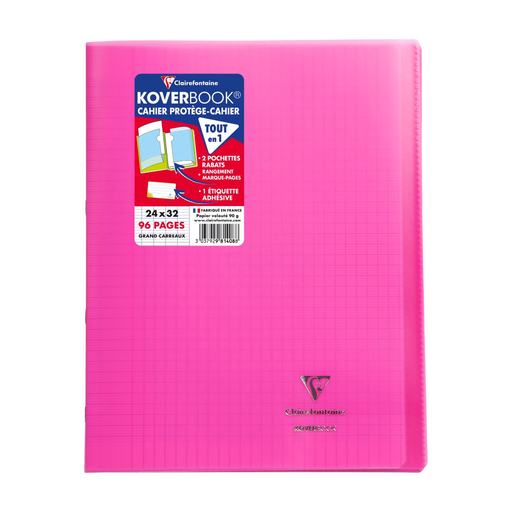
Why this choice suits this user: This model combines Séyès ruling, a transparent cover and two storage flaps in a familiar school format.
The cover and pockets are integrated, so there is no need to buy separate protection.
96 pages, 90 g Velin Velouté paper, stitched binding and a customisable self-adhesive label.
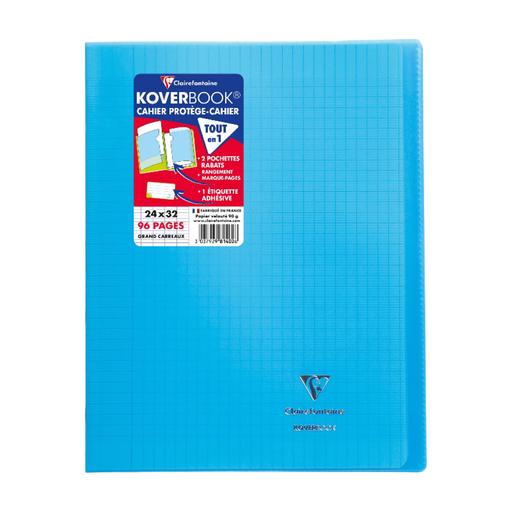
Why this choice suits this user: Its format and finish are aimed at those who value a polished presentation for lessons, files or meetings.
The detailed specifications make it possible to check the format, ruling, paper and binding before ordering.
Polypropylene cover, two flaps, 90 g/m² paper, stated PEFC certification and made in France.
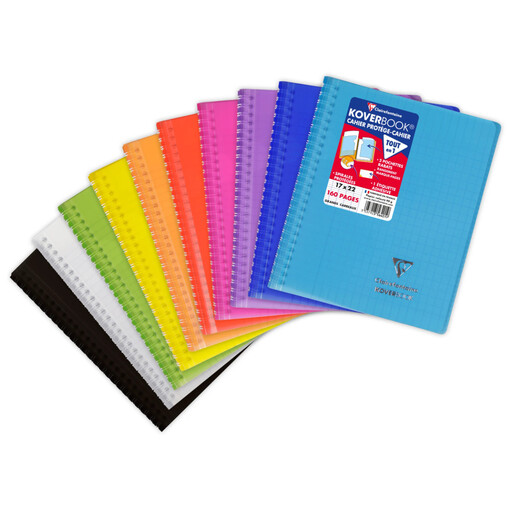
Why this choice suits this user: Its spiral binding and 360° opening are ideal for frequent note-taking, workbooks and use on the go.
The spiral meets the need for a notebook that opens completely flat, unlike a stitched exercise book whose pages remain attached.
160 pages, transparent polypropylene cover, two flaps and 90 g Velin Velouté paper.
We have put together a complete, real-time updated selection of products that meet these exacting criteria, as well as European safety standards.
Yes, this 24 × 32 cm school exercise book provides a larger writing area than an A4 exercise book. However, check the teacher’s requirements and the dimensions of the schoolbag.
No. The two flaps are mainly designed to store a few sheets, page markers or notes. They are not intended for carrying a large pile of documents or bulky items.
Store the exercise book flat or upright in a sufficiently wide compartment. Avoid moisture and clean the cover with a soft cloth. If you use felt-tip pens, test them on a page first to check the result and reduce the risk of ink transferring.