
Livraison le jour même ou le lendemain

Qualité garantie

Débloquez vos offres de bienvenue: Livraison GRATUITE | Jusqu'à -80 % | 30 jours d'essai gratuits à JoyPlus
Téléchargez l'application
An envelope might seem like a simple stationery item. Yet choosing the wrong size, weight or closure can crease your documents, make preparing mail more fiddly, or leave an unprofessional impression. Whether it's a personal letter, an invoice, an invitation or a business file, Clairefontaine envelopes come in a range of sizes and finishes – so it's worth comparing before you order.
An envelope that's too small means you have to fold the contents more than necessary. On the other hand, an oversized model lets the document shift around during transit. The smart approach is to start with what you're putting inside:
Not all white envelopes offer the same opacity or durability. Paper that's too thin can let the contents show through or warp more easily. For everyday use, 90 gsm paper is a good benchmark: it strikes a nice balance between stiffness, weight and postage cost.
Texture matters too. A smooth surface makes writing and printing easier, while laid paper brings its characteristic lines and a more traditional look.
Gummed envelopes are sealed by moistening the adhesive strip before folding down the flap. They work well for occasional preparation, especially for invitations and letters where you want to add a personal touch.
Self-seal envelopes, also known as peel-and-seal envelopes, are closed by removing a protective strip and pressing the flap down. This is the quickest solution for bulk mailings, invoices or association correspondence. Just make sure the protective strip is intact and store the envelopes in a dry place.
Check the dimensions in millimetres rather than relying solely on the commercial name. A DL envelope typically measures 110 × 220 mm, while a C6 envelope measures 114 × 162 mm. For unfolded documents, the C4 size of 229 × 324 mm leaves enough room for an A4 sheet measuring 210 × 297 mm.
Paper weight refers to the weight of the paper per square metre. It's not the only factor in envelope quality, but it does help you compare different options. The Clairefontaine models featured here use 90 gsm, while some LALO envelopes come in 100 gsm with a laid finish.
For formal correspondence, a laid texture or lined paper can add a touch of elegance. For bulky documents or mailings that need to withstand handling, kraft envelopes offer a brown surface and a structure suited to unfolded sheets.
Where stated, the FSC label means the fibres come from forests managed according to responsible forestry criteria. The PEFC certification also covers sustainable forest management, under its own framework.
Several Clairefontaine references in this selection are described as envelopes made in France, with manufacture attributed to PAPETERIES SILL. Just be careful not to confuse this with an environmental certification: the first refers to the place of manufacture, while the second tells you about the origin or management of the raw materials.
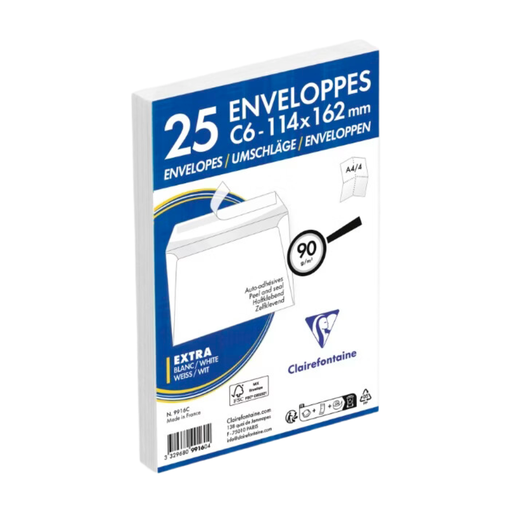
Why this choice suits this profile: The C6 size works well for short letters, cards and invitations. The pack of 25 envelopes gives you a few spares without having to buy a large quantity.
The dimensions are clearly stated and the capacity matches an A4 sheet folded into four, which helps prevent size mistakes.
90 gsm paper, white shade, self-seal closure with silicone strip protection and FSC certification stated.
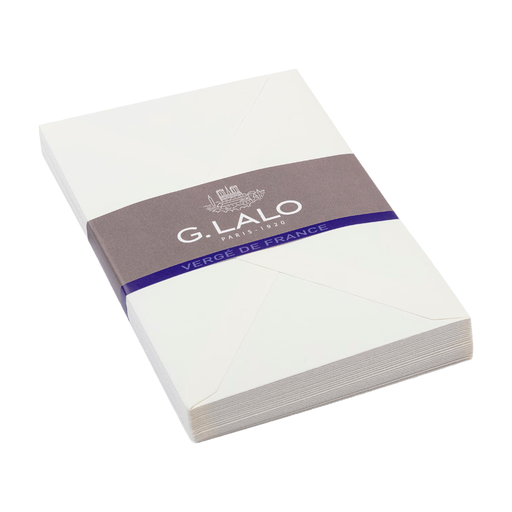
Why this choice suits this profile: The laid texture and 100 gsm weight give a more refined look to invitations, menus, thank-you cards and personal correspondence.
The product page specifies the C6 size, paper weight and gummed flap, so you won't mistake a decorative finish for a self-seal closure.
French white laid paper at 100 gsm, visible texture and a surface described as suitable for printing.
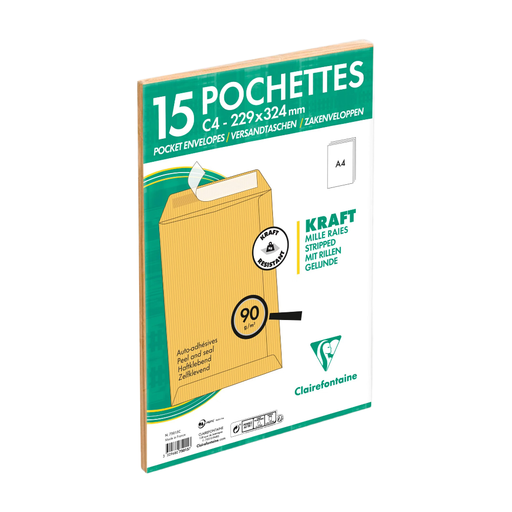
Why this choice suits this profile: The C4 size takes an A4 sheet without folding. It's ideal for files, reports, posters, artwork and documents that need to stay perfectly flat.
The size is designed to hold an A4 sheet without folding, and the virgin-fibre kraft paper is described as tear-resistant.
We've put together a comprehensive, real-time selection of products that meet these strict criteria, as well as European safety requirements.
For an A4 sheet folded into three, choose a DL envelope measuring 110 × 220 mm. If you're folding the sheet into four, C6 size usually works. When the document needs to stay flat, go for a C4 envelope instead.
A gummed envelope is sealed by moistening the adhesive strip. A self-seal envelope has a protected strip that you simply peel off before folding down the flap. The latter is generally quicker to prepare when you have lots of mailings.
Store them flat, in a dry place away from moisture and direct heat. This helps preserve the paper, reduces the risk of warping and prevents the gummed or self-seal strips from activating prematurely.