
Livraison le jour même ou le lendemain

Qualité garantie

Débloquez vos offres de bienvenue: Livraison GRATUITE | Jusqu'à -80 % | 30 jours d'essai gratuits à JoyPlus
Téléchargez l'application
A Clairefontaine 24 x 32 cm large-square notebook offers more space than a standard A4 notebook. It’s suitable for homework, note-taking, diagrams and any work that calls for a generous margin. But a few easily overlooked details can turn a carefully considered purchase into the wrong choice after just a few weeks.
Here are the points to check before choosing a large-format school notebook, along with a selection of models for different needs.
The 24 x 32 cm measurements refer to the notebook, cover included. The usable writing area depends on the margin, ruling and cover design. A model with flaps may be slightly thicker, but it often makes it easier to keep loose sheets together.
A soft paper cover may be fine for occasional use, but it creases and scuffs more easily in a full bag. A polypropylene-covered notebook offers better protection against rubbing and minor splashes. Keep in mind, though, that a simple protective cover doesn’t offer the same storage options as a model with flaps or built-in pockets.
A 96-page notebook won’t suit the same needs as a 48-page model or a 100-page spiral-bound notebook. For a subject you’ll be studying over several weeks, a 96-page Clairefontaine notebook means you won’t have to keep switching notebooks. For a subject you study less often, a slimmer model may be more comfortable to carry.
In France, Seyès ruling is very common in primary and secondary schools. It combines horizontal and vertical lines with a coloured margin. Some Clairefontaine models use three-colour Seyès ruling, with a red margin, purple lines and blue spaces between the lines.
Product listings may therefore use “large squares” and “Seyès ruling” to describe the same grid layout. Even so, check the product details, as the design can vary between ranges. A 24 x 32 cm Seyès-ruled notebook is particularly suitable for essays, French exercises, maths and structured note-taking.
The 90 gsm figure refers to the weight of the paper per square metre. It doesn’t guarantee that two notebooks will feel exactly the same to use, but it’s a useful indication of the paper’s substance.
The models featured here use 90 gsm Vélin Velouté paper, which the brand describes as smooth and suitable for writing. It feels pleasant to write on with a ballpoint pen, rollerball or pencil. If you’re using very inky felt-tip pens, though, it’s best to try them on one page first: the result depends a lot on the pen.
A Clairefontaine staple-bound notebook is held together with staples or stitching, depending on the model. It’s usually compact and easy to store with your other school supplies. A spiral binding, meanwhile, makes it easier to open the notebook flat or fold it back 360°, but it can take up more room in a pencil case or bag.
Built-in flaps let you mark a page or temporarily store a few documents. They may not replace a document wallet if you need to carry several sheets.
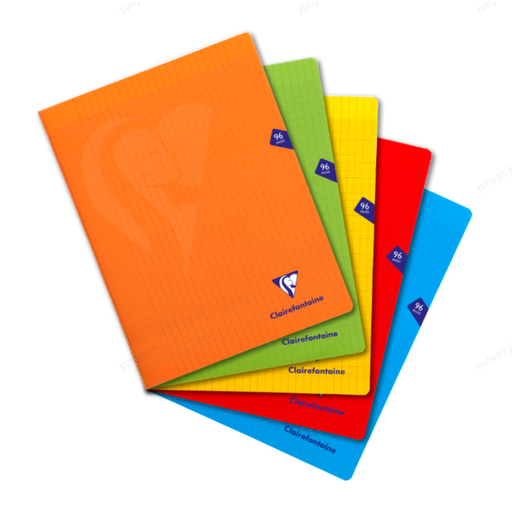
Why it suits this type of user: This pack of five notebooks lets you keep different subjects separate or stock up for the school year in one purchase.
The polypropylene cover means you won’t need to add a separate protector, while the five colours make it easy to identify different subjects.
Pack of 5 notebooks, 96 pages per notebook, 24 x 32 cm format, 90 gsm Vélin Velouté paper and made in France, according to the product listing.
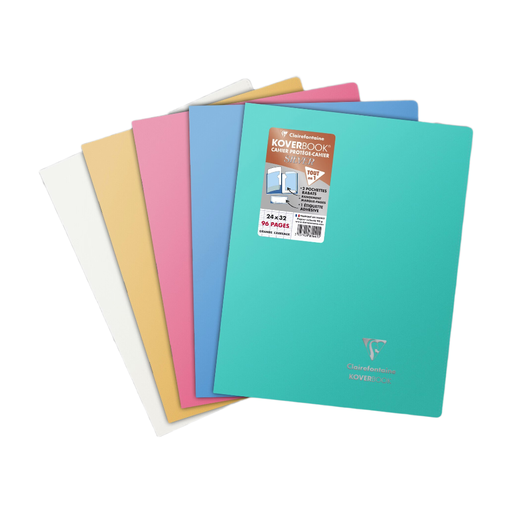
Why it suits this type of user: This model combines a metallic finish with practical organisation, making it a good choice for students, professionals and anyone who values quality craftsmanship.
The two generous built-in flaps let you store documents or mark pages, without having to carry an extra folder.
Opaque polypropylene cover, 96 pages, 90 gsm Vélin Velouté paper, adhesive label and large-square ruling, according to the product listing.
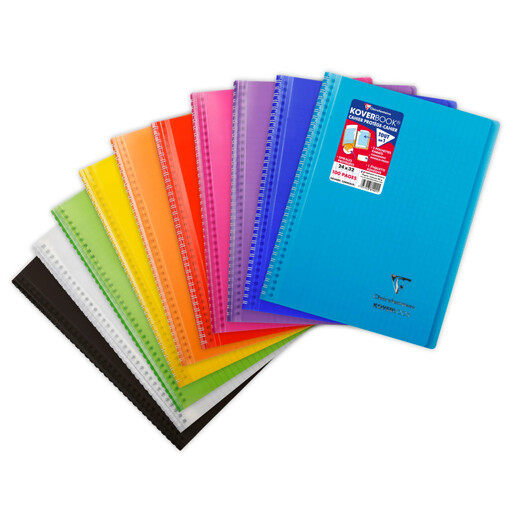
Why it suits this type of user: The 360° opening makes it easier to take lots of notes, make corrections and refer to the notebook while it’s lying flat.
The transparent cover also protects the spiral, while the two flaps hold useful sheets without the need for extra accessories.
100 pages, spiral binding, 360° opening, polypropylene cover, two flaps and 90 gsm Vélin Velouté paper.
We’ve put together a comprehensive selection, updated in real time, of products that meet these selection criteria and the requirements of European safety regulations.
It depends on how many pages you use, how often you carry the notebook and how much strain is put on the binding. A polypropylene cover generally withstands scuffs better than a paper cover, but it won’t necessarily hold up to heavy wear or prolonged exposure to moisture.
In French school supplies, Seyès ruling is a grid with spaces between the lines and a margin, often called “large squares”. If a product listing isn’t clear, it’s best to check the images and technical details.
A Clairefontaine notebook multipack can be a good choice for several subjects, for a family or when getting ready for the new school year. Before comparing prices, though, check the page count, colour — which may sometimes be selected at random — and ruling to make sure they suit your needs.