
Livraison le jour même ou le lendemain

Qualité garantie

Débloquez vos offres de bienvenue: Livraison GRATUITE | Jusqu'à -80 % | 30 jours d'essai gratuits à JoyPlus
Téléchargez l'application
Smartphones, GPS, tablets for the kids, dashcams… Your car's single cigarette lighter socket has become a major bottleneck on the open road. You're looking for a solution, but the market for cigarette lighter splitters feels like a minefield: inflated power claims, risks to your devices, and confusing compatibility. As product experts, our mission is to help you see things clearly and make an informed decision, cutting through the marketing jargon.
Before you rush into a purchase, watch out for these 3 common and costly traps for drivers:
To find a reliable model that's truly suited to your needs, focus on these three technical points. They matter far more than any marketing claim.
Power is the name of the game. Don't be fooled by the total number on the box. What really counts is the maximum power per port.
The right port, paired with the right protocol, is what separates a full charge in 40 minutes from a battery that barely moves for hours.
Often overlooked, these details make all the difference in terms of durability and everyday convenience.
Instead of an endless list, we've selected models that meet specific user profiles, based on the objective criteria discussed above.
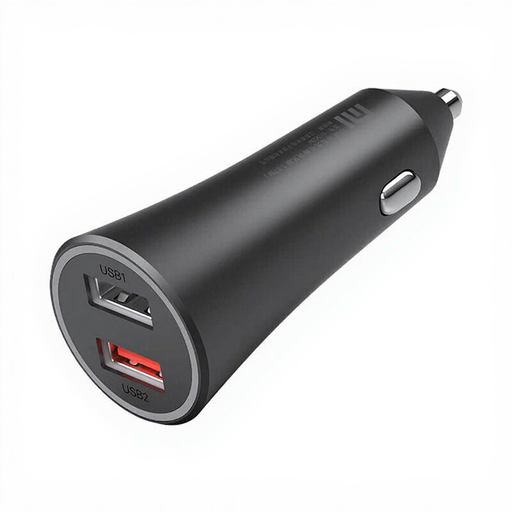
Why we love it: Perfect for those who just want to quickly charge their phone and a second device (GPS, headphones) without cluttering the dashboard. Its metal design is both discreet and robust.
It makes no empty promises about total power. It offers a clearly identified red port for fast charging (up to 27W), which helps avoid the "fake fast charging" trap if your device is compatible.
Its compact and elegant all-metal design. Its universal 12V-24V compatibility makes it equally at home in a city car or a heavy-duty truck.
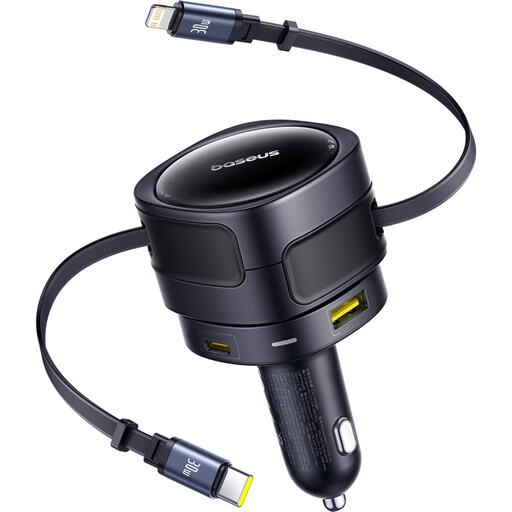
Why we love it: The perfect ally for long family trips, when you need to power an iPhone, an Android smartphone, the kids' tablet, and other devices all at once. No more forgotten or tangled cables thanks to its integrated retractors.
It bypasses the headache of incompatible protocols by offering dedicated outputs: one Lightning cable (30W), one USB-C cable (30W), one USB-C port (30W), and one USB-A port (30W). The power is clearly distributed, with no nasty surprises.
Two retractable cables (USB-C and Lightning) plus two additional ports for unbeatable versatility. Its 90W total output allows you to fast-charge up to 3 devices simultaneously.
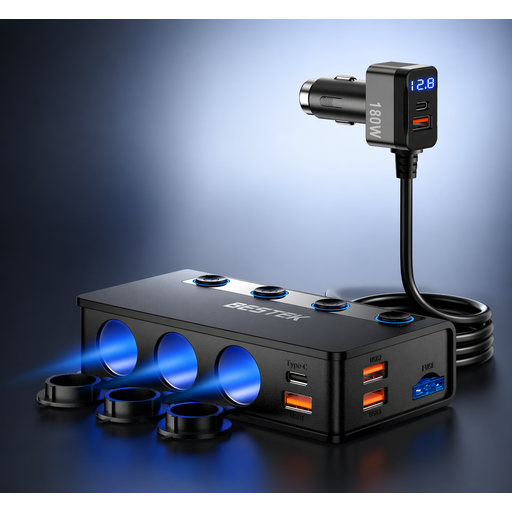
Why we love it: Indispensable for ride-share drivers, delivery professionals, or operators of heavy-duty trucks and camper vans. It can continuously power pro equipment (pro GPS, dashcam, electric cooler) while charging multiple personal devices, including a laptop.
It directly tackles the risk of a dead battery thanks to its independent switches. Its colossal 180W output is designed for heavy use, distributed across 3 sockets and 6 USB ports, including a 65W PD port dedicated to laptops.
A true 9-in-1 power station. It combines a 180W total output, a 65W USB-C PD port for laptops, and individual switches for each socket.
We have compiled a complete and up-to-date selection of products that meet our demanding selection criteria and UK/EU safety standards.
1. Can a cigarette lighter splitter drain my car battery? Yes, and it's a classic trap. In many vehicles, the cigarette lighter socket remains powered even when the ignition is off. If you leave a charger plugged in (even without a device connected, as it has a parasitic draw), it can slowly drain your battery. The solution? Choose a model with independent switches or, even simpler, get into the habit of unplugging it after each trip.
2. How do I know if a splitter is compatible with my truck (24V)? This is crucial information that must be stated in black and white in the technical specifications. Look for the "Input: DC 12V-24V" label. Never use a charger marked only "12V" in a 24V vehicle (heavy-duty truck, bus): you risk frying the charger, your devices, and damaging the vehicle's electrical system.
3. What wattage is needed to charge a laptop in the car? To efficiently charge a modern laptop (MacBook, Dell XPS, etc.), a USB-C port with Power Delivery (PD) is non-negotiable. The required wattage varies, but consider 45W a strict minimum. For a comfortable and fast charge, aim for a port that delivers 65W or more. The easiest way to be sure is to check the wattage printed on your laptop's original power adapter.