People keeping an eye on declared sugar content
You want to compare a Christmas meal accompaniment without confusing a figure in the nutritional information with a “reduced sugars” claim.


For a Christmas meal, don’t choose green beans based solely on the claim “reduced sugars”. Compare the “of which sugars” figure per 100 g and check any claim on the exact product. Ready-cooked tinned beans make serving them quickly easier; frozen beans need freezer space and time to cook. In either case, check the salt content too, along with how many beans you’ll be able to serve.
You want to compare a Christmas meal accompaniment without confusing a figure in the nutritional information with a “reduced sugars” claim.
You need to choose between ready-cooked green beans, which can be served cold or reheated, and frozen beans, which need space in the freezer and time to cook.
You check the ingredients and the “salt” figure, and, for tinned beans, the drained weight to estimate how much you can serve.
First choose a format that suits your meal preparation, then compare the nutritional information and usable quantity across the products you’re considering.
| Criteria | What to check | Who it matters to |
|---|---|---|
| Sugars and claims | Compare the “of which sugars” figure per 100 g across similar products. If you’re specifically looking for the “reduced sugars” claim, check that it appears on the exact product. | I want to know the declared sugar content of the accompaniment without mistaking a low figure for a claim. Around 40% of consumers prioritise this distinction. |
| Meal preparation | Check whether the beans are ready-cooked or need cooking, along with the preparation and storage instructions for the product you’ve chosen. | If I need to serve them quickly, I prefer to plan the preparation time while I’m shopping. This is the top priority for around 40% of consumers. |
| Salt and portions | Read the “salt” figure and the ingredients; for tinned beans, use the drained weight to estimate portions. | When I’m serving a large group, I want to know what’s in the product and how much will end up on people’s plates. Around 20% of consumers put these factors first. |
The “of which sugars” figure gives nutritional information; on its own, it doesn’t confirm that the product carries this claim. The DGCCRF distinguishes between nutrition claims and nutritional information.
Check the exact wording on the packaging or the manufacturer’s product page, then compare figures per 100 g across similar products.
The Bonduelle and Auchan product pages cited for different tinned and frozen products also show varying salt levels. Sugar content alone therefore doesn’t tell you everything about a product’s composition.
Read the “of which sugars” and “salt” figures together, along with the ingredients list for the product you’re planning to buy.
The total weight may include the liquid in the tin. For the 800 g Bonduelle tin shown by the brand, the stated drained weight is 440 g.
Where it’s stated, use the drained weight to work out how much you’ll have for your meal.
A bag of frozen beans needs to be stored according to the instructions on its packaging until you’re ready to prepare it. The Joybuy product page for Bonduelle 750 g says to store it at −18 °C and not to refreeze it after defrosting.
Check you have room in the freezer, and read the storage instructions and cooking time before adding the bag to your meal plan.
The brand offers tinned and frozen green beans. Check the format before comparing their nutritional information.
The retailer’s product pages let you compare extra-fine tinned beans with a 1 kg bag of POUCE frozen beans.
The Carrefour Bio product checked is a 600 g bag of very fine frozen green beans, which should be cooked without defrosting first.
The ALDI product page checked lists a 280 g tin from Fleurs des Champs, a size worth considering if you only need a small amount.
This selection includes a 440 g Bonduelle product to consider for quick serving, bags that need to be kept in the freezer, and a HÜNKAR mix that also contains tomatoes. Check the exact product before choosing one for your menu.
 Image unavailable
Worth considering if you’d prefer green beans that are ready to serve cold or reheat. The listed pack size is 440 g; check the “of which sugars” figure and the instructions for storage after opening on the exact product.
 Image unavailable
Worth considering if you have room to store and cook a bag of frozen beans for your meal. The Joybuy product page lists a 750 g pack, storage at −18 °C and says not to refreeze after defrosting; it also warns that traces of celery may be present.
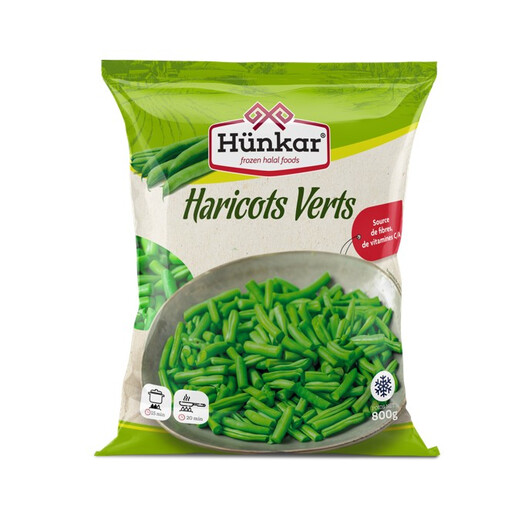 Image unavailable
The 800 g pack could provide several portions. If you choose it for Christmas, check the pack for cooking instructions and how it needs to be stored.
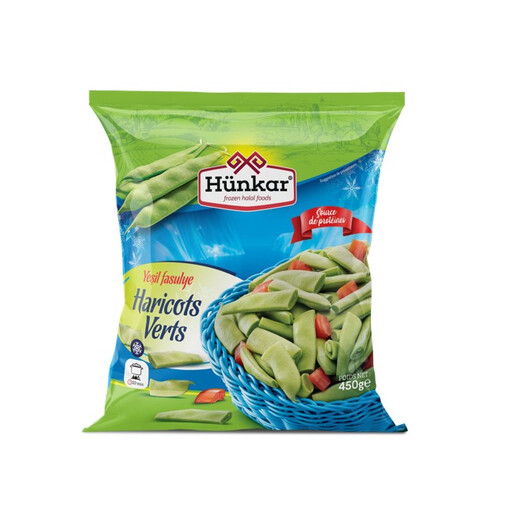 Image unavailable
Consider this if tomatoes suit the accompaniment you have in mind: the product information states that the 450 g pack contains 93% green beans and 7% tomatoes. It isn’t a bag of green beans on their own, so check the preparation instructions too.
No. The “of which sugars” figure alone doesn’t prove that a product carries a “reduced sugars” claim. The DGCCRF distinguishes nutrition claims from the figures in the nutrition table, so check the wording on the exact product if this claim is influencing your purchase.
A tin of ready-cooked beans is suitable if you want to serve them cold or reheat them; Bonduelle recommends reheating its extra-fine tinned beans for two minutes. A bag of frozen beans needs freezer space and the cooking time specified for that product.
Follow the instructions for the exact product. For its extra-fine tinned beans, Bonduelle recommends storing them at a maximum of 4 °C and eating them within 48 hours of opening. The Joybuy product page for the 750 g bag of Bonduelle frozen beans says to store it at −18 °C and not to refreeze it after defrosting.
Yes. If your choice depends on the sugar, salt or ingredients, check the information for the product you’re ordering. Auchan says that the composition of some products may vary depending on the collection point and purchase date.