Anyone making the sauce for Christmas dinner
A tin of tomatoes with no added salt lets you choose the herbs and how much salt to add as you cook. Still, check the ‘salt’ figure on the packaging: ‘no added salt’ doesn’t mean ‘salt-free’.


For Christmas meals, a ready-made sauce saves you having to cook a tomato base, as long as you compare the salt content per 100 g before buying. If you’d rather season it yourself, choose tomatoes with no added salt for cooking: passata or chopped tomatoes take more preparation and may still contain a little naturally occurring salt.
A tin of tomatoes with no added salt lets you choose the herbs and how much salt to add as you cook. Still, check the ‘salt’ figure on the packaging: ‘no added salt’ doesn’t mean ‘salt-free’.
A ready-cooked tomato sauce saves you having to prepare a base. To find an option that suits you for salt content, compare the ‘salt’ value per 100 g across sauces in the same category, rather than relying on the recipe name alone.
The weight of the jar or tin helps you work out how much you’ll need. Also think about any leftovers: storage instructions after opening depend on the product you buy.
For your Christmas food shop, start by comparing the salt content per 100 g. Then choose between a ready-made sauce and tomatoes for cooking, depending on how much preparation time you have and how many portions you need.
| What to consider | What to check | Who is it for? |
|---|---|---|
| Controlling salt | The ‘salt’ value per 100 g and, where applicable, the ‘no added salt’ statement on the exact product. | If I want to season the meal myself without assuming that a claim on the front of the pack tells me everything, I need a clear salt content. Around 36% of consumers put this first. |
| Ready-made sauce | What the product is — a ready-cooked sauce or a tomato base — and the ‘salt’ value per 100 g. | When I don’t have time to make a sauce, I look for a product I can serve straight away with pasta. This convenience is the main priority for around 29% of consumers. |
| Customising the recipe | The texture — purée, pulp or chopped tomatoes — and the ingredients list. | If I’m making a sauce for a special meal, I want to choose the herbs and texture myself. Around 21% of consumers put customisation ahead of other criteria. |
| Pack size and portions | The net weight, how much you need for the meal and the instructions for storing the product after opening. | To serve several people without keeping leftovers for too long, I first look for a suitable pack size. Around 14% of consumers prioritise this. |
On their own, these claims don’t tell you how much salt a sauce contains. A ready-made sauce may contain salt, even if its packaging highlights other qualities.
Compare the ‘salt’ value per 100 g on the labels of the sauces you’re interested in, then check the ingredients list and any ‘no added salt’ claim.
Purée or chopped tomatoes with no added salt are a base: you still need to season them before serving with pasta.
If you need to serve dinner quickly, choose a ready-made sauce with a salt content that suits you. Otherwise, plan the ingredients for your homemade sauce using the tomato base.
You’ll also need time and herbs or spices to prepare it.
Any salt you add while cooking is on top of the salt already present in the other parts of the meal.
Taste before adding salt. Manger Bouger also recommends not adding extra salt to tinned food and limiting the salt in cooking water; herbs and spices can add extra flavour.
A quantity that’s right for the meal may leave you with leftovers that only keep for a short time.
Work out how many portions you need and follow the refrigeration and use-by instructions on the packaging you buy.
Its 400 g tin of organic chopped tomatoes with no added salt can be used as the base for a homemade sauce.
Its organic tomato sauce with no added salt is ready to use with pasta or lasagne.
The retailer stocks Jardin BiO étic chopped tomatoes with no added salt, as well as ready-cooked tomato sauces.
The retailer stocks Jardin BiO étic chopped tomatoes with no added salt, as well as its own tomato sauces.
Tomacouli Nature is a tomato base for cooking, while Tomates Cuisinées is a ready-made sauce.
Barilla’s cooked tomato sauce is ready to serve with pasta.
These tomato purées are suitable for making a pasta sauce that you season yourself. They aren’t ready-cooked sauces, so compare their nutritional labels and choose a pack size to suit the number of portions you plan to make.
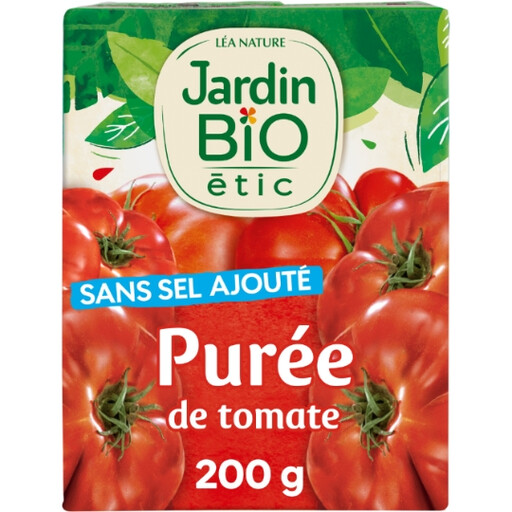 Image unavailable
A 200 g pack for making a tomato sauce that you season yourself, rather than a ready-made sauce. Check the salt content and storage instructions after opening on the packaging you buy.
 Image unavailable
A 500 g purée to cook with if you’re planning to make a larger quantity of sauce. It needs seasoning, so check the ‘salt’ value and storage instructions on the packaging for this product.
No: this claim doesn’t mean the ‘salt’ value is zero. For example, Léa Nature lists 0.02 g of salt per 100 g for its Jardin BiO étic chopped tomatoes with no added salt. Always check the nutrition table for the product you choose.
For products in the same category, compare the ‘salt’ value per 100 g, then take into account how much you’ll serve. Checking the nutritional information and ingredients helps you tell a ready-cooked sauce apart from a tomato base that needs cooking.
Taste the sauce before adding salt. Manger Bouger recommends not routinely adding extra salt to tinned food and limiting the salt in cooking water; you can use herbs or spices to add flavour to your recipe.
Follow the storage time and conditions shown on the product packaging, and refrigerate any leftovers as instructed. Choose a pack size based on the number of portions you plan to prepare and use.
No: to compare salt accurately, check the ‘salt’ value per 100 g for each sauce. The Nutri-Score gives an overall nutritional indication; on its own, it doesn’t tell you the salt content you’re looking for.