People keeping an eye on the calories in their snack
If you’re planning to have just one bar during your visit, check its weight and the kcal for the whole bar, rather than looking only at the values per 100 g.


When choosing a snack at the Christmas market, compare the calories and sugars in the amount you plan to eat, then check the ingredients and allergens. As a guide to one specific product, Snickers France lists 241 kcal and 26 g of sugars for its 50 g bar. So a claim about sugars alone is not enough to judge the energy content of another bar. If displayed, Nutri-Score can help you compare products, but it doesn’t replace checking the portion size.
If you’re planning to have just one bar during your visit, check its weight and the kcal for the whole bar, rather than looking only at the values per 100 g.
Compare the grams of sugars per portion, while keeping the total energy content in mind. If a bar is marketed as reduced in sugars, check the ingredients list too.
Check the ingredients and any ‘may contain’ warnings on the product you’re buying. Snickers France and KitKat France list different allergens for their recipes.
For a break at the Christmas market, start with the amount you’ll eat: a single bar, a few pieces and a meal-replacement bar are not the same choice.
| What matters to you | What to check | Who is it for? |
|---|---|---|
| Calories in your snack | The kcal per bar or per portion you’ll actually eat; the number of portions in the pack. | If I’m having one treat during a break, I want to know the energy content of what I’ll eat, not just the value per 100 g. Around 45% of consumers are said to prioritise the calories in their snack. |
| Sugars and on-pack claims | The sugars and kcal for the same portion; the ingredients in a bar marketed as reduced in sugars. | If I’m mainly looking to limit sugars, a claim on the front of the pack doesn’t tell me the bar’s energy content on its own. Sugars are said to be the main consideration for around 33% of consumers. |
| Allergens and recipe | The ingredients list, declared allergens and any ‘may contain’ warnings on the exact product packaging. | If certain ingredients determine whether I can buy a product, I need to be able to rule out a recipe that isn’t suitable for me, even if the portion appeals. Ingredient suitability is said to come first for around 22% of consumers. |
This figure may not match the whole bar or the amount you’ll eat. Single-serve bars and meal-replacement bars also suit different needs.
Check the weight of one portion, then compare the kcal and sugars for the number of bars or pieces you plan to have.
Carrefour’s listing for a FULFIL protein bar states that it contains less than 2 g of sugars per bar, and includes maltitol and sucralose among its ingredients. This information about sugars doesn’t tell you the energy content of the portion on its own.
Check the sugars, kcal, portion weight and ingredients together. For a claim that a product has reduced energy value, the EU regulation presented by EUR-Lex sets a minimum reduction of 30%.
Santé publique France explains that producers can choose whether to display it. If it’s not shown, you should still check the product’s nutrition information.
If it appears on the packaging, use it as a guide when comparing similar products, then check the portion, sugars and allergens.
Depending on the product, the recipes reviewed list ingredients or traces such as peanuts, milk, wheat or tree nuts. Focusing on calories or sugars doesn’t change what the product contains.
If you have an allergy, rely on the information on the packaging of the product you’ve bought, not just the brand name or an old product listing.
These brands include classic chocolate bars. Figures for one product shouldn’t be applied to other recipes or formats.
The milk chocolate wafer bar comes in several formats, so check the stated portion against the amount you’ll eat.
The chocolate and hazelnut product listed by Carrefour is a protein bar, so it’s different from a classic chocolate bar.
This selection features a single-serve bar with dried fruit and nuts, partially coated in dark chocolate. Compare it with other snacks by the portion you’ll eat, but don’t mistake it for a classic chocolate bar.
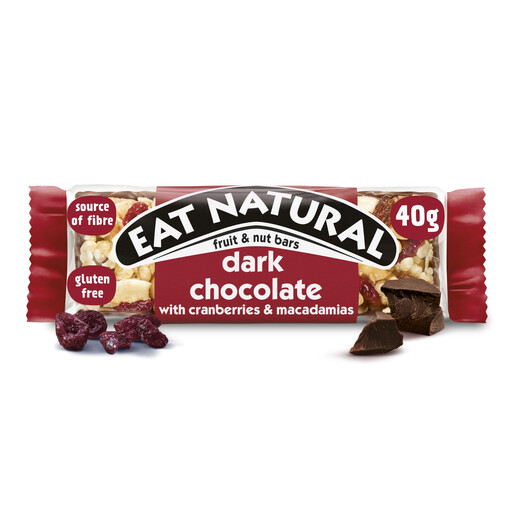 Image unavailable
If you’re having one bar during a break, the 40 g format makes it easy to compare the whole portion with other snacks. It’s a dried fruit and nut bar with a partial chocolate coating, rather than a classic chocolate bar.
If you need to avoid soya or macadamia nuts, or possible traces of other nuts and peanuts, check the information on the exact product packaging.
No. It doesn’t apply to solid chocolate bars: the contribution described by Légifrance applies to drinks. Checking the sugars in a bar is still useful when comparing products, but not because this contribution applies to it.
No. Santé publique France says producers can choose whether to display it. If it appears, you can use it to compare similar products, while also checking the kcal, sugars and portion sizes.
Check the ingredients list, allergens, net quantity and nutrition information, among other details. The DGCCRF includes these among the labelling information required for prepacked food. To compare snacks, match the values to the amount you’ll actually eat.
No. Sugars and energy value are two different things. Compare both for the same portion and read the ingredients list. A protein bar or meal-replacement bar shouldn’t be confused with a classic chocolate bar intended as a snack, either.