Parents preparing lunch boxes
Individual portions that are easy to divide up are useful when you need to prepare several snacks. Before giving any product to a child, check its ingredients and allergens on the label.


For lunch boxes, choose a format where you can easily check the individual portions and allergens. For an occasional group snack, an assortment may be a better choice if you’re looking for variety, provided you check the recipes and plan how to serve it. In either case, compare the sugar content per 100 g, the ingredients and the product’s storage instructions.
Individual portions that are easy to divide up are useful when you need to prepare several snacks. Before giving any product to a child, check its ingredients and allergens on the label.
A box or bag of assorted chocolates lets you offer a variety of bites when serving a group. The weight and, where stated, the number of pieces can help you work out how much to serve.
The nutrition declaration lets you compare sugar content per 100 g, among other things. The DGCCRF explains that this format makes it easier to compare products; ingredients and allergens should still be checked separately.
First decide whether the chocolates will go into lunch boxes or be served to a group, then compare the labels of formats suited to that purpose.
| Criteria | What to check | Shoppers concerned |
|---|---|---|
| Portion sizes | Number of units or portions stated; whether each chocolate is individually wrapped. | When I’m preparing several lunch boxes, I want to be able to divide up the chocolates without treating the total pack weight as a single portion. Around 44% of shoppers prioritise individually portioned units. |
| Sharing and variety | Net weight, number of pieces where stated, and the assortment’s recipes. | For an occasional group snack, I look for enough bites to serve and a choice of recipes; around 33% of shoppers share this priority. |
| Ingredients and labelling | Sugar content per 100 g, ingredients list and highlighted allergens. | If I need to check what’s in a festive treat, I start with the label on the exact product. Around 23% of shoppers prioritise checking nutritional information and allergens. |
The levy described by BOFiP-Impôts applies to non-alcoholic drinks containing added sugars, not solid chocolate. So it can’t help you choose between two boxes of chocolates.
Instead, compare the portion sizes and the ‘of which sugars’ line in the nutrition declaration.
According to Santé publique France, displaying the Nutri-Score is voluntary. If it isn’t shown, you’ll still need to check the nutritional information.
Compare products in the same category using their nutrition declarations per 100 g, then check their ingredients.
Different recipes may contain different allergens. The DGCCRF reminds shoppers that allergens must be highlighted in the ingredients list of prepacked foods.
Before preparing a lunch box or serving an assortment, read the information on the exact pack.
The total weight of an assortment doesn’t tell you how many bites you’ll serve at each snack time. When choosing a sharing format, you should also take the storage instructions on the packaging into account.
Check the number of pieces, if stated on the pack, and choose an amount that suits the occasion.
Lindt’s Christmas range includes gift boxes and assortments designed for sharing or giving as a present.
Ferrero’s range includes Ferrero Rocher chocolates and seasonal Kinder assortments.
Auchan features a 250 g bag of Jacquot Christmas chocolates as an option for sharing.
This Advent calendar is suited to an individual treat during the festive season, rather than an assortment to serve to a group.
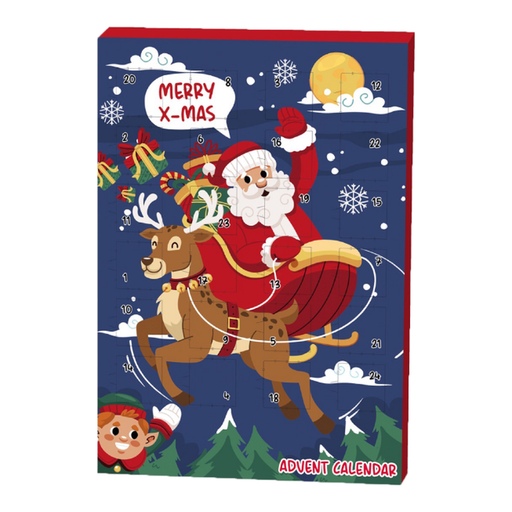 Image unavailable
The calendar format is suited to enjoying on your own during Advent, but is less suitable for a group snack. The stated weight is 50 g. For a lunch box, check whether the chocolates are individually wrapped, and check the packaging for allergen information too.
No. The levy described by BOFiP-Impôts applies to non-alcoholic drinks containing added sugars, not solid chocolate. To compare solid chocolates, check their nutrition declarations and ingredients lists instead.
No. Santé publique France explains that displaying it is voluntary. For most prepacked foods, a nutrition declaration is still required; it lets you compare sugar and fat content per 100 g, among other things.
Check the ingredients and allergens for the exact product, as well as how its individual pieces are wrapped. An Advent calendar or box containing several chocolates doesn’t necessarily mean that each one is individually wrapped.
Follow the instructions on the pack you’ve chosen. For example, the Auchan product details for the 250 g Jacquot assortment recommend storing it away from moisture and heat, between 18 °C and 20 °C.