Anyone making several Christmas desserts
If you’re planning several cakes, mousses or ganaches, first choose the chocolate required for each recipe, then add up the quantities you’ll need.


For ganache, mousse or cake, start with the type of chocolate specified in the recipe: a filled standard chocolate bar isn’t automatically a suitable substitute for baking chocolate. A multipack can be handy if its total weight covers several recipes. For sharing or lunchboxes, check the ingredients and allergen information for each product separately.
If you’re planning several cakes, mousses or ganaches, first choose the chocolate required for each recipe, then add up the quantities you’ll need.
If you’re cooking and sharing on several occasions, the total weight and the number of bars you can keep unopened matter more than the size of the multipack alone.
A bar you can break into pieces may suit this purpose. However, check its fillings and allergen information for anyone who’ll be eating it.
For Christmas baking, first choose chocolate that’s suitable for the recipe, then pick a format that works for the quantities you need and the other ways your household will use it.
| What to consider | What to check | Who is it for? |
|---|---|---|
| Baking suitability | Whether the bar is labelled for baking and whether it’s the type of chocolate your recipe calls for. | For ganache or mousse, I want to avoid a filled bar changing the texture of the recipe. Around 36% of consumers prioritise choosing chocolate that suits the recipe. |
| Multipack quantity | The total weight needed for your recipes and the weight of each bar. | If I’m planning several batches, I want enough chocolate without opening more bars than necessary. The right size is the main concern for around 29% of consumers. |
| Sharing and portions | How easy the bar is to break into portions and whether it contains any fillings. | For decorations, snacks or lunchboxes, I’d choose pieces to share rather than chocolate intended for melting. Around 21% of consumers put this use first. |
| Ingredients | The ingredients, allergens and nutritional information per 100 g for the product you’re considering. | Before serving dessert to a group, I need to be able to check exactly what the bar contains. Around 14% of consumers put checking the ingredients ahead of other criteria. |
Inclusions such as biscuits or nuts can change the texture of a mixture that needs to stay smooth, and affect which allergens you need to take into account.
For ganache or icing, use the type of chocolate specified in the recipe. Keep filled bars for recipes that call for them or for decorative pieces.
The number of bars alone won’t tell you whether a multipack will cover all your recipes or how many bars you’ll need to open.
Add up the weights required, then compare the total with the multipack’s overall weight and the weight of each bar.
According to Santé publique France, displaying Nutri-Score is voluntary. So, the absence of the logo doesn’t tell you what’s in a bar.
Check the ingredients, allergens and nutritional information per 100 g. If Nutri-Score appears on the packaging, treat it as extra information.
The scope of the contribution set out in the General Tax Code, published by Légifrance, covers drinks and liquid preparations for drinks, not chocolate bars.
To compare the sugar content of chocolate bars, check the nutritional information per 100 g instead.
The range includes dark chocolate intended for baking. Auchan France, for example, lists a multipack of two 205 g bars.
Lindt France lists a 200 g Lindt Dessert dark chocolate bar with 70% cocoa, intended for desserts.
Carrefour France lists baking chocolate bars, including a multipack of three 200 g bars.
Milka describes bars with a variety of textures, as well as its MMMAX format, which may be worth considering for pieces to share.
Côte d’Or highlights the flavour profile of its chocolate and shares dessert ideas.
These two products suit different needs: a multipack of dark chocolate for several recipes, and a white chocolate bar for a recipe that calls for this type of chocolate.
 Image unavailable
This multipack can help you plan several recipes that call for dark chocolate: its three bars weigh 300 g in total. Check that the type of chocolate suits each recipe; the ingredients list for this product includes soya lecithin.
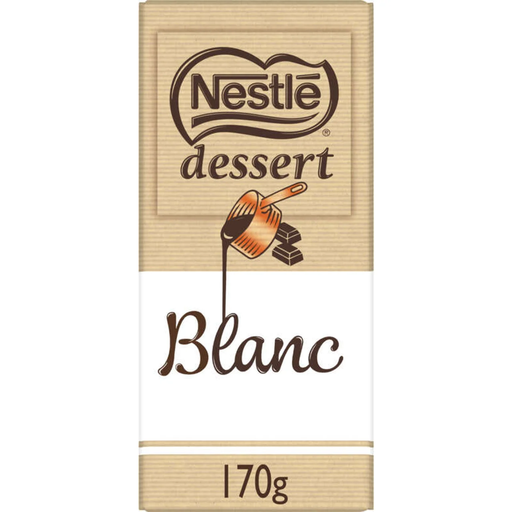 Image unavailable
This single bar is suitable for a recipe that calls for white baking chocolate, rather than for buying a multipack for several batches. The product information lists milk and warns of possible traces of egg, gluten and nuts. Check the packaging before serving.
No. Under the scope set out in the General Tax Code, published by Légifrance, this contribution applies to drinks and liquid preparations for drinks that meet the conditions in the legislation, not chocolate bars. To find out how much sugar they contain, check the nutritional information per 100 g.
No. Santé publique France states that manufacturers display Nutri-Score voluntarily. The European Commission distinguishes this front-of-pack label from the nutrition declaration required for most prepacked foods. So, also compare the nutritional information and ingredients of the bars you’re considering.
Add up the weights required by your recipes, then compare the total with the contents of each multipack. For reference, Auchan France lists a Nestlé Dessert multipack of 2 × 205 g, or 410 g, and Carrefour France lists a baking chocolate multipack of 3 × 200 g, or 600 g. Check the weight of the product you’re buying.
Read the information on the specific bar, including any warnings about possible traces. Lindt France lists soya for its Dessert dark chocolate 70% product, as well as possible traces of milk and nuts. The Nestlé Dessert dark chocolate product listed by Auchan France may contain milk and nuts. The brand name or cocoa percentage alone doesn’t tell you what another bar contains.