People comparing labels
You want to compare nutritional values per 100 g across biscuits intended for the same purpose, and check the Nutri-Score when it appears on the packaging.


For your Christmas shopping, choose a classic Digestive if you’re looking for its distinctive cereal-based recipe, shortbread biscuits in individual packets for sharing, or a biscuit clearly labelled gluten-free and lactose-free if you need those features. Then check the allergens, pack size and nutritional values per 100 g. Nutri-Score can help you compare similar biscuits when it’s displayed, but the DGCCRF confirms that displaying it is voluntary in France.
You want to compare nutritional values per 100 g across biscuits intended for the same purpose, and check the Nutri-Score when it appears on the packaging.
You’re looking for a product explicitly labelled gluten-free and lactose-free, while checking separately for other allergens and any ‘may contain’ warnings.
You prefer a pack that’s easy to share between several guests, such as shortbread biscuits packed in individual bags.
Start with the recipe or dietary requirement that matters to you, then check the packaging and label on the pack you’ve chosen.
| Criteria | What to check | Who is it for? |
|---|---|---|
| Nutritional values | Compare sugars and fat per 100 g in particular; check the Nutri-Score if it’s displayed on comparable products. | If I’m choosing between two biscuits for the same purpose, I want to be able to compare their values on the same basis. Around 29% of consumers would put this nutritional comparison at the top of their list. |
| Ingredients and allergens | Check the ingredients list, declared allergens and any ‘may contain’ warnings on the exact pack. | When I need to avoid gluten, lactose or another allergen, the ingredients come before taste and pack size. This compatibility would be the priority for around 29% of consumers. |
| Pack size for sharing | Check the net weight, number of individual packs and best-before date. | When I’m hosting at Christmas, I want a suitable quantity and portions that are easy to hand out. Around 21% of consumers would make pack size their top criterion. |
| Digestive recipe | Check the product name and ingredients: a cereal biscuit isn’t necessarily a classic Digestive. | If I specifically want the Digestive biscuit I know, I won’t choose a shortbread biscuit or another cereal recipe based on appearance alone. The classic recipe would come first for around 21% of consumers. |
The DGCCRF distinguishes between the mandatory nutrition declaration on prepacked foods and Nutri-Score, which is voluntary in France. So the absence of a logo isn’t enough to judge a biscuit.
Compare nutritional information per 100 g and the ingredients. If the logo is displayed, use it to help choose between comparable products.
The word “Digestive” or the name “Happy Digest” doesn’t, on its own, prove that a biscuit has an effect on digestion.
Choose based on the recipe and label rather than assuming it offers a physiological benefit.
A pack that’s convenient for several people doesn’t mean its recipe suits everyone’s dietary requirements. St Michel, for example, lists gluten, milk and soya in its family-size Sablés de Retz tin.
Check the label on the pack you’re planning to share, and keep it handy for your guests.
Worth considering if you’re looking for a classic Digestive: Carrefour lists McVitie’s Digestive Original in a 360 g pack.
Auchan’s Happy Digest Céréales biscuits are explicitly labelled gluten-free and lactose-free.
Sablés de Retz in a family-size tin are another option to consider for sharing, although they aren’t classic Digestives.
PÉPITO Croc Sablé is a chocolate biscuit, rather than a plain Digestive. The Joybuy listing is for a 294 g pack.
This fig and bran option could be included when comparing cereal biscuits for your Christmas shopping. Its name doesn’t identify it as either a shortbread biscuit or a classic Digestive.
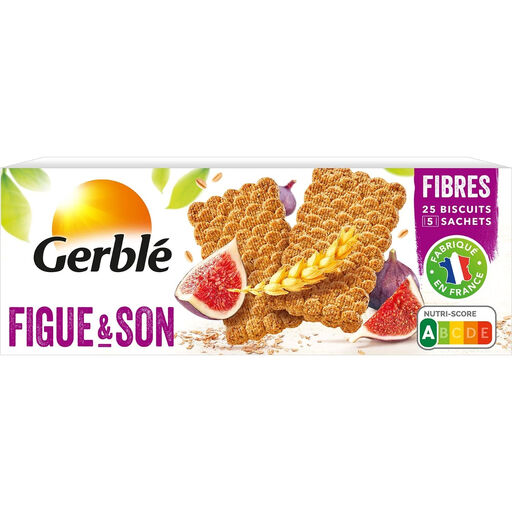 Image unavailable
Worth considering if you’d like to compare a fig and bran recipe with other cereal biscuits. The pack weighs 210 g; if you’re planning to share it, check the packaging for details of how it’s packed.
No. The DGCCRF confirms that a nutrition declaration is mandatory for prepacked foods, whereas Nutri-Score is voluntary. If there’s no logo, compare the nutritional information per 100 g.
If it’s displayed, compare the scores on biscuits of the same type and for the same purpose, but don’t make it your only criterion. Check the ingredients and allergens too. Santé publique France says the new Nutri-Score algorithm has been gradually introduced in France since March 2025.
No. Auchan says that Gerblé Happy Digest Céréales is made in a facility that also handles tree nuts, eggs, milk proteins, sesame and soya, among other ingredients. If you have an allergy, check the ingredients and any ‘may contain’ warnings on the exact pack.
Check the best-before date and storage instructions on the pack you’ve chosen. For its Sablés de Retz, St Michel recommends storing them in a dry place, away from heat and light.