Anyone making desserts where texture matters
For ganache, mousse, a filling, icing or decoration, you need white chocolate intended for baking rather than a bar chosen purely for eating.


For a light-coloured bake with a milky flavour, choose white chocolate. If you want a more intense cocoa flavour, start with a recipe for baking with dark chocolate rather than looking for ‘dark’ white chocolate. For white chocolate ganache, mousse or icing, a product labelled ‘for baking’ or ‘couverture’ is a more suitable starting point than an eating chocolate bar. Then check the ingredients, allergens and sugars to make sure it suits your recipe.
For ganache, mousse, a filling, icing or decoration, you need white chocolate intended for baking rather than a bar chosen purely for eating.
You want to keep the base light-coloured, milky and mild in a recipe that might include fruit, spices or biscuits, without expecting the flavour of dark chocolate.
Before cooking for a group, check the ingredients and allergen information for the product you choose, including any ‘may contain’ warnings.
First decide whether your recipe calls for the flavour and colour of white chocolate or the taste of dark chocolate. If it calls for white chocolate, check that it is suitable for baking and read the label.
Choose it: when you want to keep your bake light-coloured and milky, particularly for white ganache or decoration.
Bear in mind: even a product displaying a cocoa percentage won’t taste like dark chocolate.
Choose it: if you want a more pronounced cocoa flavour in your dessert.
Bear in mind: it will change the colour and flavour of a recipe designed for white chocolate. Don’t substitute it in equal quantities without adapting the recipe.
| What to consider | What to check | Who is it for? |
|---|---|---|
| Suitability for baking | Look for a ‘for baking’ or ‘couverture’ label and check that the product is suitable for the dessert you’re making. | If I’m making ganache or icing, the texture matters just as much as the flavour. Around 42% of consumers prioritise how well it melts and its texture. |
| Family recipe | Check that the bar is white chocolate, has no fillings that would clash with your recipe, and is the right size. | For a Christmas cake, I want an easy-to-use white chocolate without having to look for specialist couverture. Ease of choosing is the main priority for around 33% of consumers. |
| Ingredients | Read the ingredients, allergen information and ‘may contain’ warnings; compare sugars per 100 g. | Before serving a dessert to a group, I need to know exactly what the bar contains. For around 25% of consumers, ingredients, sugars or allergens take priority over other considerations. |
White and dark chocolate suit two different types of recipe. A cocoa percentage on white chocolate doesn’t mean it will have the flavour or colour of dark chocolate.
Choose according to the result you want: a light-coloured, milky base or a dessert with a more pronounced cocoa flavour. If you change the chocolate, adapt the recipe rather than making a direct substitution.
According to Santé publique France, displaying the Nutri-Score is voluntary. Its presence doesn’t remove the need to read the ingredients and nutritional information relevant to your recipe.
Compare the sugars and fat per 100 g in particular, then take into account how much you’ll use in the dessert.
Added ingredients such as biscuits or nuts change the composition of the chocolate you’re using. An eating chocolate bar won’t necessarily be suitable for ganache or icing.
For these bakes, look for plain white chocolate intended for baking, and check that its stated use matches your recipe.
Nestlé Dessert Blanc’s Carrefour listing, for example, warns that the product may contain egg, gluten and nuts. The ingredients list alone may not give you all the information you need about allergens.
Before serving the dessert, read the packaging of the product you actually bought, including any ‘may contain’ statements.
Valrhona describes Ivoire 35% as white chocolate for baking, available in 250 g and 1 kg callets.
Callebaut describes W2 as white couverture chocolate with 28% cocoa.
Nestlé describes its Dessert Blanc bar as suitable for baking, particularly for mousses and fondants.
If by ‘dark’ you mean dark chocolate, Lindt’s Dessert range includes a Noir 51% cocoa bar and a Noir Intense 70% cocoa bar.
Carrefour Bio white chocolate is an example of a white chocolate bar whose product listing includes ingredients and nutritional information.
This white chocolate is presented as suitable for baking, so it could be an option when choosing an ingredient for biscuits or other Christmas desserts. For ganache or icing, also check what your recipe says about the required melting properties and texture.
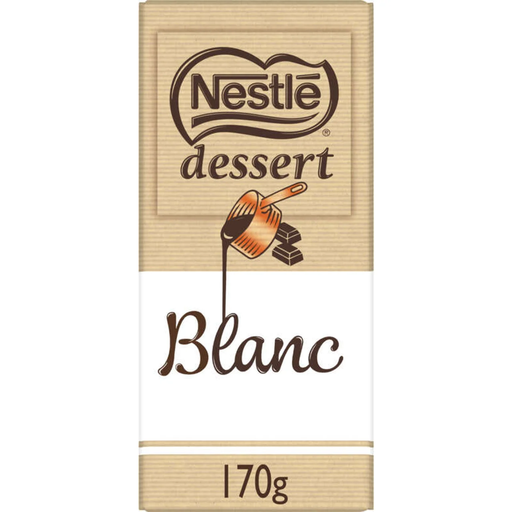 Image unavailable
This 170 g bar of white chocolate for baking is a good choice for biscuits or another dessert that calls for white chocolate. If texture is important, as it is for ganache or icing, check that the recipe’s guidance matches the product’s packaging. Also check the ingredients and allergen information before cooking for your guests.
If by ‘dark’ you mean the intense flavour of dark chocolate, choose a recipe made with dark chocolate for baking. Lindt, for example, offers dark chocolate in its Dessert range at 51% and 70% cocoa. White chocolate, even with a stated cocoa percentage, won’t give you the same flavour or colour.
No. According to Santé publique France, producers display Nutri-Score voluntarily. Whether or not the logo is shown, read the ingredients and nutritional information on the bar you’re considering.
White couverture is worth considering if your recipe calls for a chocolate designed for working with, but it isn’t necessarily needed for every ganache. Check which type of chocolate your recipe specifies: a bar labelled simply ‘white chocolate’ doesn’t, by itself, tell you how it will behave in this preparation.
It may work for shavings or simple decoration if its composition suits the recipe. For decoration that needs a particular finish or consistency, follow the recipe and check whether it calls for chocolate for baking or couverture.
First check the allergens and ingredients on the packaging you’ve chosen, then look for ‘may contain’ warnings. Carrefour’s listing for Nestlé Dessert Blanc mentions milk and possible traces of egg, gluten and nuts. Check these details on the actual bar you use.