If you’re melting chocolate or adding it to a homemade bake, start with the type specified in the recipe and choose a bar clearly marketed for that purpose. A box of chocolates makes a suitable gift, but its presentation doesn’t guarantee that the contents will work in a recipe too. Then compare the type of chocolate, the quantity you need, the ingredients and the allergens listed for the product you’ve chosen.
Who are these options for?
Anyone making homemade desserts
For a cake, mousse, ganache or topping, check which type of chocolate the recipe calls for, then make sure you have enough. Lindt DESSERT and Nestlé Dessert include ranges of bars that their manufacturers recommend for desserts.
Anyone keeping an eye on ingredients and allergens
If you’re cooking for someone with dietary requirements, read the ingredients list and any precautionary allergen warnings on the packaging of the bar you buy. This information varies between products, even within the same range.
Anyone choosing between a gift and an ingredient
A box of chocolates can be given as it is. If you also plan to use its contents for baking, check each chocolate individually rather than assuming it’s suitable based on the box’s presentation.
What should you check before buying?
For homemade baking, start with how you’ll use the chocolate and the type specified in the recipe. Then consider the flavour you’re looking for, the ingredients and the quantity you need, especially if the product is also intended as a gift.
| What to consider |
What to check |
Who is it for? |
| Suitability for baking |
Any guidance on how to use it and the type of chocolate specified in the recipe. |
When chocolate needs to go into a batter or ganache, I want to choose a bar marketed for baking rather than a product meant to be given as a gift. This is the priority for around 25% of consumers. |
| Chocolate flavour |
The type of chocolate, the cocoa percentage if stated, and the sugars per 100 g. |
If I want the chocolate flavour to stand out in my dessert, I choose a product that suits the result the recipe calls for and the people I’m serving. This is the main priority for around 31% of consumers. |
| Ingredients and allergens |
The ingredients, highlighted allergens, any possible traces and the nutritional information per 100 g. |
When I’m cooking for someone else, I need to be able to check the ingredients in the specific bar I’m using. For around 25% of consumers, this comes before any other consideration. |
| Quantity and gifting |
The net weight compared with what the recipe requires and, if it’s a gift, how the product is presented. |
If I want my purchase to work both as a gift and as an ingredient, I need the right quantity without confusing a gift box with a baking chocolate bar. Around 19% of consumers put this dual purpose first. |
What common mistakes should you avoid?
-
Assuming a Nutri-Score label is compulsory
According to Santé publique France, producers choose whether to display it. The DGCCRF distinguishes this label from the nutrition declaration, which is compulsory for the relevant prepacked foods.
Read the nutritional values per 100 g and the ingredients list. If a Nutri-Score is shown, use it as an additional guide when comparing similar products.
-
Using the ‘soda tax’ to choose a chocolate bar
The French Ministry of the Economy describes the contribution in question as applying to non-alcoholic drinks. It isn’t a useful factor when choosing between solid chocolate bars.
When comparing products for your recipe, focus instead on their ingredients and nutritional information.
-
Confusing a gift box, an eating chocolate bar and baking chocolate
Lindt and Nestlé market some of their bars for desserts, while the Joybuy product listing for a Milka bar describes it as ready to eat. This difference in how the products are presented doesn’t mean they’re all suitable for the same uses.
For baking, check the intended use of the specific product and the type of chocolate your recipe calls for. For a gift, consider the product’s presentation separately.
-
Relying on allergen information from another product
Ingredients and precautionary allergen warnings can differ between two bars from the same brand. The French Ministry of the Economy states that allergenic ingredients must be listed and highlighted on the label.
Before serving the dessert, check the ingredients and warnings on the packaging of the bar you used.
Ranges worth knowing
Lindt
The Lindt DESSERT range includes a 200 g 51% dark chocolate bar and a 200 g 70% intense dark chocolate bar, both recommended for baking by Lindt France.
- The product details for both bars state the cocoa percentage, ingredients, allergens and nutritional values per 100 g.
- These details don’t apply to every Lindt bar. Both products contain soya and warn that they may contain traces of milk and nuts.
Nestlé Dessert
Nestlé’s Dessert range includes dark, milk, intense, white, caramel and praline chocolate for homemade desserts.
- With different types available, it’s easier to find the one your recipe calls for.
- Check the ingredients and allergens for the specific product you’re buying; the range’s general description isn’t enough.
Carrefour Original
Carrefour’s 200 g dark chocolate bar for desserts contains at least 52% cocoa.
- The product details list the ingredients and any possible traces.
- It warns that it may contain traces of nuts, cereals containing gluten and milk. Check the packaging of the product you choose.
E.Leclerc / TABLETTE D'OR
E.Leclerc offers TABLETTE D'OR baking chocolate bars in dark chocolate (200 g) and milk chocolate (170 g).
- The product details for both bars list the ingredients and nutritional values. They also display a Nutri-Score E.
- The milk chocolate contains dairy ingredients. Check the ingredients of the specific bar before using it when cooking for others.
Baking chocolate bars on Joybuy
These two Nestlé Dessert bars are suited to recipes calling for white or dark chocolate respectively. First choose the type specified in your recipe, then check the size and packaging of the product you’ve selected.
 Image unavailable
NESTLÉ DESSERT white baking chocolate, 170 g
Worth considering if your recipe calls for white chocolate. This bar is listed as 170 g, so check that it matches the quantity you need. Before baking, check the ingredients and allergen information on the packaging.
View on Joybuy
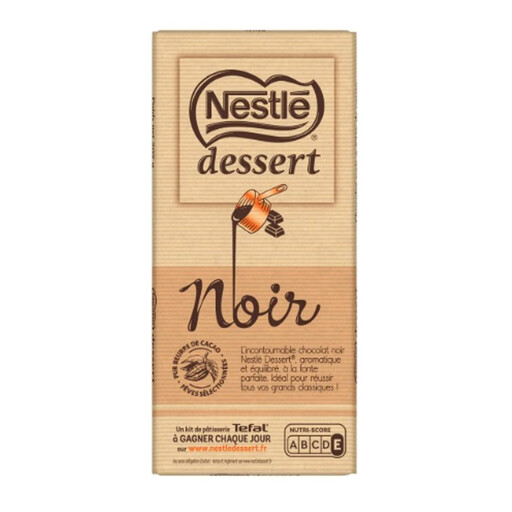 Image unavailable
Nestlé Dark Dessert dark chocolate, 205 g
Worth considering for a recipe that calls for dark chocolate. The bar is listed as 205 g. If your recipe requires a specific cocoa percentage, check this on the packaging. Also check the ingredients and any possible allergen traces.
View on Joybuy
Frequently asked questions
Is a Nutri-Score compulsory on a chocolate bar?
No. According to Santé publique France, producers can choose whether to display one. The DGCCRF says that a nutrition declaration is compulsory for the relevant prepacked foods. Read the values per 100 g, then use the Nutri-Score as an additional guide if one is shown.
Does the ‘soda tax’ affect your choice of chocolate bar?
It isn’t a factor to apply to a solid chocolate bar. The French Ministry of the Economy describes the measure in question as a contribution on non-alcoholic drinks. This distinction doesn’t amount to a tax conclusion about every individual product.
What should you check on a chocolate bar if you’re serving dessert to someone with an allergy?
Read the ingredients list, highlighted allergens and any precautionary warnings on the packaging of the bar you’re using. Information can vary between products, so the ingredients on another bar from the same brand aren’t enough.
Can a box of chocolates replace a baking chocolate bar?
Not without checking what’s inside. A box of chocolates can be given as it is, but if you plan to melt or add its contents to a recipe, check the type of chocolate the recipe calls for, the ingredients and the stated use of each product you intend to use.


