Which measurements should you choose for your needs?
Start with what you want to monitor, then check exactly what the model measures and how to interpret its readings.
| Priority | What to check | What you need |
|---|
| Stuffy air |
CO₂ measurement, measuring method and calibration conditions; whether it has a history feature so you can compare periods when the room is occupied and aired. |
In a bedroom or home office where I spend a lot of time, I want to see whether readings change when I air the room. According to Netatmo Assistance, CO₂ is an indicator of stuffiness, not a measure of all pollutants. |
| Humidity |
Relative humidity and temperature measurements; whether you can track changes over time. Separately check air inlets, ventilation and any signs of leaks or water ingress. |
Condensation or damp patches keep coming back in my home. I want to track how they change without treating a reading as a diagnosis of the cause. |
| Particulates |
Clearly specified PM2,5 and, if needed, PM10 measurements; a history feature that lets you compare readings in the same room under similar conditions. |
I want to monitor changes while cooking, using candles or after airing the room, rather than relying on a one-off impression. |
| Smells and volatile emissions |
Clearly specified VOC measurements; the scope of the readings and calibration period for the model you’re considering. |
A smell returns after cleaning or in a recently furnished room. I want to track any changes without assuming a VOC reading identifies the substance or its source. |
| Interpreting results |
Stated accuracy, calibration and access to historical readings; what the displayed colours and alerts mean. |
I need to compare readings from different times in the same room, not draw health conclusions from a single colour. Anses highlights the limitations of interpreting data from micro-sensors. |
Which branded models should you compare?
These models illustrate different combinations of measurements. Choose one based on the parameter you want to monitor, then check the conditions of use for that model.
Airthings
According to Airthings, the View Plus measures CO₂, PM2,5, VOCs, humidity and other parameters, including radon.
- According to the manufacturer’s specifications, it lets you monitor several types of readings with one device.
- Airthings says initial calibration takes around seven days for CO₂ and VOC measurements, so bear this in mind when interpreting the first readings.
Aranet
Aranet describes the Aranet4 PRO as a monitor for CO₂, temperature, relative humidity and pressure.
- Its stated measurements are suited to monitoring stuffiness and humidity in a room.
- If you want to monitor particulates or VOCs, look for a model that specifically measures these parameters.
Qingping
Qingping lists CO₂, PM2,5, PM10, temperature and humidity measurements for the Air Monitor Lite.
- According to its specifications, it combines monitoring for stuffiness, particulates and humidity.
- The Qingping shop says Mi Home isn’t supported in Europe for this model, so check which app you want to use.
Netatmo
Netatmo says its indoor air quality monitor measures temperature, humidity and noise, as well as monitoring CO₂, as described by its support team.
- The brand says its app gives you access to historical readings and alerts.
- Before using CO₂ readings to compare different periods, check the automatic calibration requirements for your model.
A Joybuy option for monitoring humidity
This thermo-hygrometer is designed to monitor a room’s temperature and humidity. If you also want to monitor CO₂, particulates or VOCs, check that the model you’re considering specifically measures these parameters.
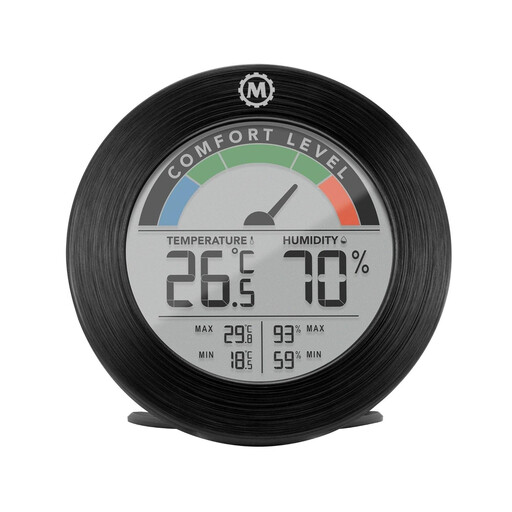 Image unavailable
Marathon Austin — wireless indoor thermo-hygrometer
If you want to monitor recurring damp in a room, this model measures temperature and humidity and records their daily highs and lows. Its readings can’t identify a leak or ventilation problem on their own. If you also want to measure CO₂, particulates or VOCs, check which parameters are listed for the model.
View on Joybuy
Frequently asked questions
Can a CO₂ sensor explain a smell in a room?
No, not on its own. CO₂ is mainly used to monitor how stuffy an occupied room is. To track particulates or VOCs, choose a model that specifically measures the relevant parameter. Even then, a reading isn’t enough to identify the source of a smell.
How can I compare readings before and after airing a room?
Monitor the same parameter in the room concerned over comparable periods, and note when you air it. Look at how readings change over time rather than focusing on a single figure. According to Anses, micro-sensor data should be interpreted with care and isn’t an individual health diagnosis.
Does high humidity mean I should get a dehumidifier straight away?
Not necessarily. If damp or mould persists, first check the ventilation and look for signs of a leak or water ingress. A sensor can help you keep track of recurring problems, but it can’t determine the cause or fix an underlying issue with the property.
What should I check before choosing a connected sensor?
Check which measurements are available in the app, whether it offers historical readings and alerts, whether it’s compatible with your devices, and what calibration the exact model requires. For example, Qingping says Mi Home isn’t supported in Europe for the Air Monitor Lite.


