Choose based on the maximum amount of fresh and frozen food you actually store, comparing the usable capacity of each compartment rather than the total capacity alone. A fridge with a small freezer compartment is suitable if you freeze very little and the compartment meets your needs. A fridge freezer combines both functions, while a separate freezer requires extra space and a comparison of the appliances’ annual energy consumption.
Who is this choice for ?
Households that cook with fresh ingredients
If you often prepare meals, check that the fridge capacity and shelf layout let you store your food without overfilling the appliance. Advice from Que Choisir Ensemble and Anses can help you understand storage and food preservation needs.
Households that freeze portions
If you prepare meals in advance or keep frozen food, compare the freezer compartment’s capacity with your usual stock and check whether it is suitable for storage or freezing. Que Choisir Ensemble distinguishes between these uses according to the compartment.
Households with kitchen constraints
An alcove, narrow access route or specific space can affect which format is suitable. Measure the access route and check the model’s dimensions and installation type; requirements vary from home to home.
Which criteria should you compare ?
Fridge freezer
Choose this if : you regularly store fresh and frozen food, and the separate capacities meet your peak needs.
Keep in mind : a large total capacity does not guarantee enough freezer space. Check the dimensions and kWh/year too.
Fridge with a freezer compartment
Choose this if : you prioritise fresh food and only freeze small quantities, after checking the compartment’s capacity and intended use.
Keep in mind : if you freeze meals yourself, check that the compartment is suitable for freezing, including its star rating.
Separate fridge and freezer
Choose this if : a fridge freezer does not have enough freezer space for your stock and you have suitable space for each appliance.
Keep in mind : check the available space and add together the appliances’ kWh/year to compare their consumption with that of a fridge freezer.
As an appliance that runs continuously, a fridge or freezer can use more energy depending on its size and features, as ADEME points out. Compare the capacities you actually need with the kWh/year shown.
| Consideration |
What to check |
Who prioritises it most |
| Fresh food capacity and storage |
Compare the usable fridge capacity, shelf layout and space needed for your containers. |
When I often prepare meals with fresh ingredients, I want to store them without overfilling the fridge. Around 36 % of consumers prioritise fresh food capacity and layout. |
| Freezing capacity |
Check the freezer capacity, star rating and usable space for your maximum stock. |
If I freeze portions in advance, I check that the compartment has enough space and is suitable for freezing. Around 29 % of consumers put frozen food storage at the heart of their choice. |
| Energy consumption |
Compare the kWh/year and capacities on the label; for two appliances, add together their annual consumption. |
I want to compare energy consumption without choosing an appliance whose capacity does not suit my needs. Around 21 % of consumers prioritise kWh/year. |
| Access, space and installation |
Measure the access route and available space; for an integrated model, check the housing unit and hinges. |
If my home has a specific access route or housing unit, I check that the appliance can be brought to its intended position and installed there. Around 14 % of consumers prioritise access and installation. |
Mistakes to avoid
-
Choosing based on total capacity alone
Fridge and freezer capacities are separate: a high total does not tell you whether the split suits your storage habits.
Compare the litres in each compartment separately with the maximum amount of food you store at any one time.
-
Confusing food storage with freezing
A three-star compartment is suitable for storing food at −18 °C. However, according to Que Choisir Ensemble, this does not mean it is as suitable for freezing food as a four-star compartment.
If you freeze meals yourself, check the star rating and capacity of the specific model’s compartment.
-
Comparing energy ratings without checking kWh/year
The rating alone cannot tell you how annual consumption compares between configurations with different capacities or numbers of appliances.
Compare capacities that suit your needs, then check the kWh/year. For a separate fridge and freezer, add together the figures shown for both appliances.
-
Ordering without checking access and installation
An alcove, hinges, a narrow access route or the conditions in a particular room can affect which format is suitable for your home and the model.
Measure the access route and available space, check the instructions and confirm with the retailer the package dimensions and any delivery or installation services available.
Brands to consider for each configuration
Bosch
The KGN36NLEA and KIL42NSE0 models illustrate a freestanding fridge freezer and an integrated fridge with a freezer compartment, respectively.
- Bosch lists 216 L of fridge capacity, 89 L of freezer capacity and No Frost technology for the KGN36NLEA.
- For the KIL42NSE0, check the housing unit and sliding hinges; this built-in model is suited to a different configuration.
Liebherr
The freestanding FNe 5006 Pure NoFrost upright freezer is an example of a solution if you need more freezer space.
- Liebherr lists a capacity of 238 L, NoFrost and the ability to operate at ambient temperatures as low as −15 °C for this model.
- You will need to provide separate refrigeration for fresh food and check the space and energy consumption for each appliance.
Electrolux
The integrated EFD6DE18S1 is an example of a configuration with limited space set aside for freezing.
- Electrolux lists 264 L of fridge capacity out of 285 L total, a housing unit size of 1780 × 560 × 550 mm and energy consumption of 166 kWh/year for this model.
- These dimensions and capacities apply to this specific built-in appliance. Check that it fits your housing unit and that its freezer compartment meets your needs.
Samsung
The RB38A7B6AS9/EF fridge freezer is an example of a large-capacity model to consider based on the capacities and dimensions you need.
- Samsung lists an A rating and estimated energy consumption of 108 kWh/year on the European label for this model.
- These figures apply to this specific model. Check that its capacities and dimensions suit your kitchen and your stock.
Fridges and freezers on Joybuy
This selection features freestanding and integrated fridge freezers, giving you options for storing fresh and frozen food in one or more compartments.
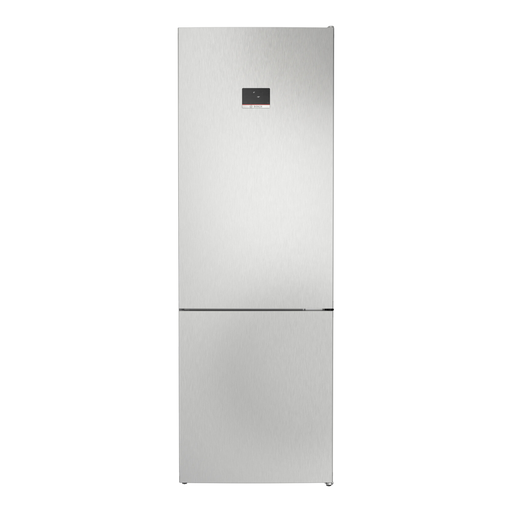 Image unavailable
Bosch KGN497LDF, 440 L, D rating
If you want to store fresh and frozen food in one appliance, compare the capacity of both compartments with your usual stock.
The model information lists 311 L for the fridge, 129 L for the freezer, 223 kWh/year, a four-star freezer, fan-assisted cooling and a reversible door.
View on Joybuy
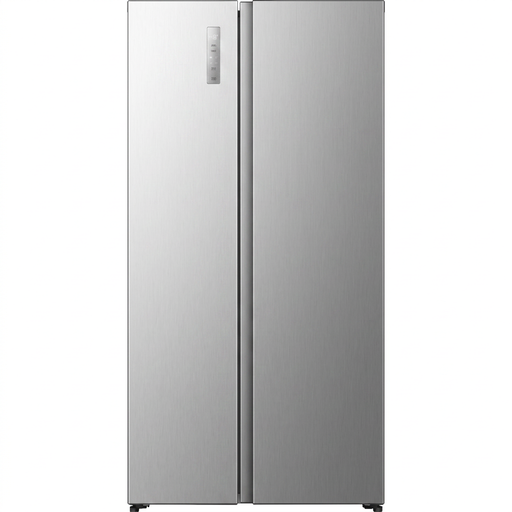 Image unavailable
Hisense RS3P558NEID, 544 L
This freestanding model, with separate compartments, may suit you if you want to store fresh and frozen food in one large appliance.
The product information lists 347 L for the fridge, 197 L for the freezer, 254 kWh/year, Total No Frost and a water dispenser with an internal tank.
View on Joybuy
 Image unavailable
AEG NSC6M18FES, integrated, 249 L, E rating
For a fitted kitchen with a compatible housing unit, this integrated model keeps chilled storage separate from the freezer space.
The product information lists 186 L of fridge capacity and 62 L of freezer capacity. Stated dimensions : 59,2 × 58,5 × 186,2 cm; it also features TwinTech Total No Frost, MultiFlow and ExtraChill.
View on Joybuy
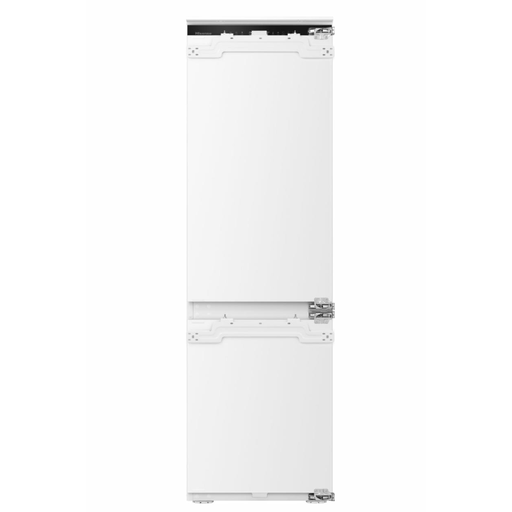 Image unavailable
Hisense RB3B250SAWC, integrated, 252 L, C rating
This integrated model may be worth considering if your kitchen has a compatible unit and its capacities suit your fresh and frozen food storage needs.
The product information lists 176 L of fridge capacity, 76 L of freezer capacity, a four-star freezer, 150 kWh/year and dimensions of 540 × 1772 × 545 mm.
View on Joybuy
 Image unavailable
Haier HTW5618ENMG, three-door, 360 L, E rating
This freestanding model splits storage between the fridge and freezer compartments. Check that both suit your needs.
The product information lists 235 L for the fridge, 125 L for the freezer, 271 kWh/year, Total No Frost and a four-star freezer. It also mentions Super Freezing, Wi-Fi and My Zone.
View on Joybuy
Frequently asked questions
Is the energy rating enough to compare a fridge freezer with two separate appliances ?
No. The European Commission says the label for fridges and freezers shows the energy rating, annual consumption in kWh, capacities and noise level. First compare capacities that suit your needs. If you choose two appliances, add their kWh/year together before comparing the total with that of a fridge freezer.
Can a small freezer compartment freeze cooked meals ?
Not necessarily. According to Que Choisir Ensemble, a three-star compartment is suitable for storing food at −18 °C; a four-star compartment is suitable for freezing food. Check the rating and capacity of the specific model.
What temperature should I set my fridge to for storing home-cooked meals ?
Anses recommends keeping the temperature between 0 and +4 °C at the coldest point. Check it regularly, avoid overfilling the appliance and follow the instructions in its manual.
What should I check before a fridge is delivered to a flat or installed in a housing unit ?
Measure the access route and the space where the appliance will go. For an integrated model, also check the housing unit dimensions and door fitting. Confirm the package dimensions and available services with the retailer. In France, the DGCCRF reminds retailers that they must provide a delivery date or timeframe before the contract is concluded; access requirements depend on the property.


