
Livraison le jour même ou le lendemain

Qualité garantie

Débloquez vos offres de bienvenue: Livraison GRATUITE | Jusqu'à -80 % | 30 jours d'essai gratuits à JoyPlus
Téléchargez l'application
Buying stationery and creative supplies seems straightforward… until you start comparing paper weight, texture, size or binding type. Paper that’s too thin can buckle when it meets ink, a poorly bound notebook quickly becomes frustrating to use, and self-adhesive photo paper can leave marks on delicate surfaces.
Whether you’re an artist, illustrator, student, teacher or professional, three mistakes crop up time and again when making your choice.
A 250 gsm paper generally stands up better to handling and wet media than an 80 or 90 gsm paper. That doesn’t mean it’s right for every use. For everyday note-taking, a high paper weight mainly makes your notebook heavier and thicker, with no real benefit.
On the other hand, an A4 drawing pad at 120 gsm works very well with pencil, charcoal, pastel or coloured pencils. However, it may not be suitable for watercolour or acrylic.
This description needs to be checked against the product’s detailed features: surface type, absorbency, paper weight and recommended media. A multi-technique paper pad might work for ink, gouache and pencil, whereas a smooth Bristol paper is better suited to precision drawing, inking or markers.
An A4 notebook gives you a generous working surface, but it also takes up more room in your bag. An A5 notebook is easier to carry around, while a spiral-bound notebook generally lies flat. If you plan to file the pages, the perforations and ruling type matter more than how the cover looks.
If you use alcohol-based markers, check for a protective sheet or any information about ink bleed-through. Always test on a page before starting a final piece.
A smooth surface makes precise lines, clean outlines and details easier – ideal for manga paper. A more pronounced grain holds dry media better and adds visible texture to your drawing. Pads offering two sides – one textured, the other smoother – let you adapt the surface to different styles.
A spiral binding lets you turn pages easily and work flat. A glued binding works well for an art pad if you want to tear sheets out cleanly. Micro-perforated sheets are handy for filing homework, notes or drawings.
For pieces you want to last, look for acid-free, pH neutral or a forestry certification such as PEFC, where these appear on the product page. Store your pads flat, in a dry place away from direct light.
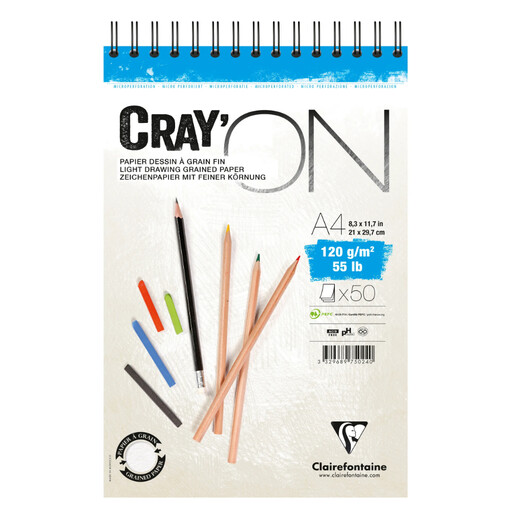
Why this choice fits the profile: a versatile A4 surface for starting out in drawing without buying lots of different pads, with two different paper sides.
At 120 gsm, it reduces the risk of choosing paper that’s too thin for repeated corrections, without jumping straight to a 250 gsm pad.
50 sheets of 100% cellulose paper, with a very fine grain, one slightly textured side and one smooth side. Acid-free paper and PEFC certified according to the product page.
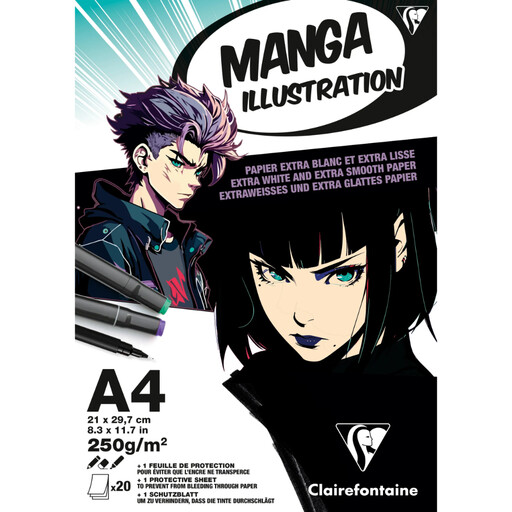
Why this choice fits the profile: its extra-white, smooth Bristol surface is ideal for illustrators working on details, inking and markers.
The product page states it’s suitable for pencils, pens, ink and markers. It also mentions a protective sheet that limits transfer between pages.
100% cellulose Bristol paper, 250 gsm, acid-free and pH neutral. The product page also notes good resistance to repeated corrections.
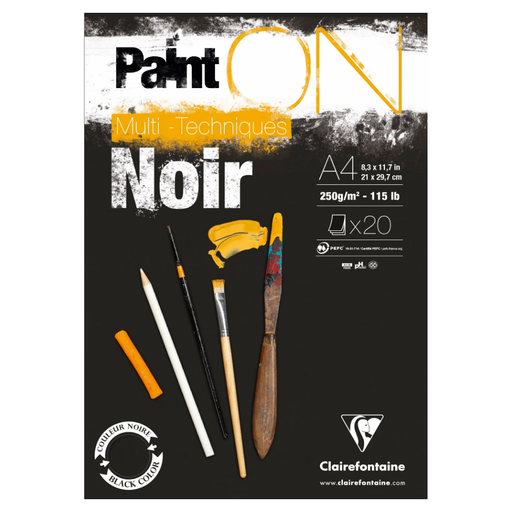
Why this choice fits the profile: its black background makes contrasting creations, metallic inks, white pencils and light paints really stand out.
The product page details the compatible dry and wet techniques, rather than just using the general “multi-technique” label.
20 A4 sheets, 250 gsm, 100% cellulose paper, with a slightly rough grain and a deep black colour.
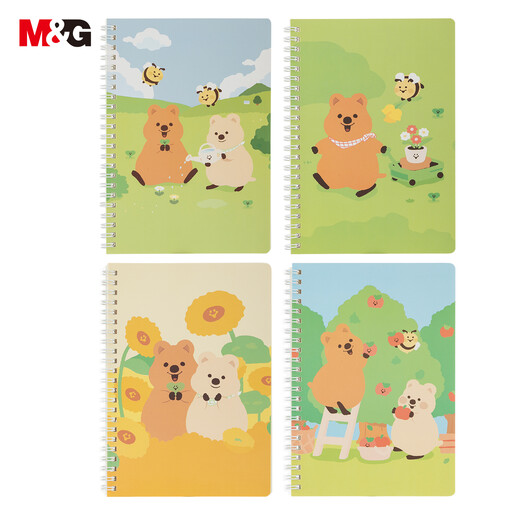
Why this choice fits the profile: four separate notebooks make it easy to keep classes, projects, lists and work notes organised.
The A5 size and spiral binding are clearly stated. You can see at a glance how easy they are to carry and that they lie flat.
Pack of four notebooks, 60 sheets per notebook, lined pages and A5 size that slips easily into a bag.
We’ve put together an up-to-date selection of products to suit different needs in paper, filing, writing and creating.
For tear-off notes, Rhodia notepads in A4+ size offer Clairefontaine vellum paper, a rigid cardboard back and micro-perforated sheets. For drawing freely while keeping your kit compact, the Clairefontaine Zap Book A4 gives you 160 sheets of 80 gsm recycled paper with a spiral binding.
Decoration projects can make use of Kodak self-adhesive photo paper in A6 size, compatible with inkjet printers. Its repositionable adhesive should not be used on wallpaper, freshly painted surfaces, skin or electronic devices.
For pencil, pen and sketches, 80 to 120 gsm is usually enough. If you regularly use ink or make lots of corrections, a higher paper weight will give you more comfort. Always check compatibility with your markers and wet media.
Yes, if you want to keep your note-taking compact. An A5 notebook is easy to carry and can be dedicated to one subject or project. For large diagrams, folders or sheets you need to file, A4 size remains more practical.
Keep them flat, in a dry place away from direct light and moisture. Use a suitable folder or ring binder and avoid overfilling a spiral binding. For prints, let the ink dry completely before sticking, folding or stacking the sheets.