
Livraison le jour même ou le lendemain

Qualité garantie

Débloquez vos offres de bienvenue: Livraison GRATUITE | Jusqu'à -80 % | 30 jours d'essai gratuits à JoyPlus
Téléchargez l'application
A ratchet and socket set can make maintaining a car, motorbike or piece of equipment considerably easier. However, with so many kits available, choosing the right one is not always straightforward. The advertised number of pieces alone is not enough to determine whether a set will genuinely meet your needs.
Before you buy, bear these three common pitfalls in mind:
Here are the criteria to consider when choosing tools for car mechanics, DIY around the home or regular maintenance work.
The drive square connects the ratchet to the socket. The most common sizes are:
A 1/4, 3/8 and 1/2-inch ratchet set covers a wider range of situations, but it also takes up more space. For versatile use, a 3/8-inch socket set may be perfectly sufficient. Also check whether adapters and extension bars are included.
In France, metric sockets are generally the preferred choice. Sizes such as 8, 10, 13, 17 and 19 mm are commonly found on vehicles and everyday equipment. However, a metric and SAE socket set can be useful if you maintain an American car, an imported machine or older equipment.
Check the exact list of sizes rather than relying solely on the total number of pieces. A 24-piece kit can be far more practical than a larger set if its contents genuinely match the work you need to do.
With a reversible ratchet, you simply operate the selector to switch between tightening and loosening, without removing the socket. A quick-release button also makes it easier to change sockets during a job.
Chrome vanadium sockets are widely used in hand tools. Their chrome finish makes them easier to clean and helps limit surface oxidation. However, when working on wheel nuts or using an impact driver, check that the sockets are designed for this purpose. Chrome molybdenum is the most common material for impact sockets.
The tooth count indicates the angle needed to advance the mechanism. A 90-tooth ratchet with an advertised working angle of 4°, for example, can be particularly useful in confined spaces. This does not mean that it can safely exceed the maximum torque recommended by the manufacturer.
Finally, choose a kit with secure storage, clear markings and a comfortable handle, including when your hands are slightly greasy. To work safely, consult the instructions, torque limits and information provided by the manufacturer or its established representative in the European Union. Where applicable to the product, regulatory marking does not remove the need to follow the usage instructions.
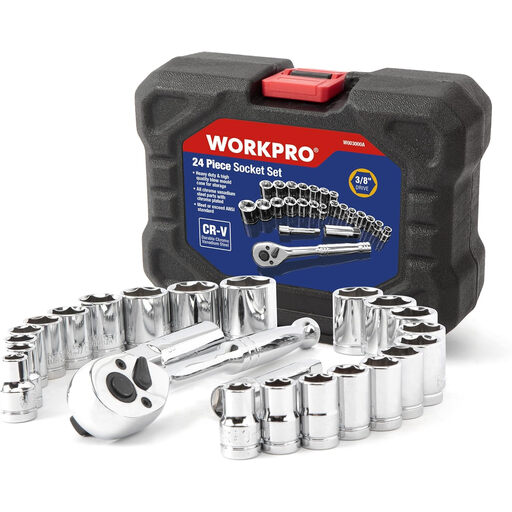
Why this product suits this profile : Compact and easy to carry, this kit is ideal for first repairs on a car, motorbike, piece of furniture or household equipment. It combines metric and SAE sizes in a portable format.
The set includes 21 sockets, a 3/8-inch ratchet and a storage case, without adding a host of unnecessary accessories.
24 pieces, sockets from 9 to 19 mm and from 5/16 to 7/8 inch, plus a quick-release button.
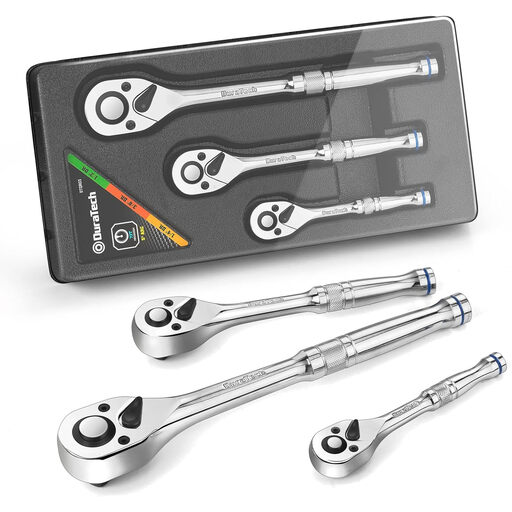
Why this product suits this profile : Anyone looking to equip a versatile workshop gets all three drive sizes in a single set.
Rather than simply boasting a high piece count, this kit offers three ratchet sizes and dedicated storage.
72-tooth mechanism, advertised 5° angle, quick-release buttons, and 1/4, 3/8 and 1/2-inch drive sizes.
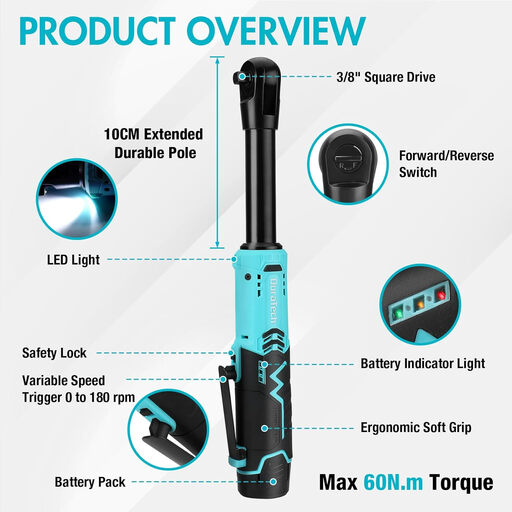
Why this product suits this profile : A 12V electric ratchet reduces repetitive movements during car maintenance, equipment assembly or work in hard-to-reach areas.
The specifications indicate a maximum torque of 65 Nm and variable speed of up to 180 rpm : clearly defined limits to help keep usage within the appropriate range.
Two 2.0 Ah batteries, LED light, charge indicator, safety lock and 3/8 to 1/4-inch adapter.
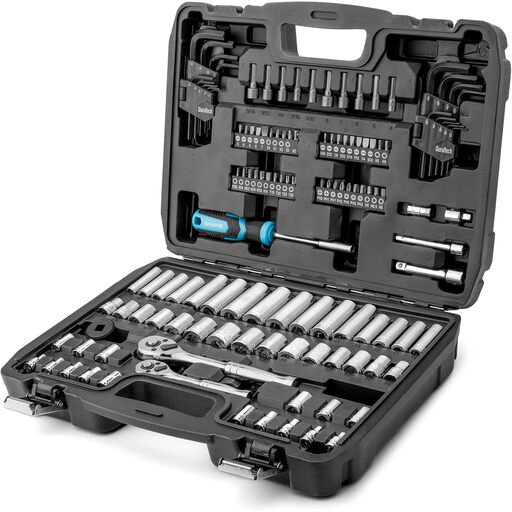
Why this product suits this profile : This mechanic’s kit is designed for anyone who wants to bring together sockets, bits, hex keys and screwdrivers for cars, motorbikes and everyday jobs.
The detailed contents list distinguishes the metric and SAE sockets, the two ratchets and the accessories, rather than simply stating the total number of pieces.
47 sockets, 1/4 and 3/8-inch ratchets, 40 bits, 18 hex keys and a storage case.
We have put together a complete, real-time updated list of products that meet these demanding selection criteria and European safety regulations.
The 3/8-inch size offers the best balance for many common jobs. The 1/4-inch size is useful for small fasteners, while the 1/2-inch size is suitable for large sockets and more demanding fastening tasks. To cover as many situations as possible, a kit combining all three sizes can be a sensible choice.
Metric sockets are measured in millimetres, for example 10 or 17 mm. SAE sockets use imperial measurements in inches, such as 3/8 or 7/8 inch. These two systems are not interchangeable: you could damage the nut. Check which standard is used by your vehicle, machine or equipment before placing your order.
Clean the tools after every job, dry them before storing them and return each piece to its proper place. Avoid using a manual ratchet with an impact tool and observe the stated torque limits. Lightly lubricating the mechanism, if recommended in the instructions, can help maintain smooth rotation.