
Livraison le jour même ou le lendemain

Qualité garantie

Débloquez vos offres de bienvenue: Livraison GRATUITE | Jusqu'à -80 % | 30 jours d'essai gratuits à JoyPlus
Téléchargez l'application
A home cinema projector is all you need to turn a blank wall into a giant screen for watching films, playing video games or following a match. However, some models quickly disappoint with a dull picture, incompatible apps, fiddly focusing or sound that is not powerful enough for a family room.
Before placing your order, it is therefore worth looking beyond the marketing claims and checking a few specific features. Here are the criteria to examine, the pitfalls to avoid and a selection of models suited to different uses.
A device sold as “4K” may simply decode a 4K signal while displaying a native resolution of 1,920 × 1,080 pixels. A 1080p projector can therefore accept 4K content without offering the same level of detail as a model equipped with a genuine 4K panel.
To avoid unpleasant surprises, look separately for the terms native resolution and 4K supported. For films, series and consoles, Full HD remains a very sensible choice in many living rooms.
ANSI lumens, ISO lumens and simple “lumens” figures are not directly comparable. Perceived brightness also depends on the picture mode, projection distance, screen size and ambient light.
A projector intended for films in a dark room has different requirements from an outdoor projector. For a session in the garden, wait until nightfall and prepare a light-coloured surface. Even a very bright compact model cannot work miracles against direct lighting or a dark façade.
A smart projector equipped with Google TV, Wi-Fi 6 or Bluetooth can make installation easier. However, you still need to check which apps are actually available, whether they are compatible with your streaming services and how updates are handled. Screen mirroring from a smartphone may also be limited by the protections applied to content on streaming platforms.
The presence of Android or a smart interface does not automatically guarantee official certification for every service. Check the product details and, if necessary, plan to connect an external device via HDMI.
Check the unit used and the measurement conditions. A device rated at 300 ANSI lumens will be better suited to a dimly lit room, while a model showing 800 or 1,800 ANSI lumens will offer more flexibility in a living room that is not fully darkened. These figures remain indicative: they should be considered alongside the picture mode and installation distance.
For an even result, use a matt white wall or a suitable projection screen. An uneven surface will reduce sharpness, even with a high-performance projector.
Autofocus saves you from making repeated manual adjustments. Automatic keystone correction straightens the picture when the projector is not perfectly perpendicular to the wall, but it may slightly reduce the usable area or display precision. Automatic alignment and obstacle-avoidance systems are particularly convenient in a bedroom or multifunctional living room.
As for connections, check for:
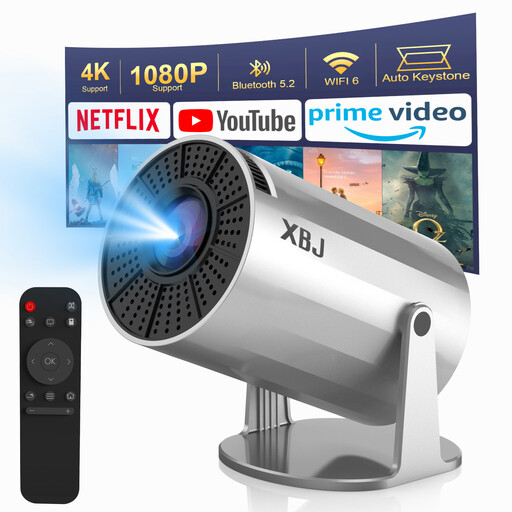
Why this model suits this profile : its compact design fits easily into a bedroom, small living room or occasional-use setup. It includes Wi-Fi 6, Bluetooth and an adjustable base.
The product details clearly distinguish the native 720p resolution from 1080p and 4K decoding. Focusing is manual, which avoids confusing automatic correction with autofocus.
Portable design, 180° rotation, HDMI, USB, Bluetooth and automatic vertical correction.
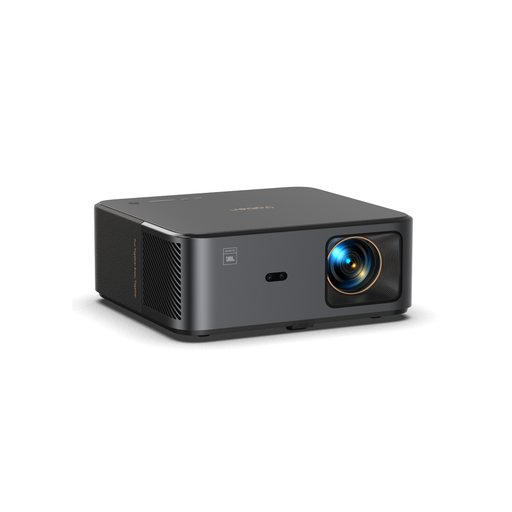
Why this model suits this profile : it is designed for those looking for largely automated setup and an integrated streaming solution for the living room or cinema nights.
The product details specify a native 1080p resolution, clearly distinguished from 4K support. Google TV, autofocus and automatic keystone correction reduce the number of accessories and adjustments required.
Advertised at 800 ANSI lumens, Wi-Fi 6, Bluetooth 5.0, two 10 W JBL speakers and projection from 40 to 200 inches.
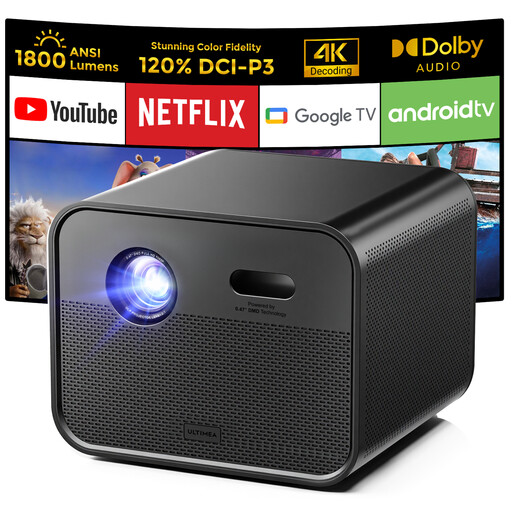
Why this model suits this profile : its advertised brightness and image-processing features are aimed at those who switch between films, sport, video games and occasional outdoor projections.
The product details specify the advertised 1,800 ANSI lumens, native 1080p resolution and 4K decoding. The 6D adjustment limits distortion when the projector is installed off-centre.
DLP, HDR10/HLG, autofocus, 6D correction, Google TV, two 10 W speakers and an advertised picture size of 20 to 300 inches.
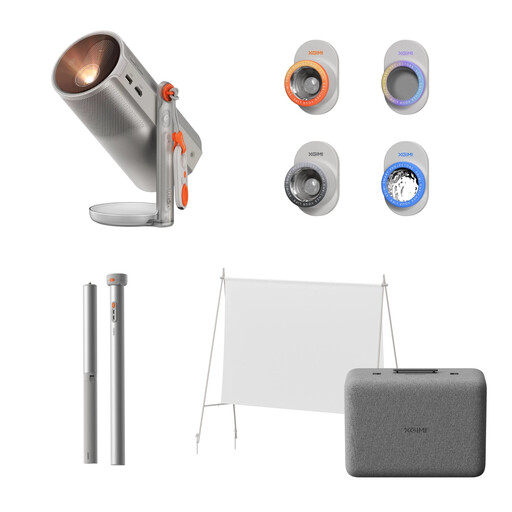
Why this model suits this profile : its built-in battery and easy-to-carry design make it possible to organise a film night in a bedroom, on a terrace or while travelling.
The product details state 450 ISO lumens, Full HD resolution and 2.5 hours of battery life. You should therefore choose a dark room and bear in mind that actual battery life varies depending on the mode used.
Google TV, licensed Netflix according to the product details, autofocus, automatic correction, Harman Kardon speakers and built-in battery.
We have put together a complete, real-time updated selection of products that meet these demanding criteria while complying with European safety regulations.
Built-in speakers are sufficient for watching everyday content, but a soundbar will provide clearer dialogue and greater depth to film soundtracks. Check for HDMI ARC or eARC, Bluetooth and an audio output compatible with your setup.
Always place the projector on a stable surface and make sure its vents are not obstructed. Never look directly into the lens while it is switched on, and allow the device to cool down before storing it away. For a ceiling installation, use a mount designed for this purpose and make sure it is properly secured.
In a well-darkened room, moderate brightness may be sufficient. If the living room remains lit, a higher advertised figure will provide more flexibility. However, only compare measurements expressed in the same unit and choose a light-coloured wall or a suitable screen.
Not necessarily. A native 1080p projector will be perfectly suitable for films, series and consoles in many situations. Native 4K becomes worthwhile if you have ultra-high-definition content, a large screen and a sufficient viewing distance. Always check whether the 4K claim refers to actual display resolution or simply signal decoding.
Only if it has a built-in battery. Despite their portable design, some compact models still depend on a mains adapter. Before planning an outdoor film session, check the advertised battery life, the projection mode used and the accessories supplied.