Buying priorities
First check the compartments you need and the space available, then compare the specifications of the exact model rather than relying on the exterior format alone.
| Priority |
What to check |
Your needs |
| Usable capacity |
Compare the net litres of the fridge and freezer separately. Also check the type of compartment and the star rating on single-door or table-top models. |
I want my fresh shopping, prepared meals and frozen food to fit without paying for capacity I will not use. |
| Access and installation |
Measure the space, door opening, delivery route and the packaged appliance dimensions where these are provided. Check the clearances specified in the model’s instructions. |
My fridge must fit through the access points in my home and be installed without obstructing furniture or movement around the room. |
| Energy use and ambient temperature |
Compare annual consumption in kWh, capacities and noise levels between similar models. Check that the climate class matches the actual temperature of the room. |
I want to avoid an appliance that is unsuitable for a cellar, garage or very warm kitchen. ADEME notes that the energy label helps you compare appliances. |
| Frost management |
Check whether fan-assisted cooling or No Frost applies to the compartments you need. Read the maintenance instructions and leave enough space for air circulation. |
I am looking for storage that is easy to maintain when frozen and fresh food is stored regularly. |
Joybuy options
These Joybuy options are fridge freezers designed to organise fresh shopping and frozen-food stocks. Compare their compartment capacities, dimensions and installation requirements with your kitchen.
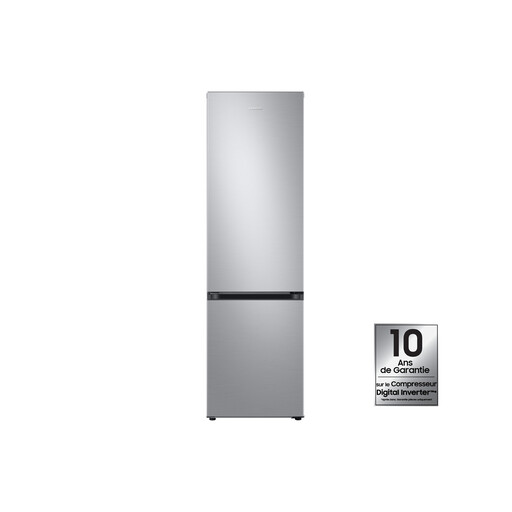 Image unavailable
Samsung RL38C602CSA 390 L, class C
For a weekly shop with a stock of frozen food, the stated capacities are 276 L for the fridge and 114 L for the freezer.
Freestanding format measuring 59,5 × 203 × 65,8 cm, reversible door, 169 kWh/year and a stated ambient temperature range of 10 to 43 °C. Check the ventilation clearances and available height before buying.
Joybuy
 Image unavailable
CHiQ JR263LGE 262 L Low Frost
This fridge freezer is presented as suitable for a small household doing a weekly shop, with 187 L of fridge space and 75 L of freezer space.
Width of 54 cm, height of 176 cm, 4-star freezer and N-ST climate class from 16 to 38 °C. The Low Frost system requires manual freezer defrosting, stated to be needed approximately once or twice a year.
Joybuy
 Image unavailable
Samsung RB33B612EBN 344 L, class E
The 114 L bottom freezer with three drawers is suitable for regular frozen-food storage, while the fridge offers 230 L.
Dimensions of 59,5 × 185,3 × 65,8 cm, reversible door, No Frost technology and stated consumption of 254 kWh/year. Compare this consumption with appliances of a similar capacity and format.
Joybuy
 Image unavailable
LG GBBSJ1CCSW 333 L, class C
For a medium-sized household, the stated capacities are 183 L of fridge space, 37 L of fresh-food compartment space and 113 L of freezer space.
Dimensions of 597 × 1 860 × 674 mm, T climate class and a stated clearance of 5 cm. Check the exact temperature range and the instructions if the appliance is to be installed outside a temperature-controlled kitchen.
Joybuy
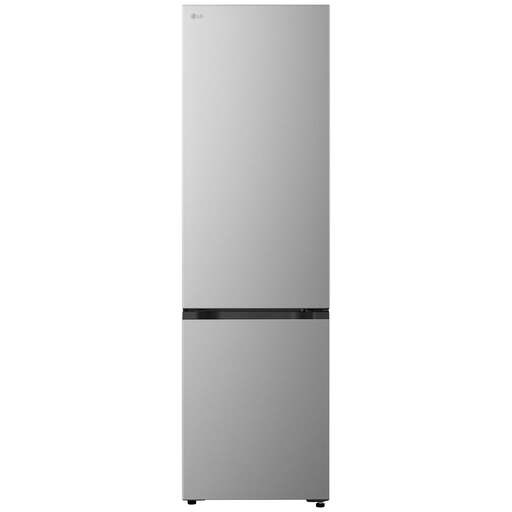 Image unavailable
LG GBBS322BPY 375 L, class B
This bottom-freezer model offers a stated total capacity of 375 L for households looking for more storage space.
Dimensions of 595 × 675 × 2 030 mm, SN-T climate class from 10 to 43 °C and stated clearances of 50 mm at the sides and 100 mm at the back. Check the net capacity of each compartment and the annual consumption before buying.
Joybuy
Frequently asked questions
How do you choose between a fridge freezer and an American-style fridge?
First compare the number of litres you need in each compartment, then consider the available space and delivery route. A fridge freezer is suitable when you want fridge and freezer storage combined in a more compact footprint; an American-style model should be reserved for a long-term need for very large capacity and a compatible kitchen. Que Choisir reports that American-style models are more expensive and use more energy than conventional fridges.
What measurements should you take before delivery?
Measure the height, width and depth of the space, the required clearances, the door opening and the complete route from the entrance. For large formats, also check the packaged appliance dimensions when the seller provides them; Samsung recommends measuring doors, lifts and corridors for its larger models.
Is ventilation the same for every fridge?
No, clearances depend on the installation type and the model. Bosch states in its FAQ that at least 200 cm² of free space is required behind and underneath the fridge, while its built-in under-counter appliances are ventilated through the plinth. Always consult the installation diagram for the exact model.
Which climate class should you choose in France?
Choose a class whose range covers the actual temperature of the room, rather than just the outdoor temperature. For example, Beko states SN as 10 to 32 °C, N as 16 to 32 °C and SN-T as 10 to 43 °C. For a garage, cellar or conservatory, check the model’s specific documentation.
What should you check on the energy label of a fridge sold in France?
At a minimum, compare the energy class, annual consumption in kWh, the stated capacities for each compartment and, where available, the model’s EPREL entry. The European Commission states that energy labelling and ecodesign requirements apply to refrigeration appliances; do not compare a class letter in isolation between formats or capacities that are very different.


