First, choose a fridge that will fit through to your kitchen, can be ventilated properly and has enough room for the door to open. Then compare the usable fridge and freezer capacities with the size of your household, how often you shop and how much freezer space you need. Que Choisir’s guide of 100 to 150 litres for one person, plus 50 litres for each additional person, is a useful starting point, but should be adjusted to suit your habits. If you’re comparing appliances of a similar size and capacity, also check their stated annual energy consumption and noise levels.
Who are these criteria useful for?
Someone living in a studio flat or with a small kitchen
Available space isn’t the only thing to consider: the appliance also needs to fit through to its intended spot, have room for ventilation and allow the door to open freely. Que Choisir suggests a table-top model as an option for a studio flat, but be sure to check its usable capacity and how much room it offers for frozen food.
A house share or small household that shops regularly
If several people share fresh food and use the freezer too, compare the capacity of each compartment. A fridge-freezer could suit both needs, as long as its layout matches the food you actually store.
A household that shops less often and stocks up on frozen food
Compare fridge and freezer capacities separately before choosing an appliance based on its total capacity. If you’re considering a larger model, check that it can be brought into your home and that there’s enough space for it in your kitchen.
Which criteria should you look at first?
Start by ruling out any sizes that won’t fit along the delivery route or in the space you have planned. From the remaining options, choose a balance of fridge and freezer space that suits what you store most often.
| Criteria |
What to check |
Who it’s for |
| Access and positioning |
Measure the narrowest point along the route and the space where the appliance will go. Check the manual for ventilation requirements and how far the door needs to open to remove bins and drawers. |
In a narrow kitchen, getting the appliance in and being able to use it once it’s installed matter more than having extra litres of capacity. Around 27% of consumers would put this constraint first. |
| Fresh food storage for a small household |
Compare the usable fridge capacity with your usual shopping. Que Choisir gives 100 to 150 litres for one person as a useful, adjustable guide. |
For someone who shops often and buys small quantities, the priority is having enough room for fresh food without choosing an unnecessarily large fridge. This is said to be the main need for around 21% of consumers. |
| Balancing fresh and frozen storage |
Check the capacity of each compartment, not just the total. Make sure the freezer has enough space for the frozen food you keep. |
When several people share an appliance, everyone needs room for their fresh food without leaving too little space for frozen items. Around 26% of consumers would prioritise this balance. |
| Less frequent shopping and frozen food |
Compare fridge and freezer capacities separately, then check the dimensions of the model you’re considering. For similar models, also compare their stated kWh/year and noise levels. |
If your shopping needs to last several days and includes lots of frozen food, the capacity of each compartment is what matters most. This would be a priority for around 26% of consumers. |
Which mistakes should you avoid?
-
Looking only at the total capacity
Two fridges with a similar total capacity can offer different amounts of space for fresh and frozen food. So a larger overall figure doesn’t necessarily mean the freezer will suit your shopping habits.
Compare the capacity of each compartment with what you store between shops.
-
Measuring only the final space
An appliance might fit between two units but still be too wide to get through a narrow access point, have insufficient ventilation or lack the clearance needed to open the door and remove its drawers.
Measure the delivery route and the space where the appliance will go, then follow the clearances and door-opening instructions in the model’s manual. Que Choisir’s general guide of 5 cm for certain clearances doesn’t replace these instructions.
-
Choosing a multi-door model just because it has a large capacity
This style can suit households with substantial storage needs, but it must fit in your kitchen and be accessible on the way in. Que Choisir describes American-style appliances as more energy-intensive than conventional fridges, so it’s worth checking the energy consumption of the model you choose.
Make sure its fridge and freezer capacities suit your shopping, then check its dimensions and stated annual energy consumption.
-
Comparing only the energy label rating
Looking at the energy class on its own doesn’t tell you how much the appliance can store or its annual energy consumption. The European Commission says the EPREL product information sheet also shows details such as capacity, dimensions and noise levels.
Compare the energy class and kWh/year figures for fridges of a similar size and format, taking into account how the space is divided between fresh and frozen food.
Brands to know
There are no brand profiles to display in this section.
Fridges available on Joybuy
These models include fridge-freezers and multi-door appliances, so you can compare different ways of dividing space between fresh and frozen food. Before choosing, compare their capacities with your shopping habits and check that you have room for them at home.
 Image unavailable
Candy CFQQ5T817EPS, four-door, 467 L
Worth considering if you do a big shop and have room for a multi-door appliance. The product description states a total capacity of 467 L, Total No Frost technology and an E energy class. Check how the capacity is divided and the clearances specified in the manual.
View on Joybuy
 Image unavailable
Haier HTW5618ENMG, three-door, 360 L
A model to consider if your household needs to store both fresh and frozen food in a 360 L appliance. The product description mentions Total No Frost, Wi-Fi, My Zone and an E energy class. Check the capacity of each compartment and the space needed to open the doors.
View on Joybuy
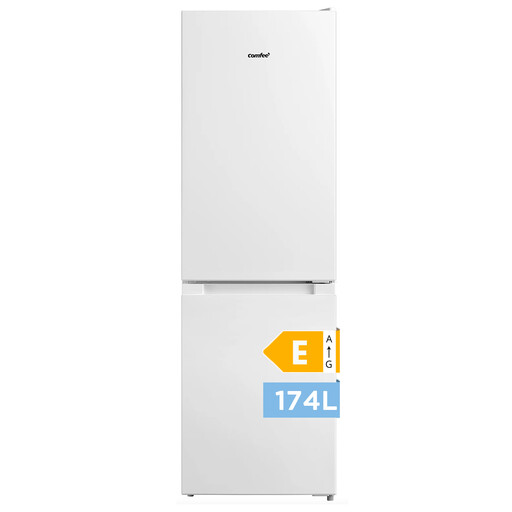 Image unavailable
Comfee' RCB169WH2(E), 174 L
Worth comparing if you have a small household and also need a freezer compartment. The product description states a total capacity of 174 L, a height of 150 cm, Low Frost, a four-star freezer, 39 dB, a reversible door and an E energy class. Check the label for annual energy consumption and the manual for installation clearances.
View on Joybuy
 Image unavailable
Samsung RF50C530EB1 multi-door, 495 L
Worth considering if you need plenty of space and have room for a multi-door appliance. The product description states a total capacity of 495 L and an E energy class. Compare the space for fresh and frozen food, then check the delivery route and how far the doors need to open.
View on Joybuy
 Image unavailable
CHiQ JR227LSE, 227 L, 54 cm wide
Worth comparing if kitchen space is limited but you need two storage compartments. Its stated 227 L capacity is divided between a 153 L fridge and a 74 L freezer. The product description also mentions Low Frost, a four-star freezer, a reversible door and an E energy class. Before you decide, check the model’s height, annual energy consumption and installation clearances.
View on Joybuy
Frequently asked questions
How can I tell if a fridge can be delivered and installed?
Measure the narrowest point on the route to your kitchen and the space where the appliance will go, then compare these measurements with the model’s dimensions before ordering. Also check the clearances required in the manual and how far the door needs to open to remove bins or drawers. For an integrated model, measure the inside of the housing unit. Let the seller or delivery company know about any stairs, lifts or other access restrictions.
What capacity should you allow for one person, a house share or a family?
Que Choisir suggests using an average of 100 to 150 litres for one person, plus 50 litres for each additional person, as a starting point rather than a fixed rule. Adjust this guide to suit how often you shop and what you store, comparing the space for fresh and frozen food separately.
What should you compare on the energy labels of two fridges?
For two models of a similar size and capacity, compare their energy classes and stated annual consumption in kWh, rather than looking at the letter alone. The European Commission says the EPREL product information sheet also gives details such as noise levels, dimensions and capacities. These details can help you check whether the appliances meet the same storage needs.


