Who is a separate freezer for?
Adding a separate appliance is mainly useful when you’re running out of room in your existing freezer compartment. The right type then depends as much on how you access your food as on how much you want to store.
Households that buy and store in bulk
If bulk shopping or meals prepared in advance regularly fill your fridge’s freezer compartment, a chest freezer is worth considering. How useful it is will depend on the floor space available and whether you can easily reach the bottom of the freezer.
People who open the freezer regularly
If you want to find portions and different types of food quickly, the drawers in an upright freezer may be more convenient than a large open chest. Check how deep the drawers are and whether there’s enough room to pull them out.
People with limited space
A compact model can supplement your fridge in a small kitchen or under a worktop, provided the installation requirements allow it. You’ll need to accept a smaller capacity than an appliance designed for storing large quantities.
How do chest, upright and compact freezers compare?
UFC-Que Choisir distinguishes between these types in particular by their capacity and how easily you can access the food. Start by choosing a model to suit your main needs, then check the features and installation requirements of each specific appliance.
Chest freezer
Consider one if: you want to store a large amount of food or bulky containers, and have enough floor space.
Bear in mind: with top access, you’ll need to organise the freezer so you can find what you’re looking for.
Upright freezer
Consider one if: you want to keep food in separate compartments and regularly access different portions.
Bear in mind: the drawers and door need enough clearance to open and use them.
Compact freezer
Consider one if: you need a little extra storage but have limited space.
Bear in mind: its limited capacity won’t meet the same needs as a large family freezer.
| Criteria |
What to check |
Who it matters to |
| Storage capacity |
Compare the usable capacity with the containers you plan to freeze, then measure the floor space required and the opening clearance. |
If bulk shopping and meal prep are overflowing your fridge, extra capacity becomes the priority; around 31% of consumers would put this need first. |
| Access to food |
Check the drawers in an upright freezer or the baskets in a chest model, and how easy they are to remove and clean. |
For some households, being able to find frequently used portions without searching matters more than having a large open chest; around 31% of consumers would prioritise access and organisation. |
| Available space |
Measure the space, door clearance and the gaps required for installation as set out in the manual. |
In a small kitchen, adding extra storage without crowding the room may matter more than maximum capacity; around 19% of consumers would make available space their main consideration. |
| Installation and power cuts |
Check that the permitted ambient temperature range suits the room and find out how long the freezer can keep food frozen during a power cut. |
If you’re using an unheated cellar or garage, or are concerned about power cuts, the appliance’s suitability and storage time become key factors; around 19% of consumers would put them first. |
To compare energy use and noise, the European Commission says the energy label provides information including annual energy consumption in kWh, storage capacity and noise emissions. Look at these details together and compare appliances with similar capacities and intended uses. The energy efficiency class alone doesn’t tell you how much space is available or how noisy the appliance is.
Brands to consider by freezer type
These examples show different types of freezer and features to check. Their specifications won’t necessarily apply to other models in the same range.
Beko
Beko’s range includes upright, chest and compact freezers. The FSE1174N is an example of a compact model, with a stated capacity of 95 L.
- For the FSE1174N, Beko gives a width of 54 cm and a storage time of 12 h.
- Its stated minimum operating temperature is 5 °C, so check this against the temperature of the room you have in mind.
Liebherr
Among its chest freezers, Liebherr lists the 248 L CFd 2085 Plus, which features FrostProtect.
- Liebherr says this model can be used at ambient temperatures as low as −15 °C.
- This information applies to the model named here. Check its dimensions too: 82 × 125 × 71 cm. Don’t assume another chest freezer has the same operating temperature range.
Whirlpool
Whirlpool’s French catalogue includes upright freezers, some with No Frost, for people who prefer vertical access.
- Depending on the configuration, the compartments may make it easier to organise food by category.
- Check the exact model for the number of drawers, dimensions, annual energy consumption in kWh and noise emissions.
Haier
Haier’s French collection includes upright and chest freezers, which you can compare according to your storage and access needs.
- Having both types available makes it easier to compare models designed for different uses.
- To compare two models, check their usable capacity, dimensions and energy label information.
Freezers for different storage needs
These Joybuy models include an upright freezer with compartments, several chest freezers and a compact model for extra storage. Start by comparing their type and capacity with your needs, then check the installation requirements for the model you’re interested in.
 Image unavailable
Heinrich´s 161 L stainless steel upright freezer
Consider this model if you’d like to organise food in the compartments of an upright freezer rather than in an open chest.
Stated capacity: 161 L. The product name mentions drawers, trays, No Frost, an alarm and energy efficiency class C.
Before choosing where to put it, check its dimensions and permitted ambient temperature range. Also check the annual energy consumption in kWh and storage time if these matter to you.
View on Joybuy
 Image unavailable
AUCMA 291 L convertible chest freezer
This chest freezer is for anyone looking for plenty of storage space and with enough room to open the lid.
Stated capacity: 291 L. The product name lists fridge or freezer mode, a removable basket, LED lighting and energy efficiency class E.
If you plan to install it in an unheated room, check the model’s ambient temperature range. Also check how long it can keep food frozen during a power cut.
View on Joybuy
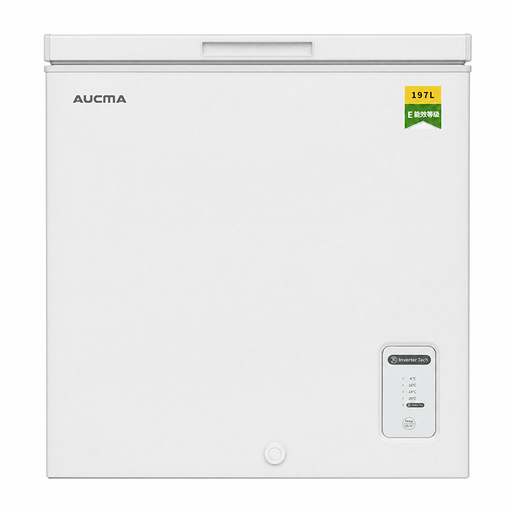 Image unavailable
AUCMA 197 L convertible chest freezer
Consider this model if you want a chest freezer with less capacity than the 291 L AUCMA model but still prefer top access.
Stated capacity: 197 L. The product name lists fridge and freezer modes, a removable basket and energy efficiency class E.
Measure the space and clearance needed to open the lid. For a cellar or garage, check the permitted temperature range against the room’s actual conditions.
View on Joybuy
 Image unavailable
COMFEE' RCU60WH2(E), 60 L compact freezer
With a capacity of 60 L, this model is for when you need some extra storage but don’t have much space, rather than for storing large quantities.
The product name lists three drawers, a reversible door and energy efficiency class E.
Before placing it under a worktop, check its dimensions and the clearances required in the manual, as well as its annual energy consumption in kWh and permitted ambient temperature.
View on Joybuy
 Image unavailable
TCL CF182EWE0FR, 140 L chest freezer
This chest freezer may suit you if you need extra storage, have floor space available and prefer an open chest to a model with drawers.
Stated capacity: 140 L. The product name mentions a basket, a counterbalanced lid and energy efficiency class E.
Before choosing this model for your room, check the clearance needed to open the lid, annual energy consumption in kWh and permitted ambient temperature range.
View on Joybuy
Frequently asked questions
Can you put a freezer in an unheated garage?
Yes, if the model’s permitted ambient temperature range covers the temperatures in the garage. Check the limits in the product details or manual rather than relying on the type of freezer alone. Beko gives the FSE1174N a minimum temperature of 5 °C, while Liebherr says the CFd 2085 Plus chest freezer’s FrostProtect feature allows it to operate down to −15 °C. These figures apply only to the models mentioned.
What should you compare on the energy labels of two freezers?
Compare annual energy consumption in kWh, storage capacity and noise between models with similar capacities and intended uses. The European Commission says the label shows this information as well as the energy efficiency class, so the class alone won’t tell you about capacity or noise levels.
What does a freezer’s stated storage time mean?
Storage time helps you compare how long a freezer can keep food frozen during a power cut, especially if you store a lot of food. In its freezer tests, UFC-Que Choisir measures the time it takes for the temperature to rise from −17 °C to −9 °C without a power supply. Check the stated figure for each model and the method used before comparing results.
What protection applies to a new freezer bought from a professional seller in France?
According to the French Ministry of the Economy, the legal guarantee of conformity applies to goods sold by a professional to a private individual in France. It covers issues such as goods not conforming to the contract. Any commercial guarantee offered by the seller is in addition to this protection, not a replacement for it.


