
Livraison le jour même ou le lendemain

Qualité garantie

Débloquez vos offres de bienvenue: Livraison GRATUITE | Jusqu'à -80 % | 30 jours d'essai gratuits à JoyPlus
Téléchargez l'application
Carrying your shopping to your flat, climbing a few steps or moving a bulky parcel does not necessarily require a car. A foldable shopping trolley can make everyday journeys much easier, provided you choose a model suited to the weight you need to carry, the terrain and the storage space available.
From foldable shopping trolleys for groceries to transport trolleys for boxes and foldable sack trucks designed for heavy loads, different needs call for different solutions. Here are the key points to consider to avoid disappointment and identify the model best suited to how you intend to use it.
A very spacious bag may seem ideal, but its capacity says nothing about the strength of the frame, wheels or handle. Some product specifications also state different maximum loads depending on whether the trolley is used in sack truck mode or platform mode.
To compare models properly, always check:
A large-capacity shopping trolley is therefore not necessarily designed to carry bottles, heavy parcels or camping equipment.
Small, rigid wheels may be perfectly suitable for smooth supermarket floors, but perform much less well on cobbles, wet grass or gravel paths. For outdoor use, choose wide wheels, impact-resistant materials and, where necessary, a braking system.
A trolley with all-terrain wheels will generally take up more space than a compact wheeled shopping bag. You therefore need to strike the right balance between easy storage and stability on different types of surface.
A lightweight, compact trolley is comfortable to carry and easy to store. However, a very lightweight structure may provide less support for bulky loads. Conversely, a robust model may weigh several kilograms and take up more room in a boot or cupboard.
The best compromise mainly depends on the journey you have in mind: weekly shopping, stairs, trips to the market, occasional house moves or transporting parcels.
Pay close attention to the stated maximum load. Never exceed the specified limit, and place the heaviest items at the bottom, as close to the axle as possible. An aluminium frame is often valued for its light weight, while an alloy steel frame is more likely to be intended for intensive use, depending on the product’s overall design.
A 2-in-1 trolley can switch from an upright position, like a sack truck, to a horizontal platform. This versatility is useful for moving boxes, crates or bags of different sizes. However, make sure you check the permitted load for each configuration.
Measure the space where the trolley will be stored: your car boot, hallway, utility room or underneath a piece of furniture. A narrow folded width may prove more useful than a large-capacity bag.
The handle should be high enough and, if possible, adjustable. A non-slip grip makes the trolley easier to control, particularly when changing direction. For older users, look for a simple opening mechanism, good stability and a brake if the trolley needs to remain stationary on a slope.
Wheels fitted with bearings can make movement smoother, but their effectiveness also depends on the weight being carried, the type of surface and maintenance. After using the trolley on wet or dusty ground, remove any debris and wipe the frame with a slightly damp cloth.
To protect the folding mechanism, do not force it shut if the fabric, a strap or a wheel is out of position. Once folded, store the trolley somewhere dry.
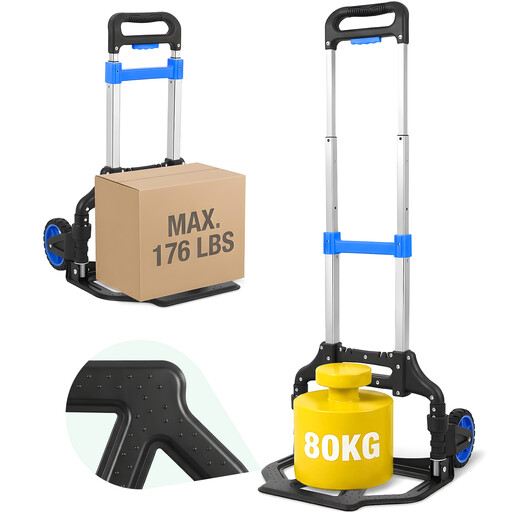
Why this choice suits this user profile: Weighing just 3.5 kg and folding away quickly, it is ideal for occasional shopping trips, small parcels and limited storage space.
The specifications clearly state a maximum load of 80 kg and three handle heights. This makes it clear that a lightweight design does not mean there is no load limit.
Aluminium frame, TPR wheels with double bearings, adjustable handle at 63, 90 or 100 cm, and a stated folded width of 5.7 cm.
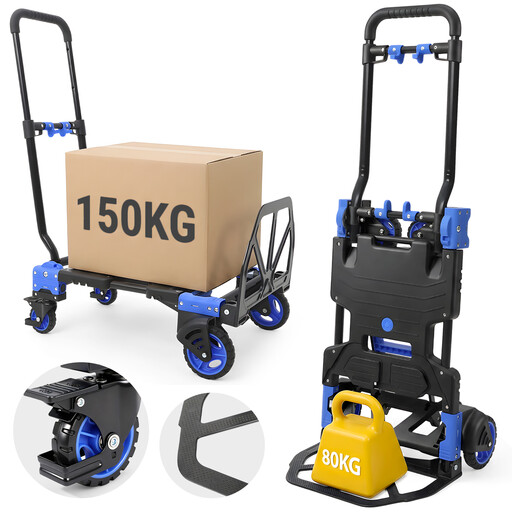
Why this choice suits this user profile: Its ability to convert into a sack truck or platform makes it ideal for anyone looking for one trolley to move boxes, organise storage or tackle a range of household tasks.
The load limits are clearly differentiated: 80 kg in sack truck mode and 150 kg in platform mode. This makes it easy to select the right configuration for each task.
Aluminium chassis, TPR wheels with double bearings, adjustable handle and integrated parking brake.
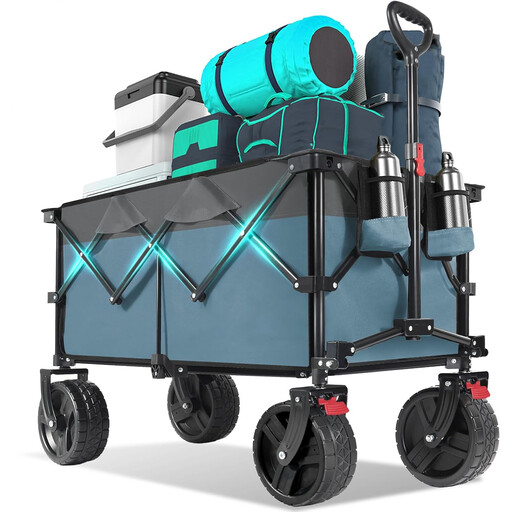
Why this choice suits this user profile: Its generous capacity is ideal for families, campers and anyone who regularly transports bulky equipment across grass or uneven ground.
The product details clearly distinguish between a 200 L capacity and a stated maximum load of 200 kg. Straps also help keep the contents securely in place.
Alloy steel frame, waterproof 600D Oxford fabric, 7 inch all-terrain wheels, brake and tool-free folding mechanism.
We have put together a comprehensive, real-time selection of products that meet these demanding criteria, as well as European safety standards.
A lightweight model with an adjustable handle and sufficiently wide wheels will be easier to control on both stairs and pavements. Also remember to check its unloaded weight: once full, a trolley that is too heavy can quickly become difficult to lift. For standard shopping bags, a reasonable capacity will often be more practical than a 200 L model.
It depends on the weight carried, how often it is used and the storage conditions. Respect the maximum load, avoid dragging the trolley over large obstacles and clean the wheels regularly. A well-maintained frame and a folding mechanism operated without force will continue to work properly for longer.
No. A conventional wheeled trolley works without a battery or mains power. Running costs are essentially limited to routine maintenance and, depending on the model, the possible replacement of a wheel or worn part. If you are looking for a manual solution for transporting shopping or parcels, focus mainly on the maximum load, dimensions and type of terrain.