
Livraison le jour même ou le lendemain

Qualité garantie

Débloquez vos offres de bienvenue: Livraison GRATUITE | Jusqu'à -80 % | 30 jours d'essai gratuits à JoyPlus
Téléchargez l'application
Hard water leaves white marks on your taps, reduces shower comfort and clogs up nozzles. A high-pressure filtered shower head can seem like a simple solution to this problem. But marketing claims alone aren’t enough to make the right choice.
Number of filter layers, the phrase “high pressure” or multiple spray settings: several factors deserve a closer look. Here are the points to check to avoid a disappointing purchase and choose a shower head that works with your plumbing in the UK.
A shower head fitted with a filter can reduce certain elements in the water, depending on the cartridge composition and the manufacturer’s specifications. However, it does not replace a whole-house water softener.
Filtration at the shower head mainly affects the water you use for washing. It does not make the water drinkable and is not a medical device. When choosing a shower head for hard water, look closely at the specific substances the manufacturer targets: residual chlorine, particles or certain metals, for example.
The feeling of pressure depends on the flow rate available in your home, the height of your installation and the condition of the hose. A shower head with fine nozzles can produce a more concentrated spray without actually increasing the mains pressure.
A water-saving shower head can also reduce the flow rate. So it’s better to look for a balance between comfort, spray coverage and consumption, rather than trusting a general promise of power.
A clogged filter can reduce the flow rate and make the shower head less pleasant to use. Its lifespan varies depending on water quality and how often you shower. Some models recommend replacement every three to four months, while others base it on a drop in flow rate or the volume of water filtered.
Before ordering, check the price and availability of replacement cartridges. An affordable unit can quickly become a hassle if its consumables are hard to find.
The phrase 20-layer filter catches the eye, but the number of levels alone isn’t enough to compare two products. You also need to look at the materials used. Some models combine activated carbon, calcium sulphite, KDF, vitamin C or mineral beads.
These components are said to help reduce residual chlorine or certain impurities. Stay alert to the wording used: “reduces” does not mean “completely eliminates”. Performance also depends on the cartridge, the flow rate and the water quality in your area.
An anti-chlorine shower filter can be useful in homes where the smell of chlorine is particularly noticeable. As for limescale, a filter can limit some deposits depending on its design, but it won’t remove all the effects of highly mineralised water.
In the UK, G1/2 threading is very common for shower fittings. A model with a universal connector can usually be fitted easily onto an existing hose. Still, check:
A shower head with hose and bracket can simplify a full replacement of your old shower head. This way, you avoid buying separate accessories that might not be compatible.
A 6-mode shower head lets you adapt the spray for different uses: rinsing hair, daily showering, a more concentrated jet or cleaning the shower enclosure. Choose a selector that’s easy to operate, rather than a mechanism that’s hard to turn with wet hands.
Soft silicone nozzles generally make external cleaning easier. However, they don’t replace regular maintenance or cartridge replacement. In a very hard water area, wiping the nozzles periodically helps limit visible build-up of deposits.
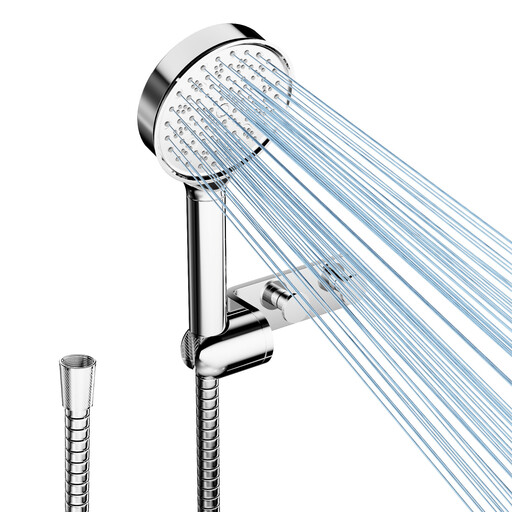
Why this choice suits this profile: This solution brings together the shower head, hose and bracket. It’s ideal for people who want to replace several items in one go, without making multiple purchases.
The 20-layer filter and six spray modes come in a ready-to-install set. This limits the need for separate accessory purchases and compatibility issues.
Advertised 20-level filtration, six spray modes, hose and bracket included.
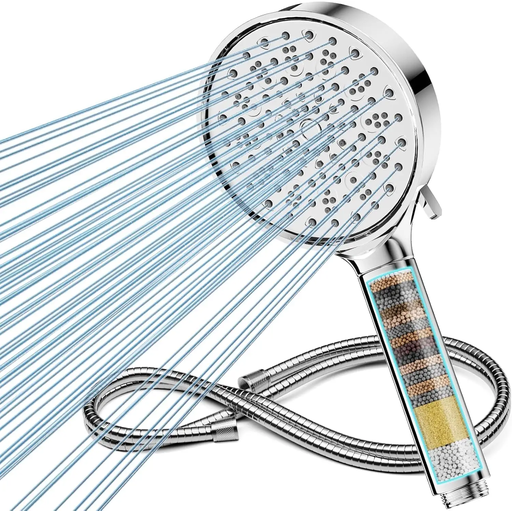
Why this choice suits this profile: Its metal housing and large panel appeal to users looking for a more refined finish and generous spray coverage.
The product page specifies the G1/2 connection and the items supplied. This makes it easier to check compatibility with your setup before buying.
Metal housing, 124 × 124 mm panel, six modes and advertised 20-level filtration system.
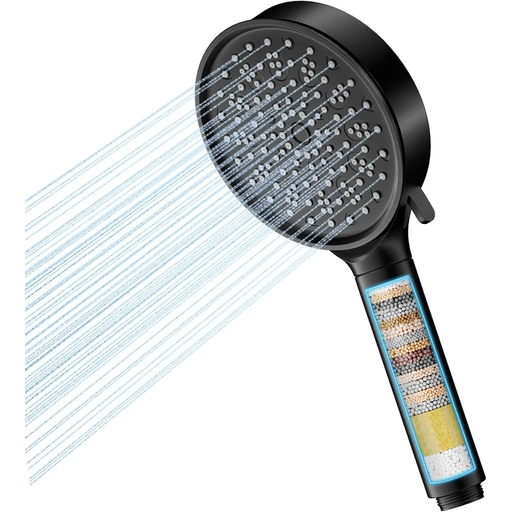
Why this choice suits this profile: Its six modes, large panel and advertised water-saving design meet the needs of a household where the shower is used frequently.
The product page recommends replacing the filter every three to four months, or as soon as the flow rate drops. This guidance makes maintenance tracking easier.
Universal G1/2 connection, pre-installed filter, six spray modes and flow restrictor supplied separately.
We’ve put together a comprehensive, real-time updated list of products that fully meet these strict selection criteria and European safety regulations.
Installing a high-pressure filtered shower head is generally something anyone can do:
Don’t use pliers directly on the chrome parts. If the flow rate is too high, adding a restrictor can improve comfort. Conversely, a gradual drop in flow rate often signals a filter that needs replacing or nozzles that need cleaning.
To extend the life of the shower head, wipe off visible deposits regularly and follow the manufacturer’s instructions. Used cartridges should be replaced at the recommended frequency or as soon as flow performance decreases.
Most models intended for the UK market use a G1/2 connection, but still check the diameter, hose type and wall bracket. An adapter may be needed for an unusual setup.
The frequency depends on the model, the volume of water used and its mineral content. Some manufacturers recommend replacement every three to four months. Also change the cartridge if the flow rate drops despite cleaning the nozzles.
Some models are designed to concentrate the spray or incorporate a flow restrictor. Actual consumption depends on the available pressure, shower duration and the mode selected. Check the flow rate data when provided and choose a setting that suits your installation.