Guests who want a pronounced cocoa flavour
If the flavour of dark chocolate matters more than milky sweetness, take a look at dark chocolate bars and their cocoa percentages. Lindt France, for example, offers DESSERT bars with 51% and 70% cocoa.


If some of your guests want a pronounced cocoa flavour on their crêpes, choose dark chocolate rather than white chocolate: white chocolate contains cocoa butter, but no cocoa mass. Dessert white chocolate is for a different kind of treat: a smooth, milky topping. Offering both separately lets everyone choose their own topping. If you’re making a sauce, check the instructions on the chocolate bar you choose.
If the flavour of dark chocolate matters more than milky sweetness, take a look at dark chocolate bars and their cocoa percentages. Lindt France, for example, offers DESSERT bars with 51% and 70% cocoa.
For a smooth, milky topping, choose a bar labelled ‘white dessert chocolate’ or ‘baking chocolate’. Nestlé France offers a DESSERT Blanc version, while Auchan and E.Leclerc also list white chocolate bars intended for desserts.
Before serving several guests, compare the nutritional information per 100 g and check the ingredients and allergen information for each bar. In France, the Nutri-Score is optional, according to Santé publique France, so if it’s not shown, you’ll still need to read the label.
First decide whether you want the topping to taste of dark chocolate or milky white chocolate. If your guests have different preferences, prepare two separate toppings and check the label on each one.
| What to consider | What to check | Who is it for? |
|---|---|---|
| Pronounced cocoa flavour | The ‘dark chocolate’ label and cocoa percentage; Lindt France offers DESSERT bars with 51% and 70% cocoa. | If I want dark cocoa to be the dominant flavour in my topping, a white chocolate bar won’t give me that. Around 40% of consumers would prioritise this intensity. |
| Smooth, white chocolate topping | The ‘white dessert chocolate’ or ‘baking chocolate’ description, followed by the preparation instructions if you plan to melt the bar. | If I’m making a milky topping to serve with crêpes, I’ll first look for a white chocolate bar suited to desserts. This smooth sweetness would be the main priority for around 40% of consumers. |
| Ingredients and allergens | Sugars and fat per 100 g, followed by allergen information and any ‘may contain’ warnings on the exact packaging. | If several people will be sharing the toppings, I want to be able to check the ingredients in each bar before serving. Around 20% of consumers would put this check first. |
According to Lindt France, white chocolate contains cocoa butter but no cocoa mass. So a cocoa percentage on a white chocolate bar doesn’t mean it will taste like a dark chocolate bar.
If your guests like different flavours, prepare a white chocolate option and a dark chocolate option separately.
The French Ministry of the Economy describes this levy as applying to sugary drinks, not chocolate bars. It isn’t a way to compare their recipes.
To compare chocolate bars, check the sugars listed in the nutritional information per 100 g and consider how much you’ll use for each topping.
In France, displaying it is optional, according to Santé publique France. The DGCCRF explains that nutrition declarations are generally required for pre-packed foods, making it possible to check sugars and fat, among other things.
If a bar has a Nutri-Score logo, use it as extra information, but don’t overlook the ingredients, nutritional information and allergens.
White chocolate listings published by Auchan, Carrefour and E.Leclerc include milk in the ingredients or, depending on the product, warn that traces of other allergens may be present. Even a small amount on a crêpe is no reason to skip these checks.
Ask your guests to let you know about any allergies, and keep the packaging so you can check the labels of the bars you actually serve.
Lindt France distinguishes its DESSERT dark chocolate bars, listed as containing 51% and 70% cocoa, from its EXCELLENCE Blanc Extra Velouté white chocolate bar.
Nestlé France offers NESTLÉ DESSERT in several flavours, including Blanc, Noir and Corsé.
Carrefour offers a 200 g Original white chocolate bar, which is worth considering for a white chocolate topping rather than a dark chocolate flavour.
Auchan offers a 180 g white dessert chocolate bar.
E.Leclerc offers products including Tablette d’Or Chocolat Blanc Dessert Pâtissier 180 g and Eco+ Chocolat Blanc in a 4 × 100 g pack.
These bars cater for two different tastes on crêpe night: a white chocolate option for baking and dark chocolate for guests who prefer cocoa. For the dark chocolate bars below, check the preparation instructions before using them to make a sauce or topping.
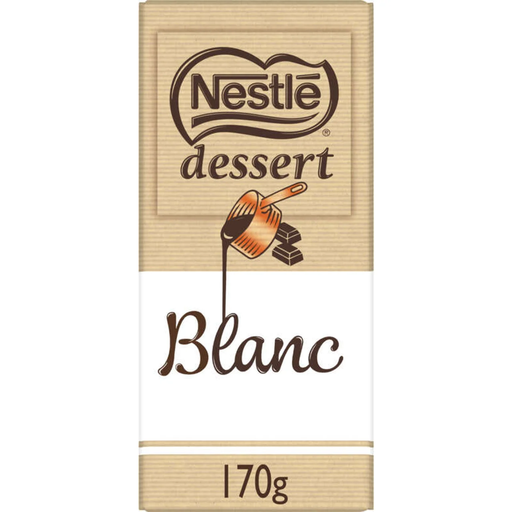 Image unavailable
Worth considering if you’d like to make a white chocolate topping rather than a dark chocolate one. This bar is designed for baking; check the preparation instructions before melting it for crêpes. Also check the allergen information on the packaging.
 Image unavailable
Worth considering if you’re looking for a dark chocolate bar with a high cocoa percentage. This is an 85% cocoa dark chocolate, distinct from Lindt DESSERT bars with 51% and 70% cocoa. Check the preparation instructions if you plan to melt it for crêpes.
 Image unavailable
This 70% cocoa dark chocolate bar is a good option if you’re looking for dark rather than white chocolate. Information for this product mentions maltitol, a warning about excessive consumption and soya lecithin. Read the label and check the preparation instructions before using it as a melted topping.
 Image unavailable
This mini size is a handy way to offer dark chocolate separately from the white chocolate topping. The bar contains 70% cocoa. Check the preparation instructions before using it in a sauce, and look out for warnings that traces of nuts, milk and soya may be present.
No, not if you want the taste of dark chocolate. According to Lindt France, white chocolate contains cocoa butter but no cocoa mass. If an intense cocoa flavour is your priority, look at dark chocolate bars and their cocoa percentages instead. Check what they’re intended for if you want to melt them.
No. The French Ministry of the Economy describes this levy as a tax on sugary drinks, not chocolate bars. To compare the sugars in two bars, check their nutritional information per 100 g.
No. Santé publique France explains that displaying it is voluntary. The DGCCRF states that nutrition declarations are generally required for pre-packed foods, so read this alongside the ingredients list, whether or not the Nutri-Score is shown.
Check the ingredients and any ‘may contain’ warnings on each pack, taking account of the allergies your guests have told you about. Listings for white chocolate published by Auchan and Carrefour, as well as the listing for NESTLÉ DESSERT Blanc published by Auchan, mention milk or possible traces of other allergens, depending on the product. Only the label on the bar you’re serving can confirm its current ingredients.
Follow the storage instructions on the bar you’ve bought. For its 180 g white dessert chocolate bar, Auchan recommends storing it in a cool, dry place. This advice may not apply to other products.