People training for a marathon
You want to distinguish a dessert treat from the food you plan to have around your race. The IRBMS guidance on marathons and post-race recovery treats these as separate occasions.


To choose a chocolate cone with a more pronounced cocoa flavour, check the ingredients and their stated proportions rather than relying on the flavour name alone. A cone is still a dessert: if you’re training for or running a marathon, the IRBMS guidance focuses on suitable food and hydration for exercise, not ice cream as race fuel.
You want to distinguish a dessert treat from the food you plan to have around your race. The IRBMS guidance on marathons and post-race recovery treats these as separate occasions.
You want to spot dark chocolate, cocoa paste or fat-reduced cocoa in the ingredients, without assuming that the word “chocolate” tells you how much of it the recipe contains.
You compare the number of cones and portion sizes, while checking the allergens in the specific recipe before sharing the box.
If a marathon has prompted your search, first separate your dessert choice from your race-day fuelling. Then compare the cocoa ingredients, followed by the cone size and allergens.
| What matters | What to check | Who it matters to |
|---|---|---|
| Marathon fuelling | Plan your food and hydration for the race separately; don’t choose a cone as a substitute for race fuel. | If I’m training for a marathon, I want to enjoy a dessert without confusing it with what I’ve planned for exercise. Around 50% of consumers put this distinction at the top of their list of concerns. |
| Dark chocolate flavour | Read the ingredients and percentages given for dark chocolate or different forms of cocoa. Don’t add together percentages that describe different things. | When I’m looking for a stronger cocoa flavour, the flavour name alone isn’t enough to judge the recipe. This would be the priority for around 30% of consumers. |
| Multipack and allergens | Check the number of cones, the portion size and the allergens on the packaging of the product you’re buying. | When sharing a box, I need to choose a size that suits my household and take everyone’s allergies into account. This would be the main concern for around 20% of consumers. |
Carrefour says its Carrefour Extra cones contain 0.6% dark chocolate; Auchan states that its chocolate cone contains 0.5% dark chocolate powder. These figures describe specific ingredients, not the total cocoa content or the intensity of the flavour.
Compare the stated quantities of ingredients in the exact recipe, and don’t assume that a product contains a lot of cocoa just from its name.
The IRBMS marathon guidance covers, among other things, complex carbohydrate intake before the event and eating appropriately around exercise. A chocolate cone isn’t a substitute for this plan.
Plan your race fuelling and hydration separately from dessert.
Depending on the product, the recipes listed by Carrefour, Auchan and Joybuy contain milk, wheat, soya or nuts. You can’t tell what’s in a chocolate cone just from its category.
Check the ingredients list and allergen information on the box you’re buying.
Auchan gives a portion size of 74.1 g per cone, while Carrefour lists a 90 mL portion for its Magnum cone. The per-portion values therefore aren’t directly comparable.
Start by comparing the nutrition information per 100 g, where available, then check the portion size for the cone you’ll be eating.
According to the Carrefour and Joybuy listings for this product, the Noisette & Chocolat cone combines several chocolate ingredients with hazelnuts.
Carrefour sells its chocolate cones in a pack of six, with chocolate sauce and a wafer cone.
The Auchan chocolate cones come in a pack of six, with nutrition information listed per 100 g and per 74.1 g cone.
The E.Leclerc listing shows TRIUM chocolate cones in a pack of six, with a net weight of 423 g.
This pack of chocolate cones is a dessert option and a format you can compare for sharing, not a choice of marathon fuel. If you’re specifically looking for a high cocoa content, check the ingredients on the packaging.
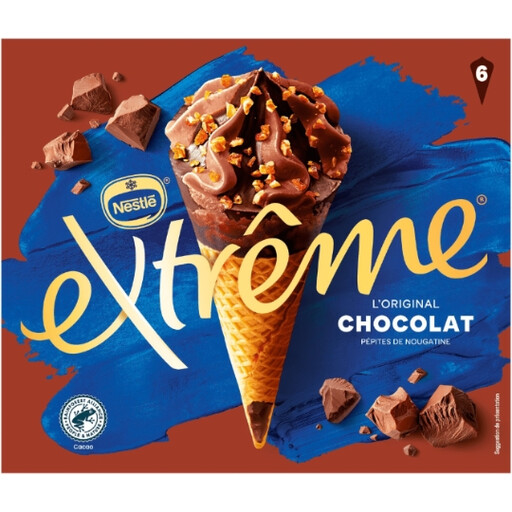 Image unavailable
This pack is a handy choice when you fancy chocolate cones to share for dessert, but it isn’t a substitute for race fuel.
Pack size: six cones, 426 g. Before sharing, check the ingredients, allergens and portion size on the packaging.
No. An ice cream cone doesn’t replace the food and hydration planned for a race. IRBMS guidance distinguishes between preparing your diet before a marathon and your needs around the event, so enjoy a cone as dessert, separately from your plan.
No. The term alone doesn’t tell you how much cocoa the whole cone contains. Look for specifically named ingredients and their percentages. The Carrefour Extra, Auchan and TRIUM listings each give a small percentage for an ingredient described as dark chocolate.
Check the packaging for the exact product you’re buying. Depending on the recipes listed by Carrefour, Auchan and Joybuy, the allergen information may include milk, wheat, soya or nuts. Don’t assume that one brand or flavour has the same ingredients as another.
First, compare the nutrition information on the same basis, such as per 100 g. Then check the portion size given for each product. If you’re choosing a cocoa flavour, read the ingredients too: nutrition information alone won’t tell you how much dark chocolate the cone contains.