People planning their portions
You want to take a chocolatey treat with you without losing sight of how much you actually eat. The weight of each bar and the kcal per portion can help you decide what to pack.


To choose a chocolatey snack while keeping track of the kcal you consume at a picnic, start with the portion you plan to eat, then compare its energy and sugars with the values per 100 g. A small bar may contain fewer kcal per bar simply because it weighs less, rather than because its recipe is lower in energy. The words ‘high-protein’ or the presence of sweeteners won’t answer this question on their own.
You want to take a chocolatey treat with you without losing sight of how much you actually eat. The weight of each bar and the kcal per portion can help you decide what to pack.
You check the ‘of which sugars’ figure, the ingredients list and the allergens, especially if you plan to share the bar.
You also compare protein bars and bars containing sweeteners. Their name alone doesn’t replace checking the energy per portion and the ingredients.
For a picnic, first decide how much you’ll take and eat. Then check the label and packaging for the specific product you’re considering.
| What matters | What to check | Who is it for? |
|---|---|---|
| Portion eaten | Weight and kcal in the bar you plan to eat; kcal per 100 g to distinguish the effect of the size from that of the recipe. | I want to take one chocolatey portion and know what it contains, rather than relying on the word ‘mini’. Around 38% of consumers prioritise the amount they eat and the kcal they consume. |
| Sugars and ingredients | ‘Of which sugars’ per portion and per 100 g; ingredients list and allergens for the exact product. | If the bar is for someone who needs to avoid certain ingredients, I check the label before sharing it and look at the sugars too. This is the first thing around 37% of consumers check. |
| Transport and sharing | Number of bars, individual packaging and storage instructions. | At the park, I prefer bars that I can hand out individually and keep in the conditions stated on the packaging. Being easy to carry and share is the top priority for around 25% of consumers. |
A smaller bar may contain fewer kcal because it weighs less. Snickers France lists 241 kcal for its 50 g bar and 88 kcal for an 18 g minis portion: these figures refer to different portion sizes.
Decide how many bars you plan to eat, then compare the kcal per portion and per 100 g.
‘With cereals’, ‘dark chocolate’ or ‘high-protein’ doesn’t tell you how much energy is in a portion. A recipe containing sweeteners also needs a closer look at the label.
Compare the energy, sugars and portion weight of each product you’re considering. Don’t assume these different types of bar are alike.
Ingredients and allergens vary between products. Products described by Snickers France, Carrefour France and E.Leclerc include recipes containing peanuts, milk, soya or cereals containing gluten.
Read the label of the product you choose and keep its packaging handy for everyone who’ll be eating it.
According to Manger Bouger, displaying it is voluntary. If it appears on the packaging, it won’t tell you how many grams you plan to eat, and it doesn’t replace checking for allergens.
If it’s shown, use it to compare similar products, then check the portion and nutritional information.
These brands offer examples of different sizes and recipes; their characteristics won’t necessarily apply to every product in their ranges.
The group is associated with brands such as Snickers and Twix, whose bars and portions differ.
Snickers France offers, among other options, a 50 g chocolate, caramel and peanut bar, as well as a minis size.
The range combines biscuit, caramel and chocolate. The Twix Top product described by Twix France comes in 21 g portions.
KitKat offers a chocolate-covered wafer bar that the brand says can be broken into pieces.
Carrefour France offers, among other options, a pack of five 50 g chocolate and peanut bars.
E.Leclerc offers chocolate bars and chocolate-coated cereal bars among its products.
These products include a chocolate and peanut protein bar, a dark chocolate and nut bar, and a fruit bar coated in dark chocolate. For each one, the size matters just as much as the name when you’re planning portions for a picnic.
 Image unavailable
Worth considering if you want to compare a chocolate and peanut protein bar with classic chocolate bars. The stated portion is one 55 g bar: check its energy per bar and per 100 g, as well as the ingredients and allergens, before choosing it.
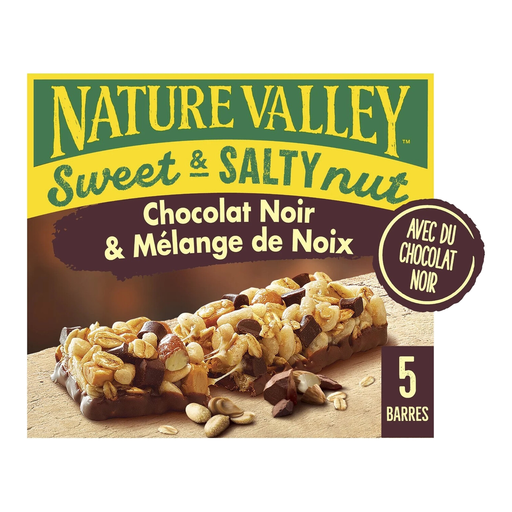 Pack of five 30 g Nature Valley Nut Bar Dark Chocolate & Nuts bars" loading="lazy">
Image unavailable
This pack may suit you if you’re planning to take or share individual bars. It’s a nut and chocolate bar, not a classic chocolate bar. Compare the values for one 30 g bar and per 100 g, then check the allergens.
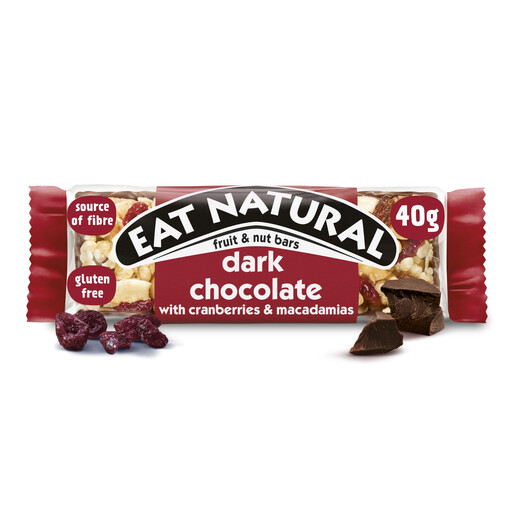 Image unavailable
This fruit and dark chocolate bar offers a different type of recipe to compare for your picnic. The stated portion is 40 g. Check the kcal and sugars per bar and per 100 g, as well as the allergens, rather than relying on the type of chocolate alone.
First check the kcal and sugars in the amount you plan to eat, then look at the values per 100 g to compare the recipes. Snickers France lists 241 kcal for a 50 g bar, while Twix France lists 106 kcal for a 21 g Twix Top portion: their different weights matter when making this comparison.
No. Manger Bouger explains that displaying the Nutri-Score is voluntary. For the prepacked foods covered by the rules, the nutritional labelling requirements described by Anses and the European Commission include a nutrition declaration. If the Nutri-Score is shown, use it as an additional guide when comparing similar products, without overlooking portion size and allergens.
No. These features alone aren’t enough to determine its energy content. Compare the portion you plan to eat with the values per 100 g, then read the ingredients and allergen information for the product you choose.
No. The French Ministry of the Economy describes this levy as applying to sugary drinks, not chocolate bars. When choosing a bar, use its weight, nutritional information and ingredients list to guide you.