People comparing sugar content
You want to choose a spread for teatime without judging it by the jar alone. The ‘of which sugars’ figure, given per 100 g, lets you compare recipes on a like-for-like basis.


To enjoy with your coffee, start by choosing a chocolate and hazelnut spread based on the sugars listed per 100 g, its ingredients and any allergens you need to consider. A recipe made with dark chocolate and hazelnuts may suit you if those are the ingredients you’re looking for, while a classic recipe may appeal for different reasons. Neither a glass jar nor the Nutri-Score, if shown on the packaging, is enough on its own to distinguish between products.
You want to choose a spread for teatime without judging it by the jar alone. The ‘of which sugars’ figure, given per 100 g, lets you compare recipes on a like-for-like basis.
You’re looking for ingredients such as dark chocolate or a stated proportion of hazelnuts to enjoy with your coffee. These details tell you about the recipe, but they don’t tell you exactly how it will taste or provide a complete picture of its nutritional values.
You may need to check for milk, soya, gluten or nuts. A ‘lactose-free’ or ‘gluten-free’ claim should be checked alongside the ingredients list and any precautionary allergen warnings for the product in question.
When choosing chocolate and hazelnut spread in a glass jar, start with the factor that matters most for your teatime, then check the other details for the product and size you’re considering.
| Criterion | What to check | Who it matters to |
|---|---|---|
| Sugars listed | Compare ‘of which sugars’ per 100 g, then check the energy and fat figures in the nutritional information too. | If I want to compare recipes by sugar content first, a figure per 100 g is more useful than the appearance of the jar. Around 36% of consumers make this comparison their priority. |
| Chocolate and hazelnut recipe | Look for the proportion of hazelnuts and any details about the chocolate or cocoa, where these are provided. | With my coffee, I’m mainly looking for a recipe that highlights dark chocolate or hazelnuts, without assuming that this determines its taste or nutritional profile. This is the priority for around 29% of consumers. |
| Ingredients to avoid | Read the ingredients, listed allergens and precautionary allergen warnings on the product label. | If I need to avoid an ingredient, checking that the product is suitable for my needs comes before the recipe or size. Around 21% of consumers prioritise this check. |
| Jar and storage | Check that the chosen size comes in glass and follow the storage instructions after opening. | I prefer a glass jar in a size that suits how much I’ll use, and I can follow its storage instructions. This is the top priority for around 14% of consumers. |
The DGCCRF states that displaying the Nutri-Score is voluntary. If it isn’t shown, you should still read the nutritional information for a pre-packed food.
Compare the figures per 100 g and the ingredients list. If a Nutri-Score is shown, treat it as additional information rather than a definitive guide to which recipe to choose.
The French Ministry of the Economy describes this levy as applying to sugary drinks. It isn’t a criterion for comparing spreads.
Instead, compare the sugars listed per 100 g for the recipes you’re interested in.
An Auchan listing for a Jardin Bio étic product described as lactose-free and gluten-free also warns that it may contain traces of milk proteins, soya and other nuts. So the claim on the front of the pack doesn’t, by itself, cover every situation where you need to avoid an ingredient.
Check the ingredients and warnings on the batch label before choosing a product.
The material of the container tells you nothing about the sugars, allergens or storage instructions.
Check separately that the chosen size comes in glass, and read the information for the recipe you’ve selected.
These products offer examples of recipes and sizes to consider. The details below apply to the products mentioned, not to every spread made by each brand.
Nutella France offers its chocolate and hazelnut recipe in several sizes and describes its jar as being made of glass.
The range includes a 300 g organic Hazelnut & Chocolate spread in a glass jar, as well as another product described as lactose-free and gluten-free.
Carrefour describes a 300 g organic dark chocolate and hazelnut spread in a glass jar, made with 40% hazelnuts and dark chocolate containing 73% cocoa.
E.Leclerc offers a spread made with hazelnuts from Lot-et-Garonne. It can be used as a point of comparison for the recipe, without making assumptions about the material of its container.
These Nutella sizes are examples of classic chocolate and hazelnut spread to enjoy with coffee at teatime. Before choosing a jar, check the container material, ingredients, nutritional values and size for each product to make sure it suits how much you’ll use.
 Image unavailable
This 1 kg size may suit you if you regularly enjoy chocolate and hazelnut spread at teatime. Check the nutritional values and allergens for this product, as well as the storage instructions for the jar.
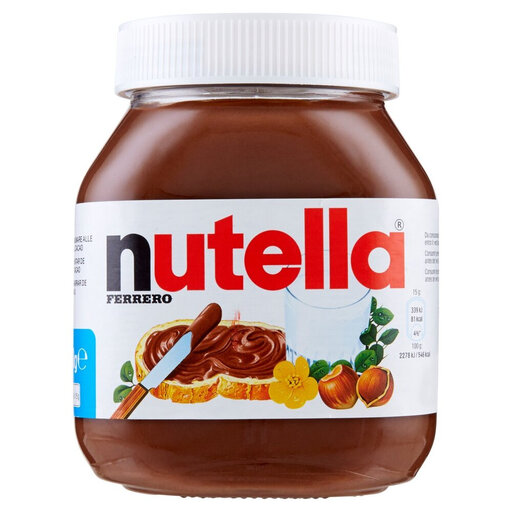 Image unavailable
This 630 g size gives you another jar size to choose from in the same range of recipes. If a glass jar is important to you, confirm the container material for this variant and check its label before buying.
 Image unavailable
This 750 g size is another option to consider for teatime with coffee. Compare the details on its label with those of the other sizes, especially if the container or avoiding a particular ingredient is guiding your choice.
No. The DGCCRF states that the Nutri-Score is a voluntary labelling system. To compare pre-packed spreads, check their nutritional information per 100 g, even if no Nutri-Score is shown.
No. The French Ministry of the Economy describes the levy known as the ‘soda tax’ as applying to sugary drinks. When choosing a spread, compare the sugars listed per 100 g on the products you’re considering instead.
The ‘lactose-free’ claim isn’t enough to establish that a product is suitable for someone with a milk allergy. The Auchan listing for the Jardin Bio étic recipe described as lactose-free and gluten-free warns that it may contain traces of milk proteins. Check the batch label and precautionary allergen warnings for your specific needs.
Follow the storage instructions for the product you choose rather than assuming the same rule applies to all spreads. The listings for the Jardin Bio étic and Natur Attitud products reviewed say not to refrigerate them. For the Jardin Bio étic Hazelnut & Chocolate product, the listing also recommends consuming it within a month of opening.