Shoppers thinking about size
If you’re stocking your cupboards for the first time, you’ll want an amount you’ll actually use, rather than a jar that stays open for ages.


For your first shop, choose a size that suits how much you’ll use, then compare the ingredients, allergens and nutritional values per 100 g. Even if you have a preferred recipe, always check the label on the specific jar. In France, the Nutri-Score can provide extra guidance when displayed, but its use is optional, according to the Ministry of the Economy.
If you’re stocking your cupboards for the first time, you’ll want an amount you’ll actually use, rather than a jar that stays open for ages.
You compare recipes by checking their ingredients, fat content and nutritional values, rather than relying on claims on the front of the jar.
Before deciding whether a product is suitable for your household, check the ingredients and any may-contain warnings for the exact product.
For your first shop, start by deciding whether size, nutritional information, allergens or a particular recipe will guide your choice.
| Criterion | What to check | Who it matters to |
|---|---|---|
| Size | Check the net weight, how quickly you’ll use it and the jar’s best-before date. | I want to stock my cupboard without choosing more than I’ll use. Around 36% of shoppers put finding the right size first. |
| Nutritional information | Compare the sugars and fat per 100 g; check the Nutri-Score only if it’s displayed. | When choosing between two recipes, I prefer to compare their nutritional values on the same basis. Around 29% of shoppers put this comparison ahead of other criteria. |
| Allergens | Read the ingredients, any declared allergens and any may-contain warnings on the exact jar. | Before making any other comparisons, I need to rule out recipes that don’t suit my household’s dietary requirements. Around 21% of shoppers make this their top priority. |
| Recipe | Check the ingredients list for the feature you’re looking for, particularly the type of fat used. | I’m looking for a particular composition and don’t want to rely on a single claim on the front of the jar. Around 14% of shoppers put this preference first. |
A jar without the logo may still show nutritional information. According to the Ministry of the Economy, the Nutri-Score is optional in France, while a nutrition declaration is required for applicable prepacked foods, subject to certain exemptions.
Read the table per 100 g, and use the logo as an additional guide when it’s shown.
The claim “no palm oil” doesn’t tell you whether a product contains hazelnuts, milk or soya. Carrefour lists these ingredients for the Poulain product mentioned here.
Check the ingredients and any may-contain warnings on the packaging of the product you’re considering.
A hazelnut and cocoa spread whose recipe Nutella France describes as containing around seven ingredients.
Carrefour lists a 400 g jar of Poulain chocolate and hazelnut spread, described as containing no palm oil.
E.Leclerc lists NUSTIKAO spread in a 1 kg jar.
ALDI lists TARTICHOC hazelnut spread in a 750 g jar.
Auchan lists cocoa and hazelnut spread in a 200 g jar.
These Nutella and BANANIA jars give you a chance to compare different sizes and recipes for your first shop. Check their labels and choose an amount that suits how much you’ll use.
 Image unavailable
This large jar suits regular use if you expect to finish it before its best-before date.
To compare it with another size, check the nutritional values per 100 g and the allergens on the packaging.
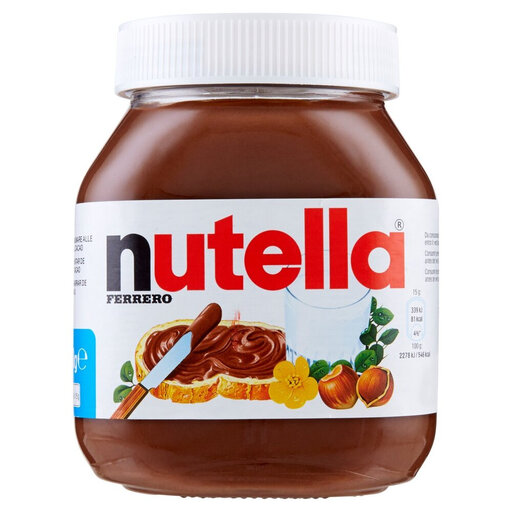 Image unavailable
This size gives you a smaller option than the 1 kg jar if it’s a better fit for how much you’ll use.
Check the ingredients, allergens and nutritional values per 100 g on the jar.
 Image unavailable
This size sits between the 630 g and 1 kg jars shown here. Choose it if that amount suits how you’ll use it.
If you have dietary requirements, check the full list of ingredients and allergens on the packaging.
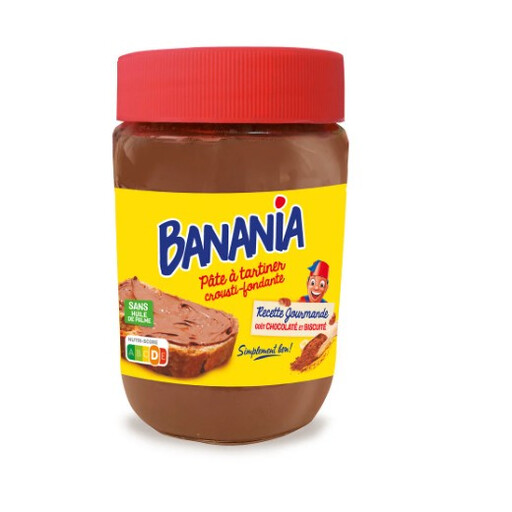 Image unavailable
This product is for shoppers looking for BANANIA’s recipe in a 750 g jar, rather than a traditional chocolate and hazelnut spread.
The claim “no palm oil” doesn’t tell you about allergens, so check the jar’s label.
Image unavailable
If you’d like to try BANANIA’s recipe in a smaller amount, this jar contains 400 g, compared with 750 g in the other size shown.
Check the ingredients and allergen information on the packaging before choosing it.
No. According to the Ministry of the Economy, displaying it is optional in France. A nutrition declaration is required for applicable prepacked foods, subject to certain exemptions. Use it to compare values per 100 g.
Compare the net weight, ingredients list, allergens and nutritional values per 100 g. According to the DGCCRF, showing values per 100 g means you can compare nutritional information on the same basis, even when the jars are different sizes.
No. This claim refers to a type of fat. The Poulain product listed by Carrefour contains hazelnuts, milk and soya lecithins, among other ingredients. Check the ingredients and any may-contain warnings on the specific jar.