Households that often serve toast
A larger jar may suit households that serve toast regularly at breakfast or as a snack, provided you have room to store it and can use it at your own pace.


If you regularly serve toast to several people, choose a quantity your household can use and store according to the instructions on the jar, rather than looking for a ‘sharing bag’ without checking the packaging. Before choosing a larger size, read the ingredients, allergen information and nutritional values per 100 g. These details apply to the specific recipe, not just the brand.
A larger jar may suit households that serve toast regularly at breakfast or as a snack, provided you have room to store it and can use it at your own pace.
Before buying a larger quantity of the same recipe, check the ingredients and allergens for the exact product. Nutritional values per 100 g also make it easier to compare recipes.
If you’re serving toast to several people, start by checking the net weight and type of packaging. Then look at the label for each recipe you’re considering: changing the size doesn’t mean you can skip checking the ingredients.
| Criterion | What to check | Who it matters to |
|---|---|---|
| Quantity and storage | Compare the net weight, packaging, best-before date and storage instructions for the product you’re considering. | If toast is often on the menu, I want enough spread without choosing a jar that’s difficult to store or finish. Around 42% of consumers would make choosing a suitable quantity their top priority. |
| Ingredients and allergens | Read the ingredients list and the allergens highlighted on the exact jar’s label. | When several people share the same jar, I need to make sure the recipe suits everyone in the household before buying a larger quantity. Around 33% of consumers would put ingredients first. |
| Nutritional values | Compare sugars, fat (including saturated fatty acids) and salt per 100 g; check the Nutri-Score if it’s shown. | When choosing between two recipes, I prefer to compare their values on the same basis rather than relying on the front of the jar alone. Comparing nutritional values would be the top priority for around 25% of consumers. |
This term doesn’t tell you the net weight or the shape of the packaging. The chocolate spreads featured here are sold in jars.
Check the packaging and net weight on the product page for the one you’re considering.
The DGCCRF states that displaying the Nutri-Score is voluntary in France. If it isn’t shown, you should still read the nutritional information.
If it appears on the jar, use it as an additional guide and compare the values per 100 g and the ingredients too.
The 1 kg and 3 kg Nutella products described here list hazelnuts, milk and soya, among other ingredients. Don’t assume another product has the same ingredients.
Check the allergens highlighted on the label of the product you’re buying, especially if you’re switching to a different recipe or size.
The chocolate and hazelnut range is available in several sizes, including 630 g, 825 g, 1 kg and 3 kg, depending on the relevant Carrefour and Joybuy listings.
Carrefour offers hazelnut spreads in several sizes, including 750 g and 1 kg.
This hazelnut and cocoa spread range is available in a 750 g jar in the Auchan grocery aisle.
Auchan offers 325 g and 650 g jars from this organic cocoa and hazelnut range.
The brand’s hazelnut and cocoa spreads are available in 360 g and 580 g jars at Auchan.
These Nutella jars, ranging from 630 g to 3 kg, suit different toast-eating habits. First, choose a size that works for your household, then check the label of the product you’ve selected.
 Image unavailable
This jar may suit households where several people regularly enjoy the same spread on toast.
Information for this product lists hazelnuts, milk and soya, among other ingredients, and 56,3 g of sugars per 100 g. Follow the storage instructions: keep in a cool, dry place and do not refrigerate.
 Image unavailable
The 3 kg jar is worth considering if you serve toast very frequently or to a large group, provided it suits your household’s storage space and usage.
Information for this product lists hazelnuts, milk and soya, among other ingredients, and 56,3 g of sugars per 100 g. Store the jar in a cool, dry place and replace the lid after use, as stated on the product page.
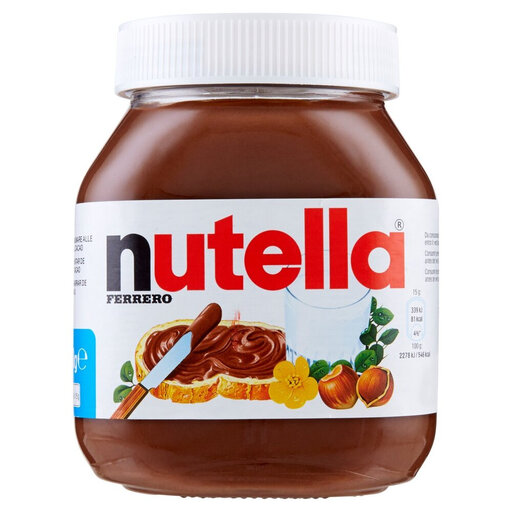 Image unavailable
This jar contains less spread than the 1 kg and 3 kg sizes for households that serve toast regularly.
Check the ingredients, allergens and storage instructions for this product on its label.
 Image unavailable
This mid-sized option may suit households that share toast without needing a 1 kg jar or larger.
For this product, check the full list of allergens and the storage instructions on the jar’s label.
No. According to the French Ministry of the Economy, the so-called ‘sugar tax’ applies to sugary drinks; it isn’t a factor when choosing a jar of chocolate spread. To compare the sugar content of two recipes, check their nutritional values per 100 g instead.
No. The DGCCRF states that displaying the Nutri-Score is voluntary in France. Pre-packed food must include a nutrition declaration, subject to applicable exemptions. This lets you check the sugars and fat per 100 g, among other details.
Check the net weight, ingredients list, highlighted allergens, best-before date and storage instructions. When comparing two spreads, check their nutritional values per 100 g rather than relying only on the values per serving.
Follow the instructions for the product you’ve bought. The 1 kg and 3 kg Nutella product pages featured here say to store the spread in a cool, dry place and not to refrigerate it. The 3 kg jar’s instructions also say to replace the lid after use.